Loudoun County Supervisors Advance 12-Month Pause on New Data Center Applications
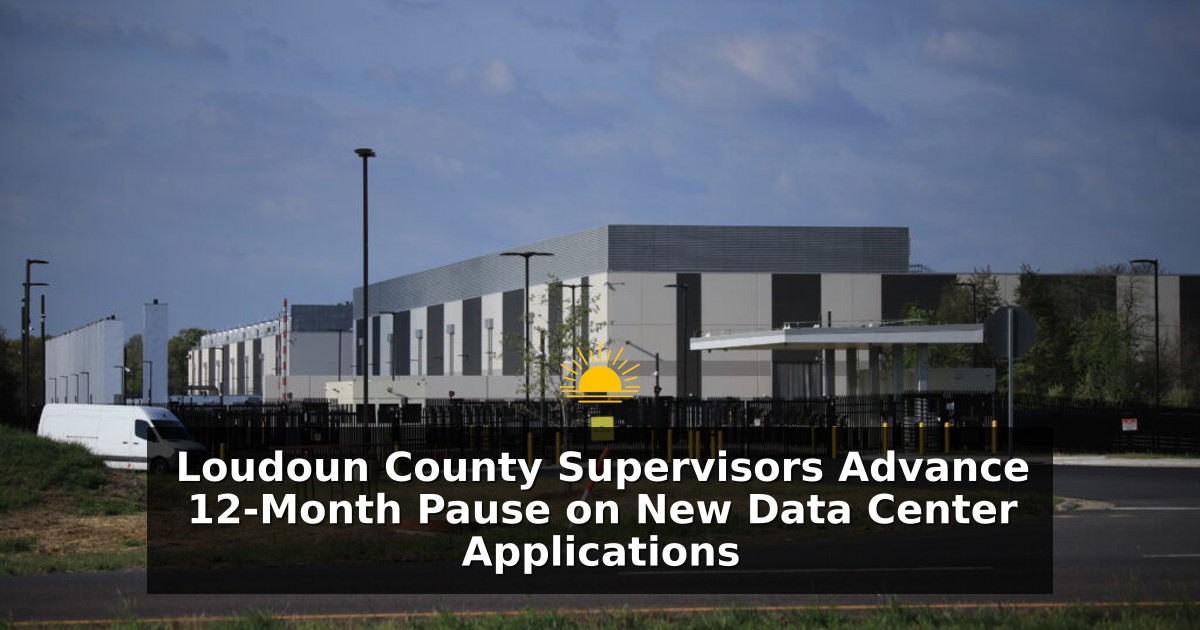
Loudoun County supervisors voted 7-1-1 to advance a temporary pause on new data-center applications, directing staff to draft a resolution that would freeze new filings for up to 12 months while the county rewrites rules governing the industry that made Loudoun a global hub for internet infrastructure.
Board Chair Phyllis Randall described the step as time to legislate, not an indefinite moratorium. County attorneys told supervisors an open-ended freeze would not survive legal scrutiny, while a bounded 12-month pause would. Board member Kristen Umstattd voted no; Caleb Kershner abstained. A final vote is expected in October.
Why Loudoun is drawing a line
Eastern Loudoun’s campuses already dominate national maps of data-center capacity. Residents have spent years fighting generator noise, diesel testing, and the high-voltage lines that follow load growth. The same week supervisors advanced the pause, homeowners were still organizing against Dominion Energy’s Golden-to-Mars transmission project, a roughly nine-mile line the utility says is needed for reliability between substations in eastern Loudoun.
Randall and colleagues who backed the motion cast it as a way to catch the ordinance up to the scale of modern hyperscale proposals. Staff will have to draft language that stops new applications without stranding projects already in the pipeline, a distinction that matters to landowners, contractors, and tax-base forecasts.
The pause would apply only to new applications. That design tries to calm neighborhood groups without inviting takings claims or abruptly canceling existing entitlements. It also mirrors a broader Virginia pattern: localities experimenting with brakes while Richmond debates statewide standards.
State pressure and local politics
Gov. Abigail Spanberger’s new data-center framework urges stronger local approval for facilities above 25 megawatts and discourages secrecy, but it leaves counties to invent their own interim tools. Loudoun’s vote is one of the clearest local answers yet. Supervisors who supported it argued that waiting for the 2027 General Assembly would leave another year of applications racing ahead of noise, setback, and power-siting rules.
Critics of a pause worry about signal risk—sending tech tenants to Prince William, Culpeper, or out of state—and about commercial tax revenue that underwrites schools and public safety. Loudoun’s budget has long benefited from data-center machinery and tools taxes. Balancing that revenue against quality-of-life complaints is now a standing item on every Board of Supervisors agenda.
Transmission politics complicate the picture further. Even if new building applications slow, Dominion’s reliability projects can still cut through neighborhoods under state utility jurisdiction. Residents fighting Golden-to-Mars say a local pause on campuses means little if the wires arrive anyway. Utility planners counter that load already approved or in service must be served safely.
What comes next
Staff’s draft resolution will need precise definitions: what counts as a data-center application, how amendments to existing projects are treated, and whether related industrial uses are swept in. October’s final vote will show whether the 7-1-1 coalition holds once landowners and industry lobbyists mark up the text.
For surrounding jurisdictions, Loudoun’s pause is a stress test. If applications simply migrate west and south, Virginia may see a patchwork of local freezes without a statewide load strategy. If the pause buys coherent zoning—clearer buffers, generator limits, disclosure rules—other boards may copy it. Either way, the county that branded itself Data Center Alley is telling the market that unlimited by-right growth is no longer the default.
Households watching the fight care less about branding than about the next power-line map and the next spike in summer bills. Supervisors say twelve months is enough to write better rules. Opponents say twelve months is long enough for capital to leave. The October vote will choose which risk Loudoun prefers to run.
Email the Loudoun County School Board:
April Chandler, april.chandler@lcps.org,
Anne Donohue, anne.donohue@lcps.org,
Deana Griffiths, deana.griffiths@lcps.org,
Ross Svenson, ross.stevenson@lcps.org,
Kari LaBell, kari.labell@lcps.org,
Jon Pepper, jonathon.pepper@lcps.org,
Lauren Shernoff, lauren.shernoff@lcps.org,
Sumera Rashid, sumera.rashid@lcps.org,
Amy Riccardi, amy.riccardi@lcps.org,
Email the Board of Supervisors at:
Phyllis J. Randall (Chair, At-Large) – Phyllis.Randall@loudoun.gov,
Michael R. Turner (Vice Chair, Ashburn District) – Mike.Turner@loudoun.gov,
Juli E. Briskman (Algonkian District) – Juli.Briskman@loudoun.gov,
Sylvia R. Glass (Broad Run District) – Sylvia.Glass@loudoun.gov,
Caleb Kershner (Catoctin District) – caleb.kershner@loudoun.gov,
Matthew F. Letourneau (Dulles District) – Matt.Letourneau@loudoun.gov,
Kristen C. Umstattd (Leesburg District) – Kristen.Umstattd@loudoun.gov,
Laura A. TeKrony (Little River District) – Laura.TeKrony@loudoun.gov,
Koran Saines (Sterling District) – Koran.Saines@loudoun.gov
Loudoun County Virginia Abigail Spanberger Amendments Amy Riccardi Anne Donohue April Chandler Bills Board of Supervisors Budget Caleb Kershner Data Data Center Deana Griffiths Dominion Energy Jon Pepper Juli Briskman Kari LaBell Koran Saines Kristen Umstattd Laura TeKrony Lauren Shernoff Loudoun County Loudoun County Board of Supervisors Loudoun County School Board Matt Letourneau Mike Turner Phyllis Randall Politics Power Prince William Richmond Ross Svenson Schools Sumera Rashid Sylvia Glass Taxes Virginia