Crabber Flags Maintenance Issues with Plastic Turtle Excluders on Bay Pots
Updated
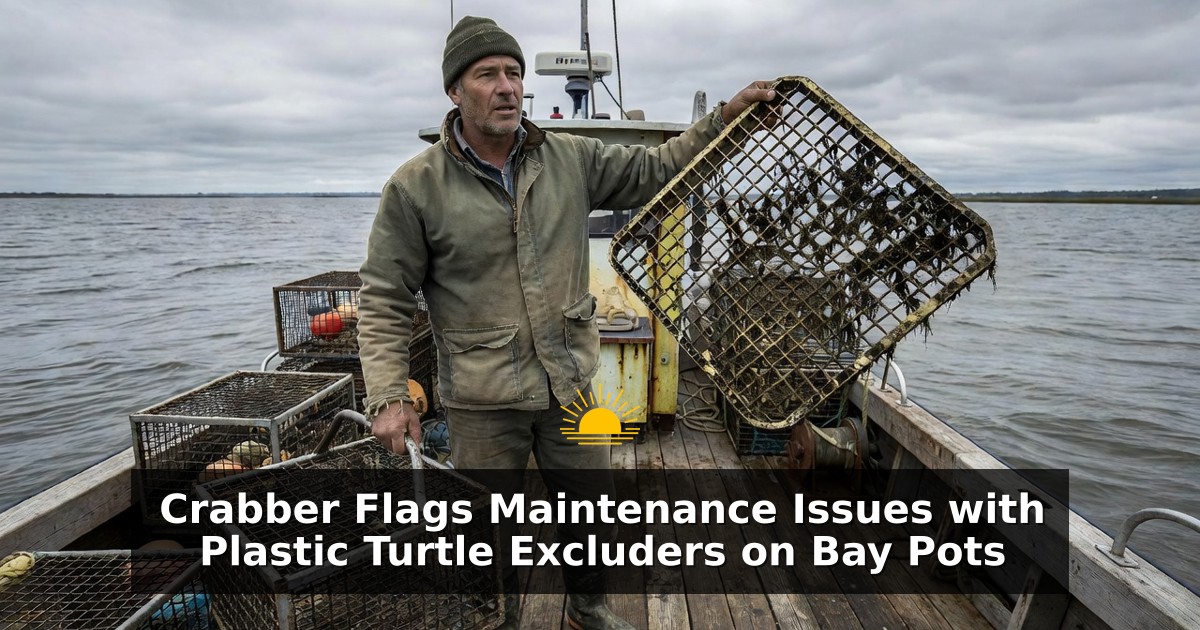
A commercial crabber working the waters of the Chesapeake Bay has raised detailed maintenance concerns about proposed plastic turtle excluder devices during a meeting of the Chesapeake Subcommittee. Nathan Everett told the panel that an existing study on the devices overlooked real-world marine growth that accumulates on plastic surfaces. He explained that such fouling could progressively reduce the openings of the excluders and affect how crab pots function over time. Everett also warned that lost or abandoned pots would leave non-deteriorating plastic components in the Bay environment. His comments centered on practical durability questions that he said remain unanswered by current research.
Everett identified himself as a commercial crabber on the Chesapeake Bay and focused his remarks on the upkeep of the proposed devices. He stated that plastic submerged in Bay waters will attract barnacles and grass more quickly than the wire traditionally used to construct crab pots. According to his account, the study under discussion did not factor in this accelerated growth or the fouling process. He described how the wider base created by the turtle excluder funnel provides a platform for barnacles to attach and expand. As those organisms grow taller and denser around the opening, the effective width of the funnel steadily decreases.
Fouling Risks and Progressive Shrinkage
Marine growth presents ongoing challenges for any gear left in the Chesapeake Bay for extended periods. Everett emphasized that barnacles form a widening foundation on the plastic, allowing successive layers to build upward and inward. This process, he said, causes the funnel to shrink continuously rather than remaining at its original dimensions. Grass and other vegetation also adhere readily to plastic surfaces, compounding the constriction. The combined effect, in his view, could alter the intended performance of the excluder and the overall operation of the crab pot.
He noted that these biological processes occur faster on plastic than on wire mesh. Traditional wire pots experience fouling as well, yet the material differences appear to accelerate attachment on the newer devices. Everett argued that any evaluation of turtle excluders must account for these changes across a full season of use. Without that data, he suggested, regulators lack a complete picture of how the gear will behave once deployed. The testimony highlighted the gap between controlled study conditions and the dynamic environment of the Bay.
Ghost Pots and Persistent Plastic Debris
Abandoned or lost crab pots, commonly called ghost pots, already pose management issues throughout the Chesapeake Bay. Everett pointed out that each such pot fitted with the proposed devices would introduce additional plastic elements that do not break down. He referenced four plastic components per pot that would remain in the water indefinitely once the gear is discarded or lost. This observation built on earlier comments from another speaker identified only as Monica. The introduction of lasting synthetic material adds another layer to existing concerns about marine debris and habitat impacts.
Ghost pots continue to fish indiscriminately and can entangle various species long after they are no longer tended. Adding non-degradable plastic funnels increases the volume of persistent refuse that managers must eventually address. Everett framed this outcome as a direct consequence of mandating the devices without fully examining end-of-life scenarios. His remarks underscored the need to weigh both active-use performance and the fate of gear that leaves the fishery. Bay resource managers have long tracked ghost-pot recovery efforts, making the durability of new materials a relevant factor.
Broader Context for Bay Fisheries Rules
The blue crab fishery remains a cornerstone of the Chesapeake Bay economy and culture, supporting numerous commercial operators across Virginia and neighboring states. Turtle excluder devices are intended to reduce unintended capture of turtles that may enter crab pots. Proposals to require specific designs therefore carry implications for both conservation goals and the daily operations of working watermen. Everett’s testimony focused on whether available studies adequately represent conditions that pots encounter after months in the water. He questioned reliance on data that omit progressive fouling and material degradation.
Regulatory bodies evaluating gear modifications typically review scientific trials, industry input, and environmental monitoring. Incomplete accounting for biofouling could lead to rules that perform differently in practice than on paper. Plastic components may offer certain manufacturing or cost advantages, yet their interaction with Bay salinity, temperature, and organism growth requires thorough assessment. Everett’s account stressed that the width of the excluder creates an especially suitable base for barnacle colonies. Over repeated growth cycles, that base could narrow the escape opening enough to change how the device functions.
Industry participants often maintain pots through scraping, drying, and repair between seasons. Additional plastic surfaces that foul rapidly would increase the labor required to keep gear operational. If funnels shrink unnoticed, catch rates or bycatch outcomes might diverge from study projections. Everett presented these points as practical observations drawn from experience rather than abstract objections. He closed by thanking the subcommittee after summarizing the dual issues of shrinking openings and lasting plastic debris.
Considerations for Future Evaluations
Any future research on turtle excluders for crab pots would benefit from multi-season trials that measure fouling rates on plastic versus wire. Direct comparison of opening dimensions at deployment and after months of immersion could quantify the shrinkage Everett described. Parallel tracking of lost-gear recovery would clarify how many plastic elements enter the system as ghost pots. Such data would give decision-makers a clearer basis for weighing conservation benefits against operational and environmental costs. The Chesapeake Subcommittee heard the concerns as part of its ongoing review of fisheries practices.
Watermen, scientists, and managers share an interest in gear that protects non-target species while remaining workable for those who depend on the harvest. Plastic turtle excluders represent one proposed tool among several options under discussion. Everett’s testimony added a maintenance-focused perspective that centers on material behavior in the living Bay. By highlighting barnacle growth, grass accumulation, progressive funnel constriction, and non-deteriorating debris, he called attention to variables that influence long-term results. Continued dialogue and expanded study designs can help ensure that rules rest on comprehensive evidence.
The commercial crabbing sector continues to adapt to evolving requirements aimed at sustaining both the blue crab stock and the broader ecosystem. Input from active participants supplies on-the-water detail that complements laboratory or short-term field tests. Everett’s appearance before the Chesapeake Subcommittee illustrated how fouling dynamics and gear longevity factor into the practicality of new devices. His description of shrinking funnels and added plastic load from ghost pots remains a concrete set of observations for regulators to consider. Balanced evaluation of all available information will shape the next steps for Bay crab-pot standards.
barnacles Chesapeake Bay Chesapeake Subcommittee commercial crabbing crab pot funnels crab pot regulations crab pots environmental study fisheries management ghost pots maintenance study marine debris marine growth Nathan Everett plastic devices plastic pollution pot maintenance subcommittee hearing turtle excluder Virginia waterways