Manufactured Housing Gains Recognition as Affordable Option in Virginia
Updated
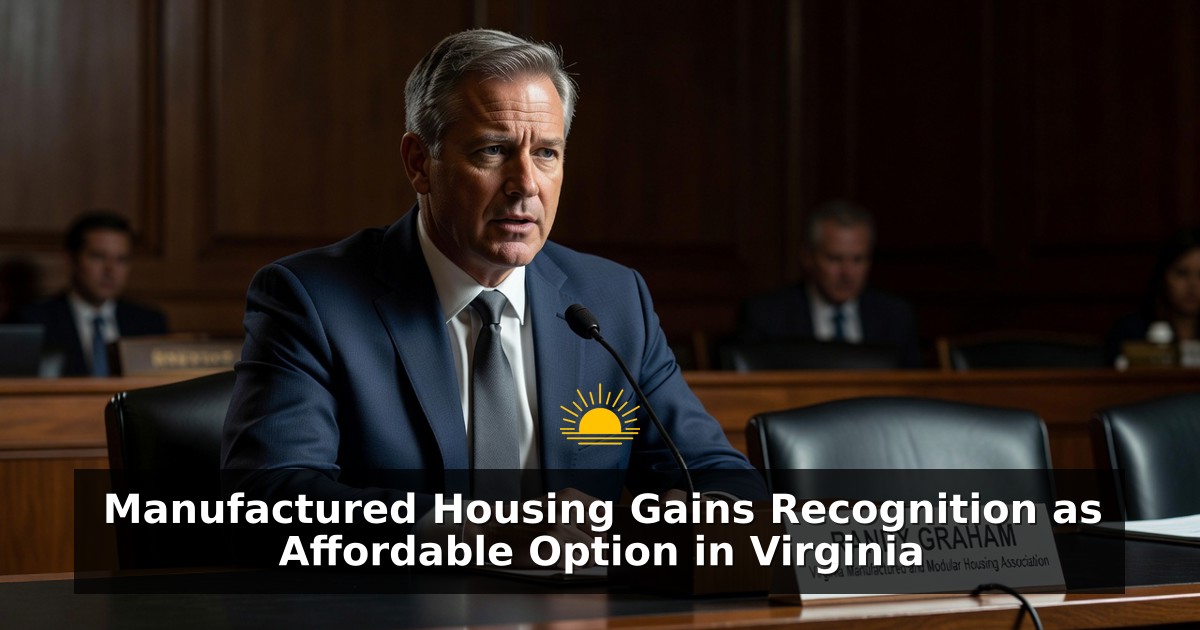
Randy Graham, representing the Virginia Manufactured and Modular Housing Association, recently testified in favor of proposed legislation that would formally recognize manufactured homes as legitimate housing choices throughout the commonwealth. The measure underscores the capacity of these factory-constructed dwellings to serve as practical responses to persistent shortages in attainable residences. Graham stressed that the sector operates without public subsidies while still delivering meaningful contributions toward greater housing availability. His comments framed manufactured housing as a ready means of expanding options for households seeking lower-cost living arrangements that still meet modern standards of quality and appearance.
Factory construction methods allow manufacturers to achieve precise design targets and performance criteria that traditional site-built projects sometimes struggle to match consistently. Homes produced in controlled environments can incorporate architectural features that help them integrate visually with existing neighborhoods rather than standing apart as temporary or inferior structures. This blending capability addresses longstanding community concerns about aesthetics and property values. At the same time, the controlled production process supports higher levels of energy efficiency, which translates into lower utility expenses for occupants over the life of the home.
Advantages of Controlled Factory Production
The factory-built approach inherently reduces weather-related delays and material waste that frequently inflate costs on conventional construction sites. Workers assemble components under standardized conditions that promote uniform quality control and adherence to federal manufactured housing codes. These efficiencies enable the industry to offer finished homes at price points substantially below those of many comparable site-built units. Graham noted that such cost advantages position manufactured housing as a direct tool for tackling the supply side of Virginia’s housing equation without requiring ongoing taxpayer support.
Energy performance represents another core strength highlighted in the testimony. Modern manufactured homes routinely incorporate advanced insulation, efficient heating and cooling systems, and durable exterior materials that minimize long-term operating costs. Residents therefore benefit from both lower purchase prices and reduced monthly energy bills, creating a dual pathway to affordability. When these homes are sited on permanent foundations and finished with conventional exterior treatments, they become nearly indistinguishable from neighboring stick-built residences. This visual compatibility has grown increasingly important as localities seek housing solutions that preserve community character.
Addressing Virginia’s Broader Housing Supply Pressures
Virginia continues to experience elevated demand for housing driven by population growth, employment expansion, and limited new construction in many localities. Rising land and labor costs have pushed traditional home prices beyond the reach of substantial portions of the workforce. In this environment, any housing type that can be delivered more rapidly and at lower cost warrants serious policy consideration. The legislation supported by Graham aims to remove outdated barriers that have historically treated manufactured homes differently from other forms of residential construction.
By affirming the legitimacy of manufactured housing, lawmakers would signal that these dwellings deserve equal standing in local planning, financing, and appraisal processes. Such recognition can encourage lenders to offer more competitive mortgage products and can prompt localities to update zoning ordinances that currently restrict placement. Graham’s association maintains that the industry already possesses the technical capacity to meet diverse design preferences while remaining financially accessible. The absence of subsidy dependence further distinguishes the sector as a market-driven participant in housing solutions.
Long-term community benefits extend beyond individual household savings. Expanding the stock of well-designed manufactured homes can help stabilize neighborhoods by providing entry-level ownership opportunities that build equity for first-time buyers. Local governments gain additional property tax base without the fiscal burden of large-scale public housing programs. Employers in high-cost regions may find it easier to attract and retain workers when reasonably priced housing options exist nearby. These cumulative effects illustrate why industry representatives view the pending bill as a constructive step rather than a narrow special-interest measure.
Design Flexibility and Community Integration
Contemporary manufactured homes are no longer limited to single-section rectangular forms. Multi-section models, varied rooflines, porches, and custom exterior finishes allow buyers to select configurations that suit both rural and suburban settings. Graham emphasized that factories can hit specific design targets requested by developers or municipalities, ensuring compatibility with surrounding architecture. This adaptability undercuts older stereotypes that once associated manufactured housing solely with temporary or low-quality shelter. Instead, the product line now spans a spectrum from modest starter homes to larger family residences that rival conventional construction in both appearance and durability.
Energy-efficient features continue to improve with each generation of production standards. Better sealing techniques, high-performance windows, and optional renewable energy packages further reduce environmental impact and ownership costs. When combined with the inherent speed of factory assembly, these attributes enable quicker responses to sudden increases in housing demand. Communities facing rapid job growth or recovery from natural disasters can therefore turn to manufactured housing as a scalable supplement to slower traditional building pipelines.
The testimony positioned the industry as a willing partner in broader efforts to expand housing supply across Virginia. Rather than competing with site-built construction, manufactured and modular producers offer a complementary channel that can operate in parallel. Policymakers who remove unnecessary regulatory distinctions stand to unlock additional private investment in attainable housing. Graham’s remarks made clear that the sector already delivers finished homes that satisfy both affordability goals and contemporary expectations for quality, efficiency, and neighborhood fit.
As Virginia evaluates strategies to ease its housing constraints, the practical advantages outlined in the recent testimony provide a concrete reference point. Factory-built homes that meet rigorous design and energy criteria while remaining unsubsidized represent one readily available tool. Continued legislative attention to their formal recognition could help translate that potential into expanded living options for residents throughout the commonwealth. The discussion now turns to how localities and financial institutions will implement any new statutory clarity in everyday permitting and lending decisions.
affordable cost affordable housing crisis AIA Virginia architects committee commonwealth delegate Helmer delegate Nicole Cole design criteria design targets energy effective factory built home is a home housing issue Madam Chair manufacturer housing Mr. Grumbiner Paul Batagling placing homes supply side the bill unsubsidized industry