Virginia Lawmaker Advances Permit Framework for Hound Hunting
Updated
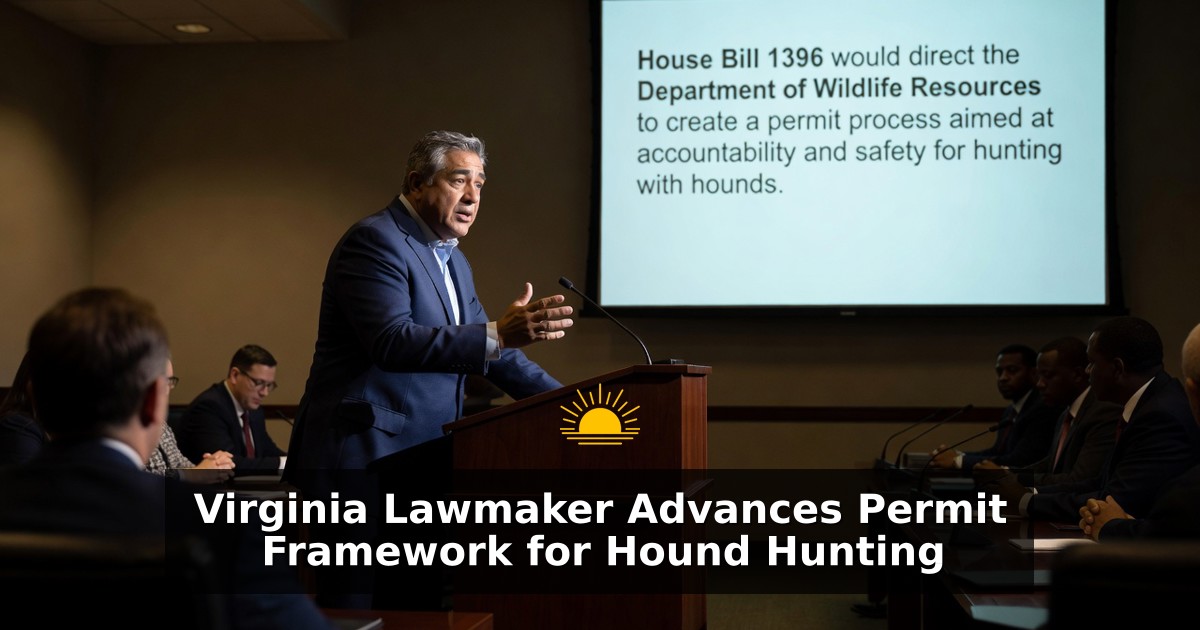
Delegate Marty Martinez presented House Bill 1396 before the Agriculture Subcommittee to establish a formal permit process for hunting with hounds in Virginia. The measure would place administration of the permits under the Department of Wildlife Resources, the state agency long responsible for outdoor recreation oversight. Martinez described the proposal as a clear and workable framework intended to promote accountability, safety, and consistency around a practice with deep roots in the Commonwealth. Supporters of structured oversight note that similar regulatory approaches already apply to other hunting, fishing, and boating activities managed by the same department.
Hunting with hounds has been part of Virginia’s sporting culture for generations, particularly in rural counties where packs of dogs are used to pursue deer, fox, and other game. The tradition involves handlers, landowners, and the broader public who share roads, trails, and private property boundaries. Over time, questions have arisen about how best to balance access for hunters with the need to prevent conflicts such as dogs straying onto posted land or creating traffic hazards. House Bill 1396 seeks to address those concerns by requiring participants to operate under a uniform set of expectations developed by professional wildlife managers.
Department of Wildlife Resources Role and History
For more than 105 years the Department of Wildlife Resources has served as the primary state entity charged with training, education, and regulation of hunting, fishing, and boating. Agency staff already issue licenses, conduct hunter-education courses, set seasons and bag limits, and enforce safety rules on public waters and wildlife management areas. The bill follows that established model by directing the department to craft specific regulations for hound hunting rather than creating an entirely new bureaucracy. Officials familiar with the agency’s work emphasize that consistent statewide standards help both newcomers and experienced sportsmen understand their responsibilities before entering the field.
Under the proposed structure, the Department of Wildlife Resources would design the permit application process, eligibility criteria, and any accompanying education or reporting requirements. Clear rules would outline expectations for dog control, landowner notification, and response protocols if animals leave designated areas. Proponents argue that such clarity protects the public from unexpected encounters while also shielding hunters from ambiguous local ordinances that can vary widely from one county to the next. A single statewide framework, they say, reduces confusion and encourages voluntary compliance.
Safety and Accountability Measures
Safety considerations form a central pillar of the legislation. Hound hunting often occurs in mixed-use landscapes where residential development has expanded into formerly rural zones. Vehicles, hikers, and livestock can all be affected when packs move across roads or property lines. By placing permitting authority with the Department of Wildlife Resources, the bill aims to ensure that participants receive standardized guidance on road crossings, night hunting protocols where allowed, and retrieval of dogs. Accountability provisions would give wildlife officers clearer tools to address repeated violations without relying solely on general trespass statutes.
The measure also recognizes that most hound hunters already practice responsible stewardship and invest significant time and resources in training their animals. A permit system could formalize those good practices and create a documented record of compliance that benefits the hunting community as a whole. When incidents do occur, regulators would have an established process for investigation and corrective action rather than ad-hoc responses. This approach mirrors how the department already manages other specialized activities such as falconry or certain commercial wildlife operations.
Impact on Local Hunters and Communities
Local hunters stand to gain predictability if the bill advances. Instead of navigating a patchwork of county-level restrictions, permit holders would operate under one set of statewide rules developed with input from biologists, enforcement staff, and stakeholder groups. Communities that have experienced friction over roaming dogs may welcome clearer lines of responsibility and faster resolution of complaints. Landowners could benefit from improved communication channels and the knowledge that permitted hunters have acknowledged basic standards of conduct.
At the same time, the tradition itself would remain intact. The legislation does not propose to ban or severely curtail hound hunting; it seeks to organize it under the same regulatory umbrella that has governed Virginia’s outdoor sports for more than a century. Department of Wildlife Resources personnel already possess the technical expertise and field presence needed to implement such a program efficiently. Training materials, online permitting portals, and regional outreach sessions could be adapted from existing hunter-education infrastructure, keeping administrative costs manageable.
Broader Context of Wildlife Management
Virginia’s wildlife agency regularly updates regulations to reflect changing land-use patterns, population growth, and evolving public expectations. Seasons, methods of take, and equipment rules are reviewed periodically through a public process that includes comment periods and board approval. House Bill 1396 fits within that adaptive management tradition by focusing on one specific method—hunting with hounds—and asking the experts already charged with wildlife stewardship to set practical parameters. The result, according to the bill’s presentation, would be greater consistency for everyone who participates in or is affected by the activity.
Observers of the legislative process note that subcommittee review is an early step. Further discussion, possible amendments, and fiscal-impact analysis typically follow before any measure reaches the full House of Delegates. Throughout that process the core objective articulated by Martinez remains the creation of transparent expectations that safeguard both the public and the hunters who continue a long-standing Virginia practice. By relying on the Department of Wildlife Resources’ century-plus record of managing outdoor recreation, the proposal seeks to strengthen rather than diminish the tradition.
In summary, House Bill 1396 represents an effort to bring structured permitting to hound hunting through an agency already trusted with similar responsibilities. The framework emphasizes safety, accountability, and uniform rules while preserving access for responsible participants. As the Agriculture Subcommittee considers the details, the underlying goal stays constant: ensure that a valued sporting heritage operates under clear, enforceable standards that serve hunters and communities alike.
accountability activity permits Agriculture Subcommittee bill framework consistency Department of Wildlife Resources DWR House Bill hunters hunting regulations hunting with hounds longstanding tradition Marty Martinez permit process public safety regulations safety Virginia hunters Virginia tradition wildlife