Fairfax Planning Panel Weighs Transit-Linked Housing Expansion Near Merrifield
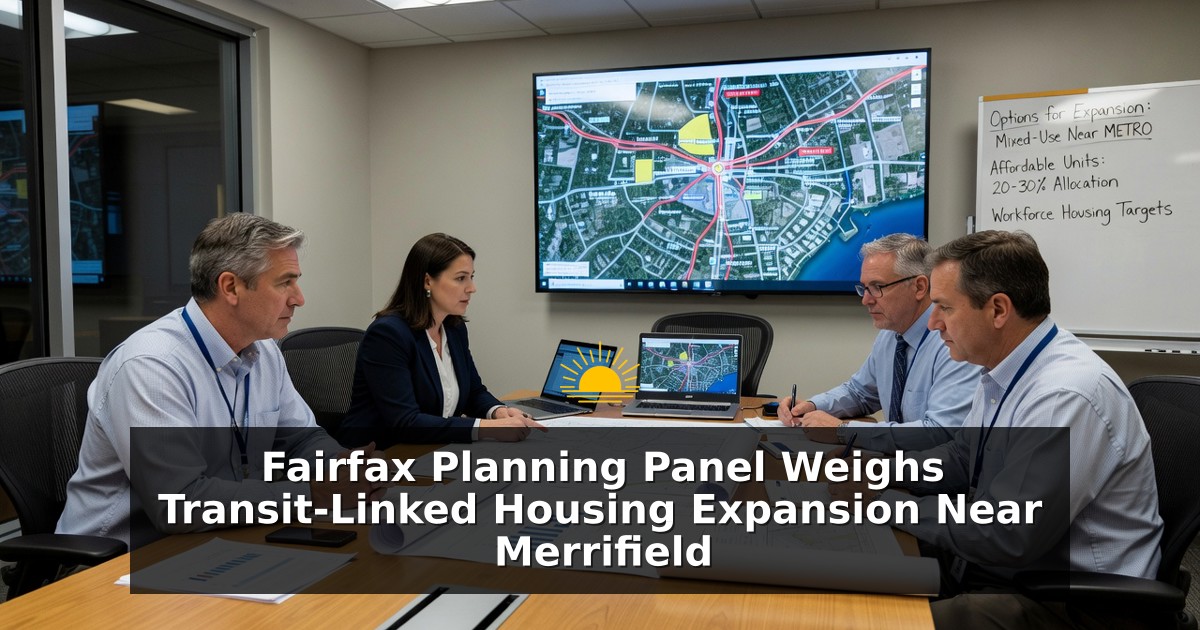
Fairfax County planning officials are examining ways to expand residential development near major transit corridors as part of broader efforts to address housing supply in Northern Virginia. Discussions center on the Merrifield suburban center, an area positioned within roughly half a mile of both the Mosaic District and the Dunn Loring Metro station. Officials have underscored the value of placing new homes close to rail service so that residents can rely less on personal vehicles and more on existing public transportation infrastructure. The focus aligns with long-standing county goals that prioritize growth in locations already served by high-capacity transit. Proposals under review seek to balance density with community amenities while creating pathways for households at varying income levels.
Transit-oriented development has become a recurring theme in local land-use conversations because of the county’s constrained geography and high demand for housing. Placing multifamily buildings and townhouses near Metro stations can reduce commute times and support commercial activity already present in mixed-use nodes such as Mosaic. County planners note that sites within a short walk of rail offer practical advantages for both market-rate and income-restricted units. The Merrifield area in particular has seen incremental redevelopment that pairs residential construction with retail and office space. Continued attention to these corridors reflects an intent to channel growth where infrastructure can absorb it most efficiently.
## Affordable and Workforce Housing Mechanisms
Central to the current review is the application of Fairfax County’s Affordable Dwelling Unit ordinance and Workforce Dwelling Unit guidelines. These tools require or encourage developers to set aside a portion of new units for households earning below certain area median income thresholds. Under one option presented to the Planning Commission, multifamily buildings would yield 98 workforce dwelling units while townhouse components would produce 59 affordable dwelling units. Together the figures represent a measurable addition to the county’s inventory of income-restricted housing. Officials describe the combination as an opportunity to expand choices for teachers, first responders, and other moderate-income workers who often struggle to remain in the jurisdiction.
The Affordable Dwelling Unit program has operated for decades as a mandatory inclusionary zoning mechanism tied to rezoning and special-exception requests. Workforce Dwelling Unit provisions function more flexibly, often through proffered conditions that secure units for slightly higher income bands. When both frameworks are applied to a single project, the result can be a layered mix of price-restricted homes inside the same development. Planners emphasize that locating these units near Metro multiplies their usefulness because transportation costs form a large share of household budgets. The Merrifield proposals therefore illustrate how regulatory tools and geography can reinforce each other.
## Location Advantages of the Merrifield Suburban Center
Merrifield sits at a strategic point along the Orange Line, giving future residents direct access to employment centers in Arlington, Washington, D.C., and other parts of Fairfax County. The Mosaic District already functions as a walkable destination with shops, restaurants, and entertainment, creating a ready-made amenity base for new housing. A half-mile radius around both Mosaic and the Dunn Loring station captures parcels that can support higher densities without extending infrastructure far into lower-density neighborhoods. County land-use maps have long identified the suburban center as appropriate for mixed-use intensification. Recent discussions simply refine how residential components can maximize both market and affordable supply inside that established framework.
Proximity to rail also supports environmental and fiscal objectives by concentrating development where roads and utilities already exist. New residents who can walk or take short bus rides to Metro are less likely to add peak-hour traffic to surrounding arterial roads. At the same time, additional rooftops help sustain the retail and service businesses that make Merrifield attractive. Planning staff have repeatedly observed that transit-adjacent sites deliver higher returns on public infrastructure investments than greenfield locations farther from rail. The current option under review attempts to capture those benefits while embedding a substantial number of income-restricted units.
## Broader Housing Context in Fairfax County
Fairfax County continues to face a structural shortage of housing that is affordable to low- and moderate-income households. Rising land values and construction costs have pushed many workforce families toward longer commutes or neighboring jurisdictions. County policy documents consistently call for more units near transit as one response to that pressure. The Planning Commission’s examination of Merrifield options fits within this larger policy direction by testing how many affordable and workforce units a single project can reasonably deliver. Each additional restricted unit near Metro reduces the spatial mismatch between jobs and housing that characterizes much of Northern Virginia.
Demographic projections indicate continued population growth and an aging housing stock that will require replacement or densification. Multifamily construction near existing stations offers one of the few scalable avenues for adding supply without large-scale rezonings of stable single-family areas. The 98 workforce units and 59 affordable dwelling units cited in the option under discussion would contribute directly to annual production goals set by the Board of Supervisors. While no single project can close the overall gap, cumulative approvals of similar transit-oriented proposals can gradually expand the pool of attainable homes. Officials therefore treat each application as both a local land-use decision and a piece of the countywide housing strategy.
## Next Steps in the Review Process
The Planning Commission’s role remains advisory; final decisions on rezonings and related land-use changes rest with the Fairfax County Board of Supervisors. Commission members typically receive detailed staff reports, hear public testimony, and forward recommendations that address density, design, transportation mitigation, and proffered contributions. In the present case, attention has centered on the numerical yield of affordable and workforce units as well as the site’s walkability to Metro. Subsequent hearings will likely refine building heights, parking ratios, and the precise distribution of unit types. Stakeholders on all sides are expected to weigh the trade-offs between added density and neighborhood character.
Public engagement remains an integral part of the process, with residents, business owners, and housing advocates invited to comment on proposed options. County staff continue to evaluate traffic studies, environmental impacts, and school-capacity effects associated with higher residential counts. Any recommendation that advances will include conditions intended to lock in the 98 workforce dwelling units and 59 affordable dwelling units described in the option. Implementation would then depend on the developer’s ability to secure financing and building permits under the approved proffers. Monitoring mechanisms already embedded in county ordinances would track delivery of the income-restricted units over time.
Taken together, the discussions illustrate how Fairfax County seeks to align housing production with transit investment. By focusing on locations such as the Merrifield suburban center, planners aim to create neighborhoods where residents can live closer to jobs and services while benefiting from dedicated affordable and workforce housing. The specific unit counts attached to the option under review provide a concrete benchmark against which future proposals can be measured. Continued attention to these corridors will shape both the physical form of growth and the socioeconomic mix of households able to remain in the county. The outcome will influence not only Merrifield but also the broader pattern of development along Fairfax’s Metro corridors for years ahead.
areas around commission commission's County discusses Fairfax focus hear Housing Maximizing night one opportunities out planning speaker specifically themes transit-oriented