Mother Urges Virginia DMV Panel to Tighten Driver Education Oversight After Fatal Crash
Updated
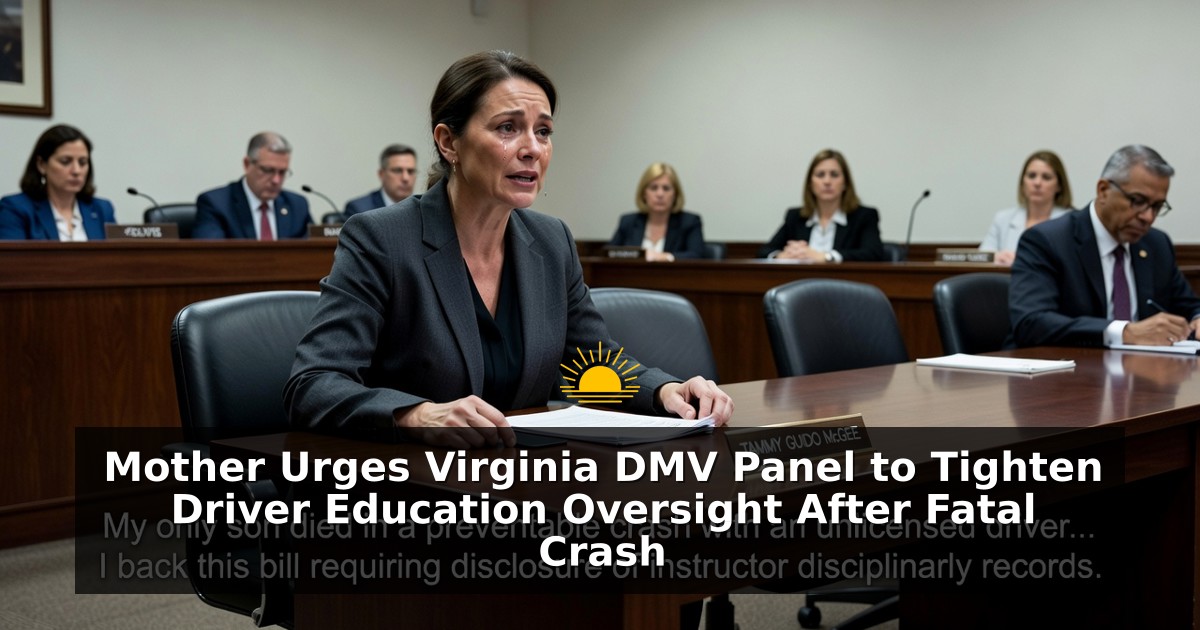
A Virginia mother whose only son died in a crash involving an unlicensed driver appeared before a Department of Motor Vehicles subcommittee to call for stronger oversight of driver education instructors. Tammy Guido McGee told lawmakers on January 27 that the fatal collision was entirely preventable and that systemic gaps allowed warning signs to go unaddressed. She described how an inexperienced motorist operating a high-performance BMW struck and killed her son Connor. McGee linked the tragedy to broader concerns about individuals with serious criminal histories or dangerous driving records quietly returning to roles teaching teens how to drive.
McGee framed the legislation under discussion as a straightforward measure focused on basic safeguards. She said the proposal protects minors, strengthens accountability, creates transparency, requires disclosure of recent disciplinary actions, and ensures meaningful oversight. According to her testimony, parents currently lack ready access to information that would help them evaluate who is instructing their children. She argued that teens deserve protection in the very setting where safe driving habits are supposed to be formed and that the public deserves clear answers about instructor qualifications.
The subcommittee hearing centered on the practical question of trust in driver education. McGee emphasized that allowing people with problematic backgrounds to resume teaching normalizes risk inside programs designed to reduce it. She noted that warning signs existed in the case involving her son yet no effective intervention occurred before the crash. Her account portrayed a sequence in which an unlicensed and inexperienced driver remained on the road long enough to cause a fatal outcome. Lawmakers heard that the absence of timely checks contributed directly to the loss of a young life.
Virginia requires formal driver education for most new teen drivers seeking licensure. Courses typically combine classroom instruction with behind-the-wheel training under certified instructors regulated through the Department of Motor Vehicles. Certification standards exist to screen applicants, yet McGee’s testimony suggested that gaps remain in how disciplinary histories are shared with families. The bill she supports would mandate disclosure of recent actions so parents can make informed decisions. Proponents view the change as a modest transparency step rather than a wholesale rewrite of existing rules.
Unlicensed driving remains a documented factor in a portion of serious crashes nationwide and within the Commonwealth. National safety data consistently show elevated risk when operators lack proper credentials or experience, particularly when high-performance vehicles are involved. Inexperienced drivers may misjudge speed, braking distances, or traffic conditions, outcomes that become more severe without prior supervised practice. McGee’s description of the BMW involved in her son’s death illustrated how those variables can combine with tragic results. Her appearance before the panel sought to translate one family’s loss into concrete policy adjustments.
Driver education instructors occupy positions of direct influence over minors. They model habits, correct errors, and shape attitudes toward speed, distraction, and impairment. When individuals with prior serious offenses or poor driving records re-enter those roles without disclosure, families lose the ability to assess suitability. McGee told the subcommittee that quiet reinstatement of such instructors undermines the safety mission of the programs themselves. The legislation aims to close that information gap by requiring recent disciplinary matters to be made known.
Accountability mechanisms already operate within Virginia’s licensing framework, including background reviews and potential suspension of teaching credentials. Critics of the status quo argue those tools sometimes fail to produce timely public notice. Supporters of the pending measure contend that adding explicit disclosure duties would reinforce existing standards without creating new bureaucratic layers. McGee presented the five elements of the bill as interlocking protections that together give parents usable information. She closed her remarks by respectfully requesting the subcommittee’s support.
Teen driving safety has long occupied a priority place in state transportation policy. Graduated licensing systems, mandatory education hours, and parental involvement requirements all reflect efforts to reduce crash rates among new drivers. Fatal incidents involving unlicensed operators highlight remaining vulnerabilities in enforcement and monitoring. McGee’s testimony connected one such incident to the instructional environment that precedes independent driving. By focusing on instructor vetting and transparency, the proposal seeks to strengthen the foundation of that system.
Legislative subcommittees routinely examine targeted adjustments to motor vehicle statutes. Hearings provide affected citizens an opportunity to describe real-world consequences of current rules. McGee used her allotted time to detail both the personal cost of her son’s death and the specific reforms she believes would reduce similar risks for other families. She avoided broad attacks on the driver education profession and instead concentrated on disclosure and oversight. The neutral presentation underscored a desire for practical improvements rather than punitive overhauls.
Public confidence in driver training depends in part on assurance that instructors meet consistent character and competence thresholds. When serious criminal histories or hazardous driving patterns surface after certification, the absence of mandatory notice can leave parents unaware. The bill under review would address that by compelling disclosure of recent disciplinary actions. McGee argued that such transparency is a minimal expectation when adults are entrusted with teaching minors a skill that carries life-or-death consequences. Her appearance placed the human stakes of regulatory detail before the subcommittee.
Crash reconstruction and licensing records often reveal sequences of missed opportunities for intervention. In the case McGee described, an unlicensed driver continued operating a powerful vehicle despite indicators that should have prompted action. The system’s failure to stop that progression ended in a preventable fatality. By linking that outcome to instructor standards, she invited lawmakers to consider upstream safeguards. Strengthened accountability and oversight, she said, form essential parts of any serious response.
Virginia families rely on certified programs to prepare adolescents for the responsibilities of the road. Classroom lessons and road sessions introduce rules of the road, hazard recognition, and defensive techniques. The credibility of those lessons rests on the integrity of the people delivering them. McGee’s central question—who is trusted to teach children to drive—captures the core policy issue. Providing parents with disciplinary information supplies one concrete tool for answering that question themselves.
The subcommittee process allows detailed examination of how proposed language would interact with existing DMV procedures. Members weigh administrative feasibility, privacy considerations, and measurable safety gains. Testimony such as McGee’s supplies qualitative context that statistics alone cannot convey. Her account of losing her only son supplied a clear illustration of why transparency provisions matter to ordinary households. The hearing record now includes that perspective as lawmakers continue their review.
Safety advocates have repeatedly noted that unlicensed driving correlates with higher rates of injury and death. Inexperience compounds the danger, especially in vehicles capable of rapid acceleration. When those factors intersect with gaps in instructor screening or disclosure, the cumulative risk rises. McGee’s narrative tied each element together in a single family’s experience. The legislation she endorsed attempts to interrupt that chain by elevating information flow and formal oversight.
As the Department of Motor Vehicles subcommittee considers next steps, the testimony stands as a call for incremental yet meaningful change. Protecting minors, requiring disclosure, and ensuring oversight constitute the stated goals. Parents, McGee maintained, deserve the facts necessary to safeguard their teenagers. Teens, in turn, deserve learning environments free from undisclosed risks. The panel’s deliberations will determine whether those principles advance into statutory form.
accountability Connor criminal history disciplinary disclosure DMV Subcommittee driver education driver instructors high performance vehicles minor protection oversight parental transparency parents rights preventable crashes public safety system failure Tammy Guido McGee teen safety unlicensed drivers Virginia DMV warning signs