Arlington Explores Space for Metro-Linked Northern Virginia Community College Campus
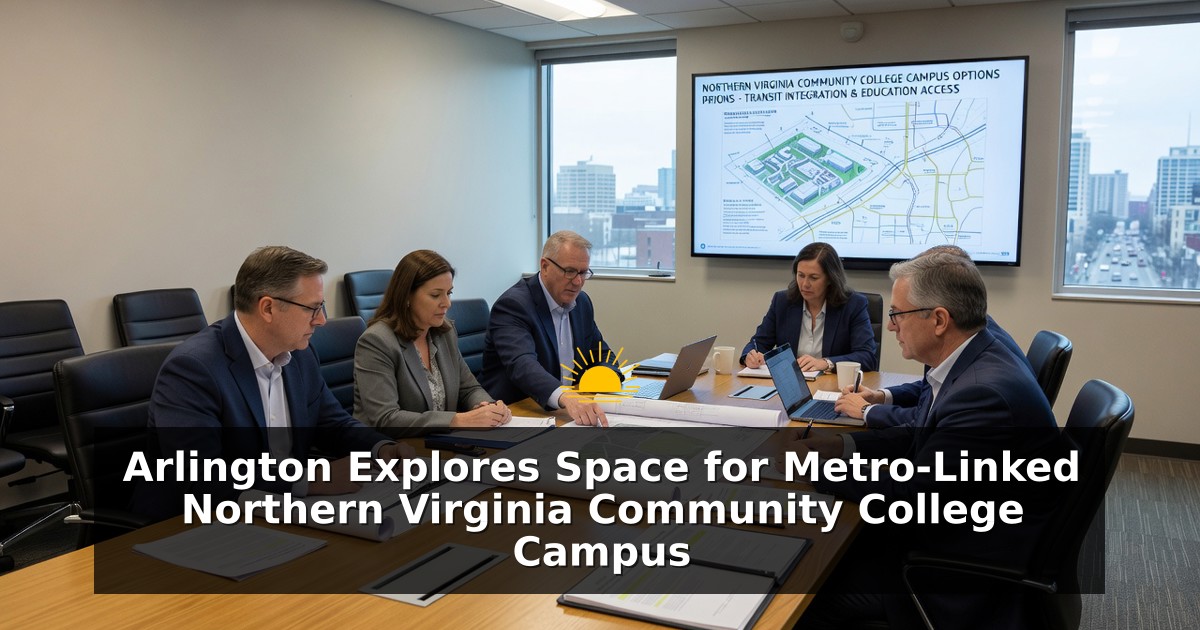
Arlington County officials examined options for bringing a Northern Virginia Community College campus to the area during a Fiscal Year 2027-2036 Capital Improvement Plan work session held on July 14, 2026. The discussion centered on the absence of any Northern Virginia Community College location inside Arlington and the lack of a fully Metro-accessible campus for the institution across the region. Participants noted that Arlington already supports a Higher Education Center along with multiple options schools that reflect local education priorities. Finding suitable space for the community college was described as a step that could strengthen both funding prospects and direct services for residents seeking affordable higher education.
The Arlington County Board oversees such capital planning discussions and currently includes members Takis Karantonis, Katie Cristol, Christian Dorsey, Libby Garvey, and Matt de Ferranti. These five elected officials guide long-range infrastructure and facility decisions that shape how public resources support education, transit, and community services. Work sessions on the Capital Improvement Plan allow the board to weigh competing needs over a ten-year horizon. The July session placed community college access alongside other county priorities for evaluation.
Northern Virginia Community College serves as the primary two-year public institution for the broader Northern Virginia region and enrolls tens of thousands of students annually across its existing campuses. Those campuses are located in Alexandria, Annandale, Loudoun, Manassas, and Woodbridge, with an additional medical education site, yet none sit inside Arlington County itself. Many students therefore travel across jurisdictional lines to attend classes. The absence of a local site creates longer commutes and limits spontaneous enrollment for Arlington residents who rely on public transportation.
## Transit Gaps and Student Access Barriers
Metro accessibility remains a central concern because large numbers of community college students depend on bus and rail connections rather than personal vehicles. Without a campus positioned near Metrorail stations or high-frequency bus corridors inside Arlington, learners face transfers and extended travel times that can discourage persistence. Research on community college completion consistently shows that transportation friction reduces course loads and increases dropout risk, especially among working adults and first-generation students. Arlington’s dense transit network could mitigate those barriers if a suitable site were identified near existing rail or bus infrastructure.
County staff and board members have long recognized that education pathways influence workforce readiness and economic mobility. Arlington already invests in options schools and a Higher Education Center that deliver specialized programs aligned with local employer needs. Extending that ecosystem to include Northern Virginia Community College offerings would create clearer transfer routes into four-year institutions and certificate programs. The work session framing emphasized that such an addition would serve residents directly rather than function solely as a financial transaction.
## Funding Linkages Inside the Capital Improvement Plan
Capital Improvement Plan discussions routinely pair facility needs with potential revenue sources and partnership models. Locating space for Northern Virginia Community College could open doors to state capital outlay funds, regional education grants, or joint-use agreements that stretch local dollars. Board members heard that the arrangement would not rest only on monetary returns. Improved service delivery for residents who want to take classes formed an equally important rationale. This dual emphasis on fiscal leverage and community benefit is typical of multi-year capital planning in Northern Virginia localities.
Available land and building inventory inside Arlington remains constrained by high demand for housing, commercial space, and public facilities. Any future proposal would require careful site evaluation against zoning, environmental, and transit-access criteria. Prior county studies of underutilized public parcels and joint-development opportunities provide a starting inventory. Partnerships with the college could also explore shared facilities that house both credit instruction and workforce training labs, maximizing daytime and evening utilization.
## Broader Regional Education Context
Northern Virginia continues to experience strong demand for affordable postsecondary credentials in fields such as information technology, health sciences, and skilled trades. Employers throughout the corridor cite persistent talent shortages that community colleges are well positioned to address. When campuses sit far from population centers or transit nodes, enrollment from lower-income and transit-dependent households declines. Placing programs closer to Arlington’s residential and commercial cores would expand the local talent pipeline while reducing vehicle miles traveled by commuting students.
State policy encourages localities and the Virginia Community College System to collaborate on facilities that improve equity of access. Recent capital budget cycles have rewarded projects demonstrating clear regional benefit and sustainable operating models. An Arlington-based site could therefore strengthen the college’s overall competitiveness for limited state construction dollars. At the same time, the county would gain an additional tool for meeting its own goals around lifelong learning and economic inclusion.
Public comment and further staff analysis will shape whether the concept advances into formal Capital Improvement Plan recommendations in coming budget cycles. Board members customarily request detailed cost estimates, enrollment projections, and transit-impact assessments before committing multi-year funding. The July 14 work session established the issue as a recognized gap rather than a fully developed project. Continued dialogue between county agencies, college administrators, and community stakeholders will determine the pace of any next steps.
Observers note that successful higher-education partnerships elsewhere in Northern Virginia have combined public land, state support, and private philanthropy. Those precedents offer practical models for governance, maintenance responsibilities, and program alignment with local labor-market data. By addressing both the missing Arlington footprint and the broader Metro-access shortfall, county leaders aim to close a long-standing service disparity. The ultimate measure of success would be higher local enrollment, smoother transfer pathways, and stronger connections between education and employment for Arlington residents.
Arlington Arlington HEC better educational path better service path campus classes educational path fund it funding improve service improved service metro accessible campus money Northern Virginia Community College options schools priority residents service service path space