Opponents Challenge Virginia HB 1238 Over Veteran and Farm Impacts
Updated
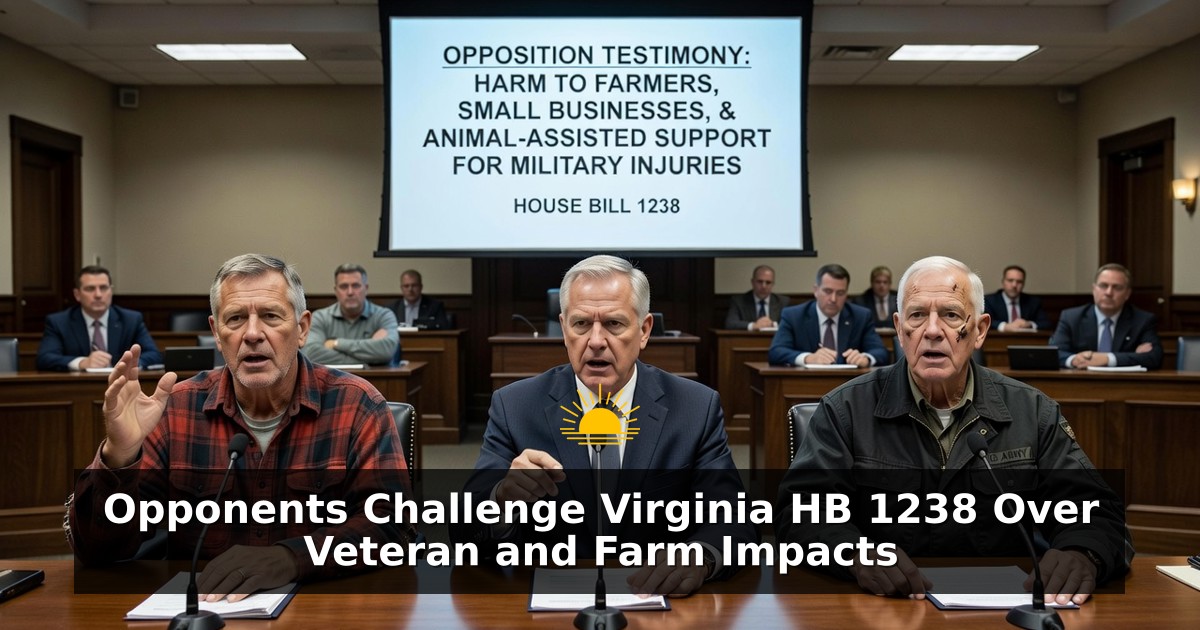
Lawmakers heard pointed opposition testimony against Virginia House Bill 1238 from representatives of the agricultural community who argued the measure would harm farmers, small business owners, and military veterans. Lewis Waski, president of the American Federation of Agriculture, stated that his organization opposes the bill in order to protect farmers and the vital agricultural industry that supports communities across the Commonwealth. Abbott Hoffman, a legislative representative for the same federation and a United States Army veteran, joined the testimony and outlined additional concerns tied directly to service members and their families. Both speakers framed their objections around practical effects on livelihoods and on established uses of animals that assist with recovery from military-related conditions.
Hoffman told legislators that the bill would take away opportunities for veterans to run businesses and would diminish a passion shared by many who have served. He emphasized that the proposal would remove the ability of veterans to use certain animals for managing post-traumatic stress disorder, traumatic brain injury, and other related military injuries. These points formed the core of his personal and professional objection, linking agricultural policy to ongoing health needs within the veteran community. Supporters of continued access to such animals have long noted that structured animal interaction can form part of broader wellness approaches for those who have experienced combat or service-related trauma.
Agricultural Industry Stakes and Small Business Effects
Waski centered his remarks on the need to safeguard Virginia’s farming sector, describing the legislation as a threat to established operations and the economic stability they provide. Agriculture remains a foundational part of the state’s economy, encompassing crop production, livestock, and related enterprises that employ residents in rural and suburban localities alike. Opponents contended that new restrictions could disrupt supply chains and daily management practices that farmers have refined over generations. They further warned that small business operators connected to animal husbandry or related sales would face heightened compliance burdens that larger entities might absorb more easily.
The testimony also addressed the possibility that the bill would push more transactions toward unregulated online sales platforms. According to the opponents, those platforms often operate with limited oversight, creating uneven conditions for traditional sellers who follow existing state and local rules. Increased dependence on such channels, they argued, could expose consumers to inconsistent standards while undercutting brick-and-mortar and farm-based businesses that maintain direct accountability. This concern was presented as both an economic and a consumer-protection issue that legislators should weigh carefully before advancing the measure.
Veteran Health Supports and Animal Assistance
Hoffman connected the policy debate to his own experience as an Army veteran and to the experiences of others who rely on animals for therapeutic purposes. He stated that the bill would interfere with the use of animals to address PTSD, TBI, and additional service-connected injuries that affect daily functioning and quality of life. Clinical and community programs across the United States have documented that carefully managed animal-assisted activities can complement conventional care by reducing isolation and providing structured routines. Removing or narrowing pathways for veterans to obtain or work with these animals, opponents maintained, would close off a practical resource that many have found beneficial.
The legislative representative also referenced broader public messaging around animals, asserting that organizations such as PETA and the Humane Society of the United States, along with other animal-rights groups, disseminate negative propaganda. He invited lawmakers and interested parties to attend a conference in St. Louis, Missouri, scheduled for August, where the American Federation of Agriculture planned to discuss these topics in greater depth. The invitation was offered as an opportunity to examine agricultural perspectives and the data the federation considers relevant to policy choices affecting livestock, working animals, and related enterprises.
Policy Context and Ongoing Deliberations
House Bill 1238 has drawn attention because it intersects multiple constituencies, including commercial agriculture, small entrepreneurs, and veterans’ advocates. Testimony against the measure stressed that any new regulatory framework should preserve legitimate pathways for veterans to engage in animal-related businesses and to maintain access to animals that support recovery from invisible wounds of war. Opponents urged legislators to consider unintended consequences that could arise if traditional sales and ownership routes become constrained. They maintained that protecting the agricultural base while respecting the needs of those who served remains a balanced objective.
Observers of the Virginia General Assembly note that bills touching animal commerce and welfare routinely generate detailed witness lists from both industry and advocacy sides. In this instance, the American Federation of Agriculture positioned its opposition as a defense of practical farming realities and of veteran well-being rather than an abstract ideological stance. Hoffman’s dual identity as a legislative representative and a veteran gave the testimony a personal dimension that underscored the human stakes involved. Waski’s focus on industry protection complemented that message by highlighting employment and production concerns that extend beyond any single demographic.
As deliberations continue, the arguments presented by Waski and Hoffman place pressure on bill sponsors to clarify how proposed rules would accommodate existing therapeutic uses and small-scale commercial activity. The speakers called for rejection of HB 1238 on the grounds that its current form would diminish opportunities rather than enhance oversight in a constructive manner. Their remarks added to the public record a set of concrete claims about business viability, mental-health supports, and the role of regulated versus unregulated marketplaces. Further committee discussion and possible amendments will determine whether those claims reshape the legislation or leave the core provisions intact.
The opposition testimony ultimately framed HB 1238 as a measure whose reach extends into farms, storefronts, and households where veterans manage long-term injuries. By linking agricultural stability with the everyday needs of service members, the American Federation of Agriculture sought to broaden the lens through which lawmakers evaluate the bill. Whether the General Assembly accepts that framing will become clearer as the session progresses and additional stakeholders contribute their own data and experiences to the debate.
Abbott Hoffman American Federation of Agriculture animal standards consumer choice Craigslist David Foley Facebook family owned pet stores HB1238 HPE1238 HSUS Lewis Waski live animals locality regulate military injuries Miss Adams pet stores PETA PTSD responsible pet ownership Sheila Annons St. Louis Missouri TBI United States Army Veterans Virginia Virginia Alliance Virginia pet advocacy alliance