Opposition Raised to Bill Expanding Virginia Public Safety Coverage
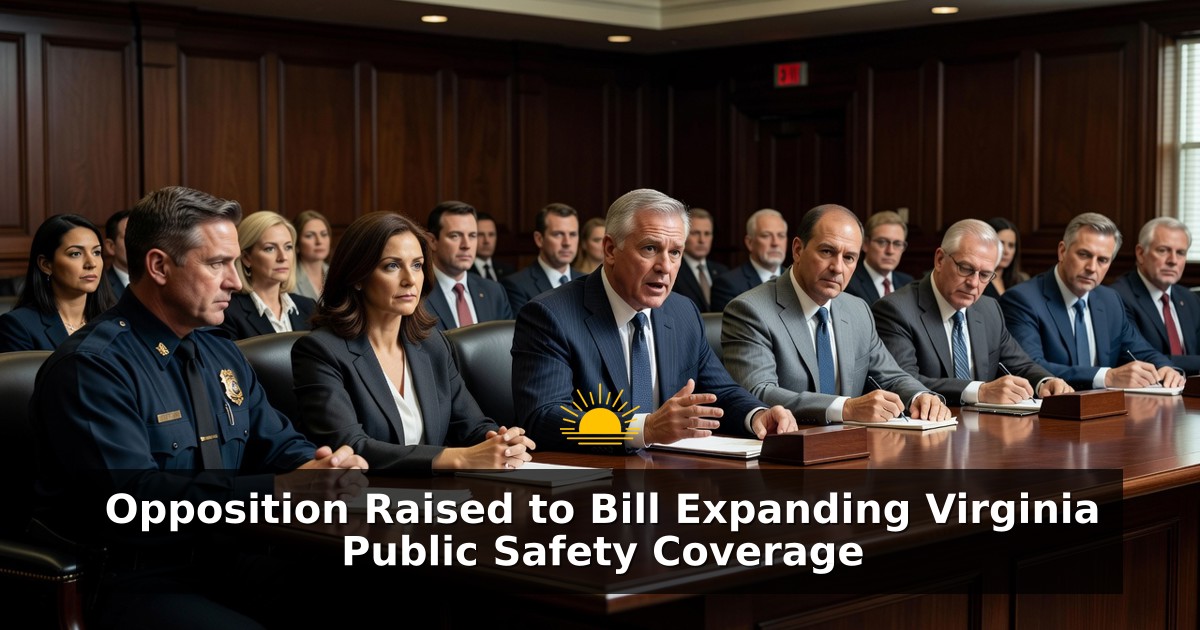
A proposal under review in a Virginia legislative subcommittee has drawn formal opposition over its potential to double insurance coverage for firefighters and law enforcement personnel under the VACorp model. Speakers noted that the current framework already encompasses approximately 4,000 firefighters and 8,000 law enforcement officers across the Commonwealth. Expanding that pool as contemplated by the measure would markedly increase the number of covered individuals. Officials cautioned that the change would transfer significant new expenses directly onto cities, counties, and other localities. The discussion underscored the tension between broadening protections for public safety workers and preserving fiscal stability for local governments.
Supporters of enhanced coverage often emphasize the hazardous nature of firefighting and policing duties, yet the immediate focus remained on the practical consequences of the legislation. Under the existing VACorp arrangement, participating localities pool resources to manage risk and claims for these essential personnel. Doubling the covered population would require recalibration of premiums, reserves, and contribution formulas. Local budget officers already navigate tight fiscal constraints driven by personnel costs, infrastructure needs, and state-mandated services. Any abrupt expansion therefore raises questions about sustainability and the capacity of smaller jurisdictions to absorb higher assessments without service reductions or tax increases.
## Current Scope of VACorp Public Safety Coverage
VACorp functions as a group self-insurance mechanism that allows Virginia localities to share risk rather than purchase commercial policies individually. Within this structure, roughly 4,000 firefighters currently receive coverage for work-related injuries, liability, and related exposures. An additional 8,000 law enforcement officers fall under the same model, bringing the combined total to about 12,000 public safety professionals. These figures reflect the scale of participation among member localities that have opted into the pool. The arrangement has historically aimed to stabilize costs while ensuring prompt claims handling for first responders. Expanding eligibility or benefit levels beyond present parameters would effectively recreate that footprint at twice the size.
The bill under consideration seeks precisely that expansion, according to testimony presented to the subcommittee. By extending the same coverage parameters to a doubled cohort, the legislation would enlarge both the protected workforce and the corresponding financial obligations. Local governments that rely on VACorp would face recalculated contribution rates reflecting the broader risk pool. Actuarial adjustments of this magnitude typically unfold over multiple budget cycles, yet the immediate pressure on annual appropriations remains a central concern. Smaller counties and towns with limited tax bases could experience disproportionate strain compared with larger urban centers.
## Fiscal Implications for Virginia Localities
Passing substantial new costs to localities forms the core objection articulated during the hearing. Municipal and county budgets already allocate large shares of revenue to public safety salaries, equipment, training, and overtime. An increase in insurance-related outlays would compete with those existing priorities and with other essential services such as education, transportation, and social programs. Finance directors frequently warn that unfunded or underfunded mandates from the state level compress local decision-making authority. In this instance, the projected cost shift is described as substantial enough to warrant formal opposition even while acknowledging the bill patron’s underlying intent.
Virginia’s system of local government finance depends heavily on real property taxes, local option sales taxes, and state aid. When insurance pools expand coverage without corresponding state appropriations, the residual burden settles on those same revenue sources. Local elected officials must then choose among raising taxes, drawing down reserves, delaying capital projects, or reducing staffing elsewhere. Each option carries political and operational consequences that vary by jurisdiction. The cumulative effect across dozens of participating localities could reshape budget deliberations for several fiscal years.
## Balancing Worker Protections and Local Budgets
Public safety personnel perform duties that expose them to elevated physical and legal risks, making adequate insurance coverage a longstanding policy priority. Firefighters confront structural collapses, hazardous materials, and intense heat, while law enforcement officers face violence, vehicle pursuits, and civil liability claims. Robust coverage helps ensure that injured workers receive medical care and that localities can defend against lawsuits without catastrophic single-year losses. At the same time, the mechanism chosen to deliver that coverage must remain affordable for the governments that employ these workers. The current debate illustrates the difficulty of enlarging benefits without destabilizing the funding base.
Legislative patrons often introduce such measures with the goal of closing perceived gaps in protection or modernizing outdated benefit schedules. Respect for that intent was expressly noted during the subcommittee exchange. Nevertheless, the practical outcome of doubling the covered population under the VACorp model led speakers to conclude that opposition was necessary. The position reflects a judgment that the fiscal impact on localities outweighs the immediate advantages of broader enrollment. Future negotiations could explore phased implementation, state cost-sharing, or alternative risk-transfer tools that mitigate the burden on local budgets.
## Legislative Context and Next Steps
The discussion occurred within Labor and Commerce Subcommittee No. 2, a panel that routinely examines employment, insurance, and workplace-related legislation. Measures affecting first-responder benefits frequently generate detailed fiscal impact statements and extensive local-government testimony. Stakeholders from the Virginia Association of Counties, municipal leagues, and individual risk pools customarily provide data on enrollment, claims history, and projected rate changes. In this case, the straightforward arithmetic of moving from roughly 12,000 covered personnel to twice that number supplied a clear basis for cost concerns. Lawmakers will weigh those projections against arguments favoring expanded safeguards.
Any bill that advances from subcommittee still faces additional hurdles in full committee, floor votes, and potential conference negotiations. Amendments could narrow the scope, delay effective dates, or introduce state general-fund support to offset local contributions. Conversely, the measure could stall if enough members conclude that the cost transfer is untenable under present economic conditions. Local governments will continue monitoring the legislation closely, preparing both advocacy strategies and contingency budget scenarios. The outcome will influence how Virginia balances its commitment to public safety workers with the fiscal realities confronting its cities and counties.
The opposition voiced in the hearing centers on preserving the financial equilibrium of the VACorp model while recognizing the valuable service rendered by firefighters and law enforcement officers. By highlighting the existing counts of 4,000 firefighters and 8,000 officers, speakers grounded their objections in concrete scale rather than abstract principle. Doubling coverage may appear straightforward on paper, yet the downstream effects on local tax rates, service levels, and long-term planning are considerable. Continued scrutiny of the proposal will determine whether a revised approach can satisfy both protective and budgetary objectives. For now, the recorded stance remains one of clear resistance to the bill in its current form.