Virginia House Bill 5 Seeks Broad Expansion of Paid Sick Leave
Updated
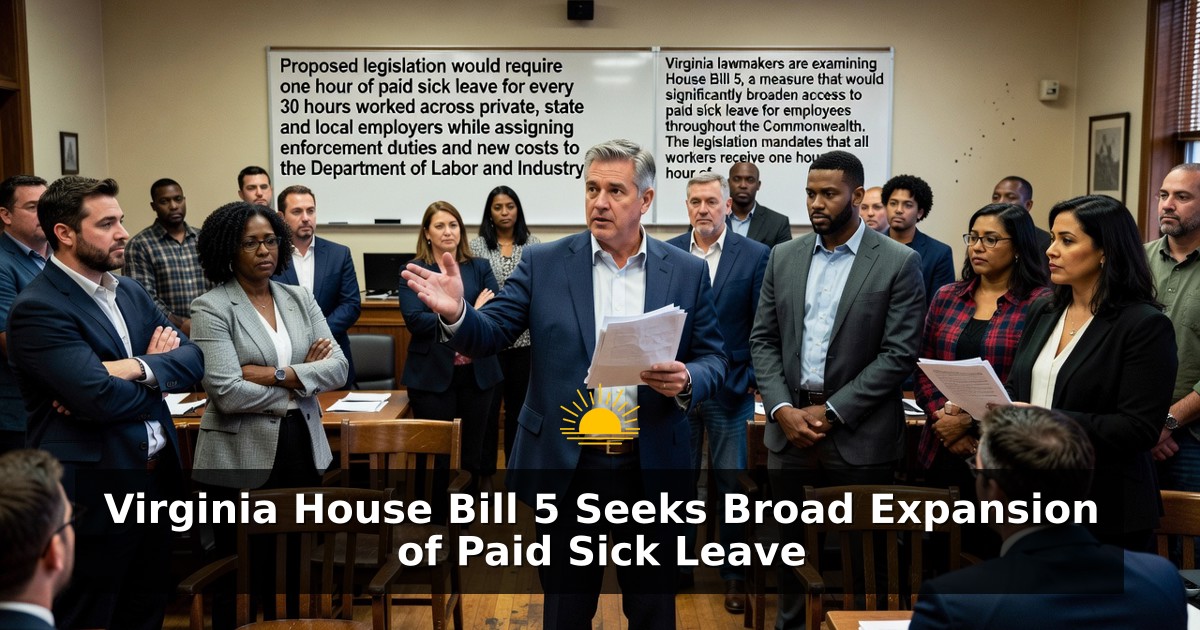
Virginia lawmakers are examining House Bill 5, a measure that would significantly broaden access to paid sick leave for employees throughout the Commonwealth. The legislation mandates that all workers receive one hour of paid sick leave for every 30 hours worked. Coverage would extend to private employers as well as state and local government staff, including those compensated on a fee-for-service basis. Officials presented the proposal during a recent subcommittee session focused on commerce, agriculture and natural resources matters. The bill represents a marked departure from existing limited protections and carries defined administrative and budgetary consequences.
Supporters of expanded leave policies often cite the need for workers to address personal or family health needs without losing income. House Bill 5 seeks to establish a uniform standard that applies across employment sectors rather than restricting benefits to narrow categories. Under the terms outlined, accrual would occur steadily based on hours worked, creating a predictable benefit structure. The proposal also includes a specific opt-out provision for certain health care staff. Overall, the measure aims to create consistency in how paid sick leave is provided and managed statewide.
Key Provisions of the Proposed Legislation
House Bill 5 establishes a clear accrual rate of one hour of paid sick leave for every 30 hours of work performed by covered employees. This requirement would apply equally to private-sector businesses, state agencies and local government employers. Individuals paid on a fee-for-service basis fall under the same mandate, ensuring broad inclusion. The bill further permits health care employees who work fewer than 30 hours per week or who serve on an as-needed basis to waive their right to the paid leave benefit. Such a waiver option provides flexibility for part-time or intermittent health care roles while maintaining the core requirement for other workers.
Enforcement authority would rest with the Department of Labor and Industry, which must receive and investigate all related complaints. The agency would gain responsibility for ensuring compliance across the expanded pool of employers and employees. These structural elements form the foundation of the bill and distinguish it from narrower existing rules. Lawmakers reviewing the text have noted the comprehensive reach intended by the language. The combination of mandatory accrual, sector-wide coverage and a limited waiver creates a detailed framework for implementation if the measure advances.
Comparison With Current Virginia Policy
The Commonwealth’s present paid sick leave policy remains narrowly focused on health care workers who perform at least 20 hours of work per month. That limited scope leaves most private, state and local employees without a statutory right to accrue paid sick time under state law. House Bill 5 would replace this targeted approach with a universal standard applicable to virtually all employment relationships. The shift would eliminate the previous hour threshold tied solely to health care roles and substitute a broader hours-worked formula. Transitioning from the current framework to the proposed one would therefore affect a far larger segment of the workforce.
Existing rules do not impose comparable obligations on private employers outside the health care field or on most public-sector positions. By contrast, the new bill extends protections and corresponding duties to those groups. The waiver available to certain part-time or as-needed health care employees offers a residual element of choice that is absent from the general mandate. Analysts tracking labor standards observe that moving from a specialized benefit to a general one typically requires careful coordination of definitions and record-keeping practices. The contrast between the two regimes underscores the scale of change contemplated by House Bill 5.
Enforcement Responsibilities and Budgetary Requirements
Implementation of House Bill 5 would assign the Department of Labor and Industry the task of handling complaints and ensuring adherence to the new leave standards. To fulfill these duties the agency would require 14 additional positions. Associated funding needs are projected at 3.1 million dollars in the first year of the biennium and 2.2 million dollars in the second year. These figures reflect anticipated costs for staffing, investigation capacity and administrative overhead linked directly to the expanded enforcement role. Budget documents accompanying the bill highlight the resource increase as necessary for effective oversight.
Without the added personnel and appropriations, the department would face challenges in processing an expected rise in inquiries and cases. The fiscal note therefore forms an integral part of legislative consideration alongside the policy language itself. Lawmakers must weigh the operational demands against the intended worker protections when deciding the bill’s path forward. Clear assignment of enforcement authority aims to promote consistent application of the accrual rules across diverse employers. The stated personnel and dollar amounts provide concrete markers for evaluating the measure’s practical impact on state resources.
Broader Context for Employers and Employees
Private businesses, state agencies and local governments would all need to adjust payroll and leave-tracking systems to accommodate the one-hour-per-30-hours formula. Employers of varying sizes would face new record-keeping obligations to document accrual and usage accurately. Employees standing to gain the benefit include full-time and part-time staff previously uncovered by the health-care-only rule. The waiver provision for qualifying health care workers introduces an element of individual choice within an otherwise mandatory structure. Taken together, these features would reshape how paid sick leave is earned and administered across Virginia.
Fiscal estimates center on state enforcement costs rather than direct employer outlays, yet businesses would still incur expenses related to providing the leave itself. Public employers would likewise incorporate the benefit into existing compensation frameworks. The bill’s design seeks to balance worker access with administrative feasibility through the defined accrual rate and complaint-driven oversight model. Continued legislative review will determine whether the proposed standards advance in their current form or undergo revision. Stakeholders on all sides continue to examine the practical implications of moving from limited to comprehensive coverage.
House Bill 5 remains under consideration as part of ongoing discussions about workplace standards in Virginia. The measure’s detailed requirements, enforcement mechanism and identified funding needs supply lawmakers with a complete picture of the policy change. Any final version would need to align statutory language with available resources to achieve the intended expansion of paid sick leave. The subcommittee presentation has placed the core facts of accrual, coverage, waiver options and departmental costs into the public record for further evaluation. Future actions will clarify the ultimate scope and timeline of any enacted reforms.
2.2 million 3.1 million as-needed basis biennium commonwealth complaints costs current policy Delga Converse Fowler Department of Labor and Industry employees enforcement fee for service first year health care employees health care workers hours per month House Bill 5 local employers paid sick leave positions private employers second year state employers subcommittee waive rights
All Virginia News is published by ALL VIRGINIA NEWS, LLC. How we're funded · Corrections · Ethics
