Fairfax Supervisor Challenges Crossing Guard Cuts at Budget Meeting
Updated
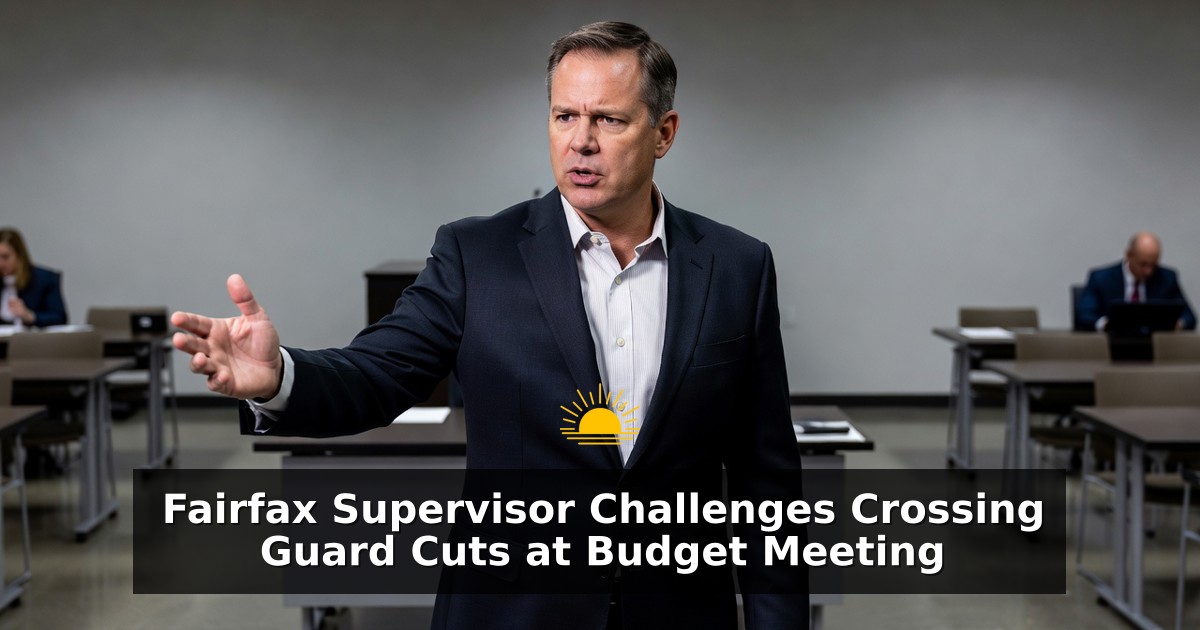
Fairfax County Supervisor Pat Herrity addressed the elimination of school crossing guard positions during the Board of Supervisors Budget Policy Committee meeting held on September 1, 2026. Herrity described the budget decision as presenting a false choice for county leaders and residents. He stated that approximately 900,000 dollars would be sufficient to restore all of the reviewed positions that had been removed earlier in the budget process. The discussion centered on ensuring adequate staffing so that every school in need could maintain proper crossing guard coverage for student safety.
The Fairfax County Board of Supervisors oversees these budget deliberations and includes Chairman Jeff McKay along with district representatives James Walkinshaw, Jimmy Bierman, Walter Alcorn, Rodney Lusk, Andres Jimenez, Dan Storck, Dalia Palchik, Pat Herrity, and Kathy Smith. Committee sessions such as this one allow supervisors to examine specific line items before final adoption of the annual spending plan. Crossing guard services fall under public safety and education support categories that regularly draw scrutiny when revenue projections tighten. Herrity focused his remarks on the practical impact of the earlier reductions rather than broader fiscal philosophy.
Herrity explained that the 900,000-dollar figure would restore the 13 or 14 crossing guard positions that had been reviewed and eliminated. He noted that these roles are not structured as full 40-hour positions in every case. As a result, more than one individual can share or occupy a single authorized position depending on school schedules and peak crossing times. This flexibility would enable the county to hire the total number of guards required to staff all affected locations. The supervisor emphasized that the restoration would cover the schools that previously had guards rather than expanding to sites that never held such positions.
School crossing guards play a documented role in protecting children who walk or bike to campus each day. National transportation safety data consistently show that trained adult guards reduce pedestrian incidents at intersections near elementary and middle schools. Fairfax County operates one of the largest public school systems in Virginia, with hundreds of campuses spread across urban, suburban, and lower-density areas. Morning arrival and afternoon dismissal periods create concentrated pedestrian traffic that coincides with commuter vehicle flows on many local roads. Maintaining visible crossing assistance remains a core element of the county’s student safety framework.
Budget documents presented to the committee earlier in the cycle had identified the crossing guard reductions as one of several efficiency measures. County staff typically evaluate part-time and seasonal positions when seeking to align expenditures with available revenue. Herrity countered that alternative reductions elsewhere in the budget could have preserved the guard slots without creating what he termed a false choice between competing priorities. He framed the 900,000-dollar restoration cost as modest relative to the overall multi-billion-dollar county budget. The remarks invited fellow supervisors and staff to revisit the specific line item before the budget advanced further.
The positions in question support a mix of elementary, middle, and selected high school locations where traffic engineering studies have justified adult supervision. Guards receive training in traffic control techniques, emergency procedures, and child pedestrian behavior. Their presence also reassures parents who might otherwise drive students to school, thereby reducing vehicle congestion at drop-off zones. When positions are left vacant, schools sometimes rely on parent volunteers or law enforcement officers diverted from other duties. Neither substitute fully replicates the dedicated daily coverage that permanent guards provide.
Fairfax County’s budget process includes multiple public committee meetings designed to surface such concerns before the full Board of Supervisors votes. The September 1, 2026, Budget Policy Committee session followed standard procedures for reviewing proposed adjustments. Supervisors routinely question staff assumptions about service levels and cost estimates during these gatherings. Herrity’s intervention added a concrete dollar amount and position count to the public record. His comments underscored the link between relatively small personnel allocations and measurable safety outcomes at school crossings.
Pedestrian safety statistics compiled by state and federal agencies reinforce the value of crossing guards in reducing child injury rates. Virginia Department of Transportation guidance encourages local governments to maintain adult crossing assistance at high-volume school intersections. Fairfax County has historically funded these roles through a combination of general fund dollars and occasional state safety grants. Any sustained reduction therefore carries implications that extend beyond a single fiscal year. Restoring the 13 or 14 positions would return staffing to the level reviewed prior to the cuts.
County budget officials have noted in past cycles that part-time public safety support roles can be difficult to fill even when funding exists. Wage rates, split shifts, and the need for reliable attendance during short daily windows all affect recruitment. Herrity’s observation that multiple people can share one authorized position acknowledges this operational reality. By restoring the full count of positions, the county would gain hiring flexibility to match guards with the precise times and locations of greatest need. The approach aims to achieve complete coverage without requiring every post to be a full-time equivalent.
The discussion occurs against a backdrop of ongoing enrollment changes and traffic pattern shifts across Fairfax County. New residential development in some districts increases the number of students walking to neighborhood schools. At the same time, other areas experience stable or slightly declining enrollment yet retain busy arterial roads adjacent to campuses. A uniform reduction in crossing guard slots can therefore produce uneven safety effects depending on local conditions. Herrity’s call for restoration seeks to reverse the eliminations across the previously staffed sites.
Independent research on school zone safety repeatedly finds that adult crossing guards contribute to lower vehicle speeds and higher driver yielding rates. These behavioral changes benefit not only students but also other pedestrians who use the same intersections. In a densely populated jurisdiction such as Fairfax County, the cumulative effect of consistent guard presence supports broader Vision Zero and safe-routes-to-school objectives. Budget decisions that trim these positions therefore intersect with multiple policy goals beyond pure education spending.
As the Budget Policy Committee continues its review, the 900,000-dollar restoration option remains on the table for further consideration by the full board. Herrity’s remarks supplied a clear cost estimate and a defined scope limited to the eliminated positions. The supervisor did not propose expanding the program to schools that never had guards. Instead, he focused on reversing the specific cuts already identified in the draft budget. This targeted framing keeps the fiscal impact contained while addressing the immediate staffing shortfall.
Final budget adoption will require majority support among the ten members of the Board of Supervisors. Public comment periods and additional work sessions typically follow committee discussions of this nature. Residents interested in school safety frequently monitor these proceedings and submit input on personnel items that affect daily student travel. The September 1 exchange added a precise figure and position count that stakeholders can reference in subsequent testimony or correspondence. County staff are expected to provide updated cost and recruitment analyses if the board directs further study.
Maintaining adequate crossing guard coverage forms one component of a comprehensive approach to student transportation safety that also includes sidewalks, signal timing, and parent education campaigns. When any single element is reduced, the remaining measures must compensate. Herrity’s intervention highlighted the relatively low cost of preserving the guard layer compared with the potential consequences of its absence. The 13 or 14 positions, once restored, would again allow flexible hiring sufficient to staff all previously covered schools during critical arrival and dismissal windows.
The Budget Policy Committee meeting record now contains Herrity’s assessment that the original reduction presented an unnecessary binary choice. Alternative savings proposals could have been advanced, according to his statement, without removing the crossing guard slots. Whether the full board ultimately reallocates the 900,000 dollars will depend on competing demands identified in the weeks ahead. For the moment, the public discussion has clarified both the scale of the earlier cuts and the specific funding level required to reverse them. School safety advocates and budget observers will continue to track the item as the fiscal year planning process moves forward.
900k Board of Supervisors budget cuts budget decisions budget policy committee budget review co-responders county budget county spending crossing guards crossing positions fairfax bos Fairfax County fairfax schools guard funding Pat Herrity public safety school crossing guards school safety supervisor herrity
All Virginia News is published by ALL VIRGINIA NEWS, LLC. How we're funded · Corrections · Ethics
