Virginia Bill Creates High School Path to CNA Licensure
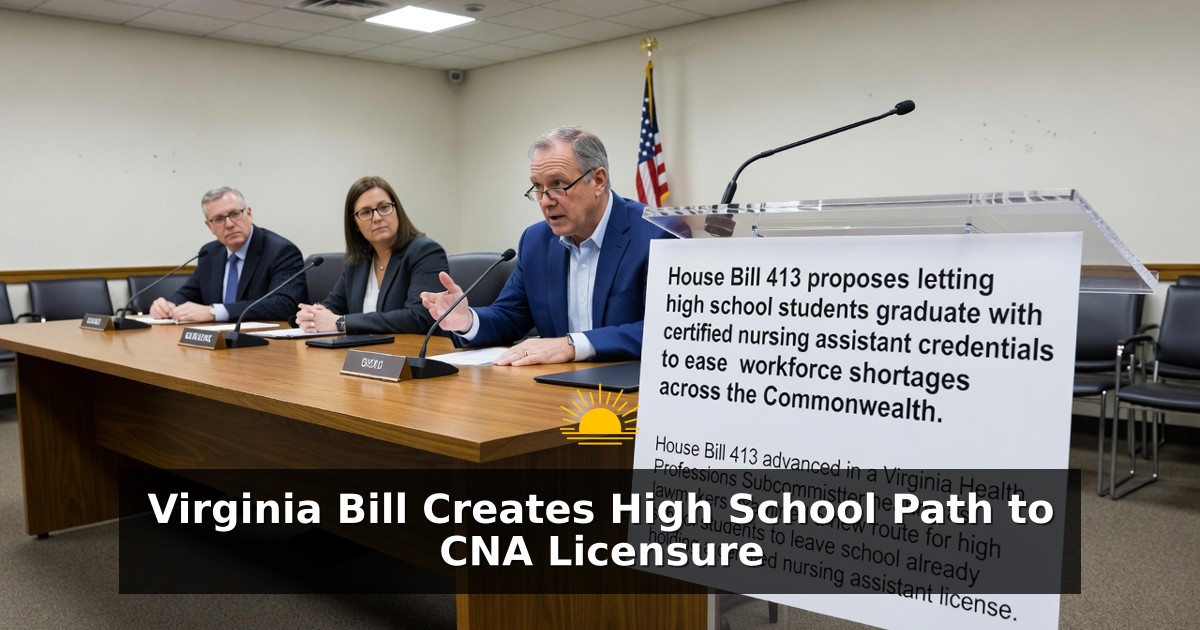
House Bill 413 advanced in a Virginia Health Professions Subcommittee hearing as lawmakers examined a new route for high school students to leave school already holding a certified nursing assistant license. The measure targets a persistent shortage of CNAs that affects hospitals, nursing homes, and home-care agencies in every region of the Commonwealth. Sponsors presented the proposal as both a workforce solution and an immediate employment option for graduates. Supporters noted that the credential would allow young people to enter the labor market quickly while keeping open doors to further nursing education.
The legislation would integrate CNA training into existing high-school career and technical education sequences so that students complete required classroom hours, clinical practice, and the state competency examination before commencement. Upon successful completion, graduates would receive the same license issued to adult candidates by the Virginia Board of Nursing. Schools already offering health-sciences pathways could expand those programs without creating entirely new administrative structures. Officials indicated the approach aligns with current state funding streams that support specialty career education.
Workforce data cited during discussion show that long-term-care facilities and home-health agencies continue to report vacancy rates well above pre-pandemic levels. An aging population and rising demand for post-acute care have intensified pressure on the entry-level nursing workforce. Certified nursing assistants perform essential daily tasks that free licensed nurses for higher-level clinical duties. Expanding the pipeline at the high-school level is viewed as one practical step toward stabilizing staffing ratios across the Commonwealth.
Educational Pathway and Student Benefits
Under the framework outlined for House Bill 413, participating school divisions would coordinate with approved nurse-aide education programs to deliver the mandated curriculum. Students would satisfy both high-school graduation requirements and the Board of Nursing’s training standards in a single coordinated sequence. Clinical rotations could occur in local hospitals, skilled-nursing facilities, or approved simulation labs already used by many career centers. The dual-credit nature of the coursework is expected to reduce the time and cost students would otherwise face if they pursued certification after graduation.
The bill’s patron described personal experience balancing college classes and parenting while working as a home-health aide. That background illustrated how an early CNA credential can supply flexible income during further study. Graduates could work weekends or summer breaks in home-care or long-term-care settings, generating earnings that help offset tuition for practical-nursing or registered-nursing programs. Lawmakers heard that the same credential also serves as the first rung on a longer career ladder leading to licensed practical nurse or advanced-practice roles.
Existing state budget language already directs resources toward nursing-education pathways at the community-college and university levels. House Bill 413 is designed to mesh with those investments by creating a seamless on-ramp at the secondary level. School systems that currently receive career-and-technical-education supplemental funding could apply those dollars to instructor salaries, lab equipment, and clinical placement coordination. Proponents argued the arrangement avoids large new appropriations while still expanding capacity.
Implementation Considerations for Local Schools
Local school boards would retain discretion over whether to offer the specialized sequence, allowing rural and urban divisions to gauge local employer demand and available clinical sites. Partnerships with nearby community colleges and healthcare providers are expected to supply both instructors and supervised practice opportunities. The Virginia Department of Education and the Board of Nursing would need to issue joint guidance clarifying how high-school transcripts document completion of the nurse-aide curriculum. Clear documentation will ensure graduates can sit promptly for the state examination and obtain licensure without administrative delay.
Healthcare employers have repeatedly told legislators that retention improves when new CNAs arrive with realistic expectations of the work. High-school programs that include substantial clinical hours can provide that realism before students enter the full-time workforce. Early exposure also helps students decide whether to continue into licensed practical nursing or registered nursing programs, potentially reducing later attrition. Several members of the subcommittee noted that similar dual-enrollment health models already operating in selected Virginia localities have produced measurable increases in local hiring.
Fiscal analysts observing the hearing indicated that the bill’s reliance on existing specialty-education funding keeps its budget impact modest. Instructor credentialing and modest equipment upgrades represent the primary near-term costs for participating divisions. Because many career centers already maintain health-sciences labs, the incremental expense is expected to remain manageable. The measure therefore fits within the broader workforce-development priorities established in recent biennial budgets.
Broader Workforce and Economic Context
Virginia’s healthcare sector remains one of the Commonwealth’s largest employers, yet entry-level vacancies constrain bed capacity and home-care availability. Economists tracking labor markets have linked CNA shortages to delayed hospital discharges and longer wait times for community-based services. By enabling high-school graduates to fill those roles immediately, House Bill 413 seeks to ease pressure on both institutional and home-based care systems. The approach also supplies students in lower-income households with a portable credential that carries value across county lines.
Supporters emphasized that the pathway does not lower training standards; every graduate would still meet the identical Board of Nursing requirements applied to adult learners. Maintaining that parity preserves patient safety while simply moving the timing of preparation earlier in a student’s educational career. The bill further encourages students who discover an aptitude for nursing to continue into practical-nursing or associate-degree programs already supported by state scholarship and loan-repayment initiatives. In that sense the measure functions as both a short-term staffing tool and a long-term talent pipeline.
As the legislation moves forward, stakeholders will monitor how many school divisions elect to participate and how quickly clinical partnerships can be formalized. Success will be measured by the number of new CNA licenses issued to recent high-school graduates and by subsequent employment rates in healthcare settings. Lawmakers and education officials alike framed the proposal as a concrete, low-cost response to a documented workforce gap that affects communities from the coalfields to the Tidewater region. Continued collaboration among secondary schools, the Board of Nursing, and healthcare employers will determine whether the pathway delivers the intended expansion of Virginia’s certified nursing assistant workforce.
budget process chairman college student commonwealth degree high schoolers home health aide House Bill license lpn mom money nurse practitioners nursing assistants nursing field nursing path pathway rn School shortage side job Students weekends