Virginia Resident Details Stray Bullet Near-Miss in Support of Target Shooting Standards
Updated
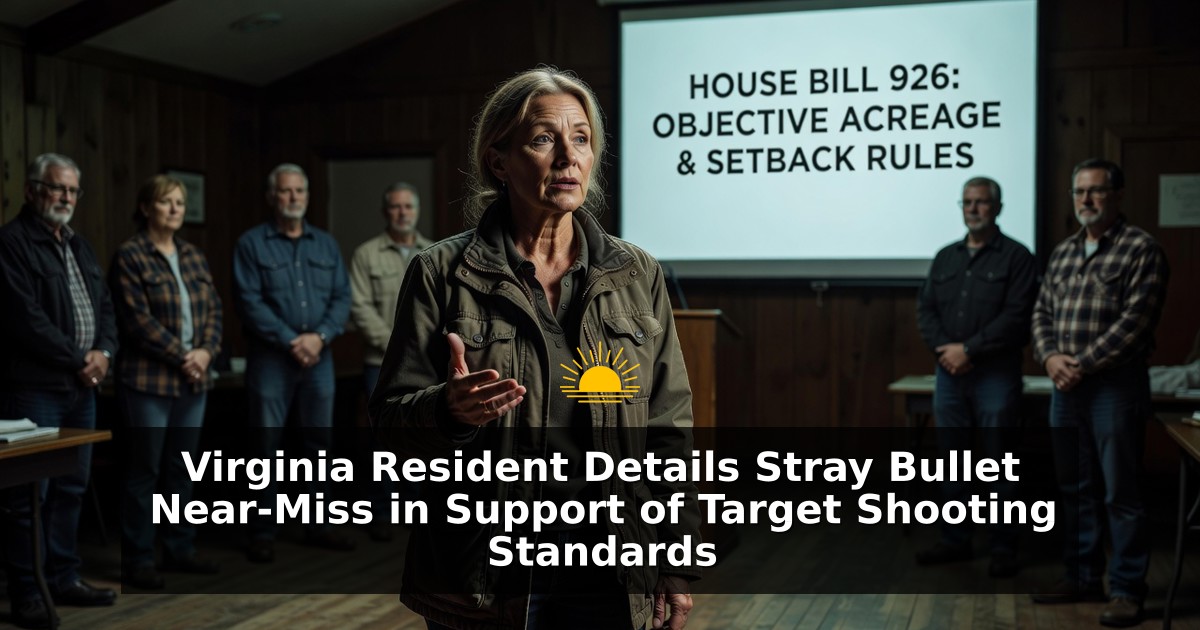
A Virginia resident described a close call involving a high-powered rifle round that traveled more than 900 yards before striking private property during testimony supporting new state legislation. The projectile pierced a truck parked in front of the family garage and came to rest roughly 30 feet from an outdoor area where children routinely play. Stephanie Fulford presented the account while speaking in favor of House Bill 926, which seeks clearer rules for recreational target shooting. She noted that similar stray rounds have arrived from multiple directions on repeated occasions. Lawmakers heard the details during a subcommittee session examining the measure.
Fulford reported contacting local police more than ten times about the ongoing problem. Existing statutes have produced no accountability for those discharging firearms in the vicinity, according to her statement. She explained that the concept of reasonable care remains undefined under current code provisions governing such activity. This lack of clarity has left families without effective recourse even after documented near-misses. The testimony underscored how reactive enforcement tools struggle to address preventable risks before injury occurs.
Incident Highlights Persistent Neighborhood Risks
The 2024 event formed part of a larger pattern of stray bullets reaching residential spaces near active shooting areas. Fulford emphasized that rounds have approached the property from varying angles over time, elevating concerns for anyone outdoors. Children playing in the yard stood only a short distance from where the spent round finally stopped. Property damage to the truck provided tangible evidence of the projectile’s path and velocity after traveling the lengthy distance. Such incidents illustrate the challenges faced by households located near informal target practice sites common in parts of Virginia.
Residents in mixed rural and developing zones often encounter overlapping land uses that place homes within potential range of discharged firearms. High-velocity rifle rounds can remain lethal or damaging far beyond typical backyard distances. Fulford’s experience demonstrates how even careful property owners cannot fully shield family members when standards for safe shooting locations remain vague. Repeated emergency calls have not altered the underlying conditions that allow projectiles to leave the intended target area. These facts formed the core of her appeal for legislative attention.
Limitations of Existing Reckless Discharge Provisions
Virginia’s current reckless discharge statutes operate primarily after an incident has already taken place. Prosecutors must establish subjective recklessness on the part of the shooter, a threshold Fulford described as difficult to meet in practice. Officers responding to complaints lack clear, measurable criteria for determining whether a given shooting location meets basic safety expectations. The absence of defined reasonable-care standards contributes to the enforcement gap she identified. As a result, families experiencing repeated stray rounds find little relief through available legal channels.
Legal observers note that reactive approaches place the burden on victims to document harm after the fact rather than preventing projectiles from leaving designated areas. Proving intent or gross deviation from accepted norms becomes especially complex when shooting occurs on private land without formal range oversight. Fulford pointed out that this framework has left her household and others without meaningful protection despite multiple official reports. The testimony framed House Bill 926 as a direct response to these documented shortcomings. Objective criteria would shift the focus toward verifiable conditions that can be assessed before rounds are fired.
House Bill 926 and Objective Safety Standards
House Bill 926 proposes to close the identified gap by incorporating measurable requirements already present in other sections of Virginia code. The measure would establish acreage thresholds and setback distances for target shooting activities. These objective, verifiable standards aim to create consistency across jurisdictions and reduce reliance on after-the-fact judgments about recklessness. Fulford stated that such clarity would help prevent avoidable harm to people and property. Supporters present the bill as a practical update rather than a broad restriction on firearm use.
Setback and minimum-land-area rules appear in various local and state provisions governing ranges, hunting, and certain discharge activities. Extending similar benchmarks to informal target practice could give both residents and shooters clearer expectations. Fulford respectfully requested that subcommittee members advance the legislation to supply needed consistency. She thanked the bill’s patron for bringing the issue forward and closed by stressing the value of preventing future near-misses. The proposal remains under consideration as lawmakers weigh public safety alongside traditional outdoor practices.
Broader Context of Firearm Discharge Rules in Virginia
Virginia maintains a combination of state statutes and local ordinances that address shooting near dwellings, roads, and occupied structures. Provisions covering reckless handling and discharge into buildings already exist, yet they often require proof of specific mental states or completed damage. Growth in residential development near formerly open land has increased the frequency of conflicts between target shooters and neighboring households. Fulford’s account aligns with periodic reports from other localities where stray rounds have prompted similar complaints. Establishing uniform acreage and distance markers could reduce ambiguity for enforcement personnel and property owners alike.
Public hearings on related measures frequently feature residents describing property strikes, livestock losses, or close calls involving family members. At the same time, many Virginians value the ability to zero rifles and practice marksmanship on private acreage. Balancing these interests has led previous General Assembly sessions to examine incremental adjustments rather than wholesale bans. House Bill 926 continues that incremental approach by importing standards already familiar within the code. Fulford’s testimony added a concrete personal dimension to the policy discussion.
Community Impact and Legislative Next Steps
Families living near active shooting areas continue to monitor outdoor spaces more cautiously after experiencing stray rounds. Children at play, outdoor workers, and even parked vehicles remain potential points of impact when projectiles travel unintended distances. Fulford’s decision to speak publicly sought to translate one household’s repeated experiences into support for clearer statewide rules. Her description of more than ten police contacts illustrated the cumulative burden placed on both residents and first responders. Lawmakers now possess a detailed firsthand record as they evaluate the bill’s language.
Subcommittee review represents an early stage in the legislative process for House Bill 926. Additional hearings, amendments, and floor consideration would follow if the measure advances. Neutral observers note that any final statute would need to define acreage and setback figures with sufficient precision to guide both compliance and enforcement. Fulford’s closing remarks centered on the twin goals of clarity and harm prevention. The record of her testimony now forms part of the public file accompanying the proposal.
Continued attention to the interaction between recreational shooting and nearby residences remains relevant as land-use patterns evolve across the Commonwealth. Documented incidents such as the 900-yard rifle round supply concrete data points for assessing whether existing tools adequately protect the public. Objective standards offer one pathway to reduce reliance on subjective post-incident determinations. Virginia residents following the bill will watch for further committee action and any refinements to the acreage and distance criteria. The personal account delivered by Stephanie Fulford keeps the human consequences of stray bullets at the center of that ongoing examination.
acreage avoidable harm Children clarity committee consistency garage House Bill 926 objective verifiable standards Patron Police reasonable care reckless discharge codes rifle round setback requirements Stephanie Fulford subjective recklessness target shooting truck Virginia Virginia code