Peter Francisco, the ‘Hercules of American independence’
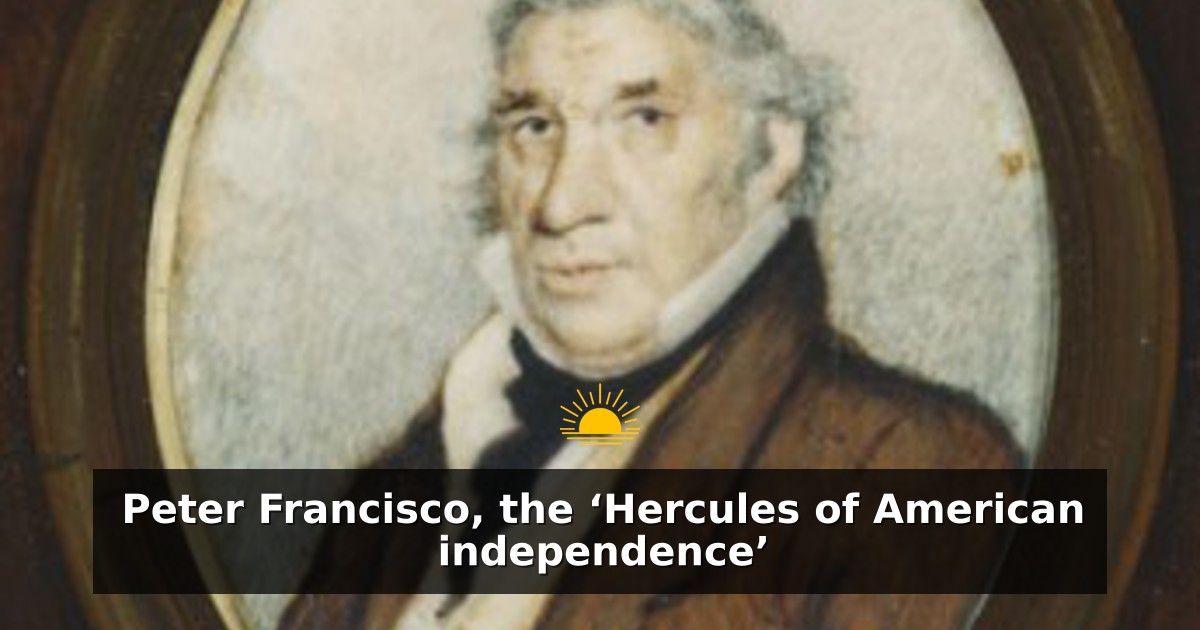
As Virginia marks the road to the 250th anniversary of the Declaration of Independence, the legend of Peter Francisco—variously called the Virginia Giant and the Hercules of American independence—offers a Revolutionary War story that is equal parts documented soldiering and frontier myth.
Cardinal News, with support from the Virginia American Revolution 250 Commission, has been retelling lesser-known Virginia independence stories across a multi-year project. Francisco’s arc fits the brief: a child of mysterious origin, extraordinary size and strength, and a combat record that made him a favorite of officers and later of nineteenth-century storytellers who rarely let facts stand in the way of a good epic.
By tradition, a strange-speaking boy of four or five appeared on a dock at City Point—later Hopewell—on the James River. Local accounts say he had been put ashore from a ship, possibly after impressment or abandonment, and that he could not at first explain his parentage in English. He grew into a young man of unusual stature in the Buckingham and Prince Edward region of central Virginia, where planter households and backcountry farms both claimed pieces of his upbringing depending on which version of the tale is told.
When the Revolution reached Virginia in earnest, Francisco enlisted and fought with Continental and militia units in the southern campaigns. Period references and later pension materials describe a soldier who excelled at the brutal close work of bayonet fights and the heavy labor of moving artillery. Stories that he hauled a cannon off a field unaided or cut down multiple opponents in a single engagement circulated widely after the war. Historians treat some of those set pieces as embellished, while still accepting that Francisco was a notably large, capable infantryman who saw hard fighting.
His name attaches especially to actions tied to the southern theater as British forces under Cornwallis pushed through the Carolinas and into Virginia. Virginia readers encounter him in local historical markers, school pageants, and museum notes more often than in national textbooks that privilege Washington, Jefferson, and Madison. That gap is part of why the 250th commemorations have room for figures like Francisco: they reconnect the independence story to counties that supplied men, food, and river transport without producing a president.
Mythmaking followed quickly. Nineteenth-century biographies and newspaper sketches leaned Homeric, describing a hero whom steel and lead could scarcely kill. Those narratives mixed verifiable service with folklore common to strongman tales worldwide. Modern researchers try to separate muster rolls, wounds, and land records from the comic-book episodes. The responsible commemorative approach holds both: celebrate a Virginia soldier of outsized reputation, and label legend as legend.
Francisco survived the war and lived into the early republic, a living souvenir of the conflict for younger Virginians who had not heard musket fire. Communities that claim him still argue over birthplace theories—Portuguese, Azorean, or other Atlantic origins appear in competing traditions—and over which county most shaped him. Genealogists and local historical societies continue to chase scraps of shipping and parish evidence. Absolute certainty about his earliest childhood remains elusive, which may be why the story endures.
For the 250th, Francisco’s value is pedagogical as much as antiquarian. He embodies the immigrant and orphan themes already present in America’s founding imagination, the physicality of eighteenth-century combat often sanitized in civic ritual, and the role of ordinary—if unusually strong—soldiers in a war won by endurance. Virginia’s commemorations can use him to bring students from Hopewell to Buckingham into the same narrative frame as Williamsburg and Yorktown.
Visitors tracing Cardinal 250 and related Commission projects will find Francisco alongside other under-taught Virginians whose lives do not fit a marble statue but who still carried the Revolution’s weight. Whether or not every cannon-lifting tale is true, the documentary core remains: a James River foundling who grew into a formidable fighter and a statewide folk hero. That is enough history to carry into 2026 without needing Homer—though the muse, as Cardinal’s writers note, would have enjoyed the material.
Amelia County Prince Edward County Richmond City Williamsburg Cardinal News Charlottesville Children Church Congress Education Farms Fire Food House of Delegates Killed Labor Land Michael President Richmond School Virginia Virginia House Virginia House of Delegates