Virginia House Bill 1372 Advances Prevailing Wage Rules for Solar Projects
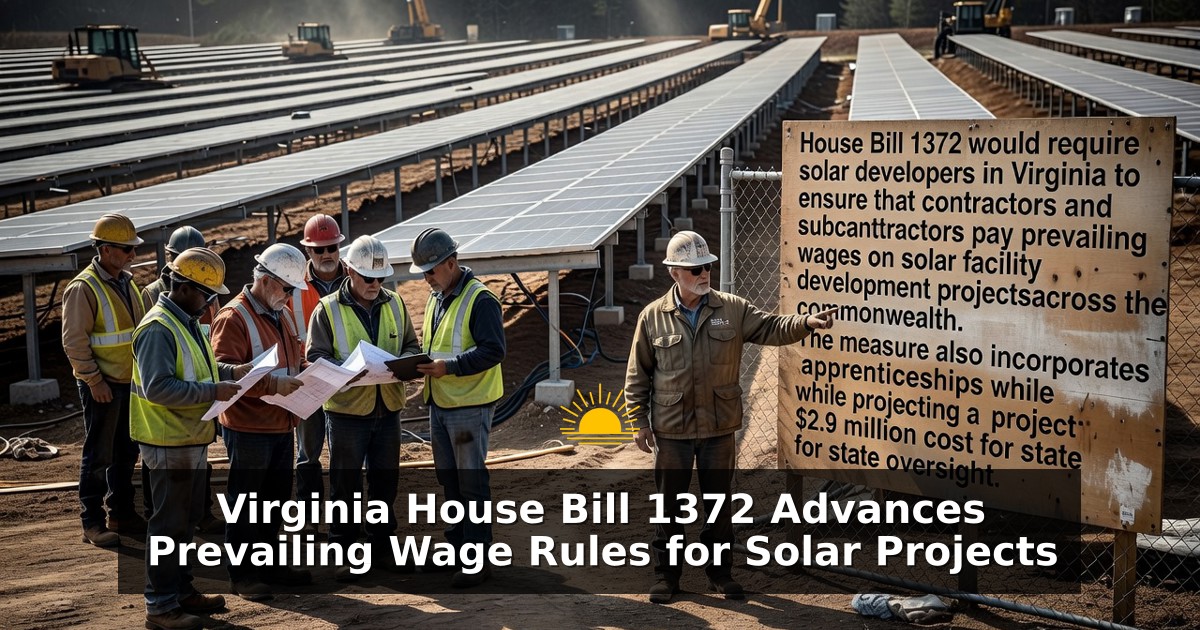
House Bill 1372 would require solar developers in Virginia to ensure that contractors and subcontractors pay prevailing wages on solar facility development projects across the commonwealth. The measure also incorporates apprenticeship requirements for any such project, aiming to standardize labor practices as the solar sector expands. Lawmakers reviewed the proposal during a recent Commerce, Agriculture and Natural Resources subcommittee session, where the core mandates were outlined in detail. Officials noted that the bill seeks to align solar construction standards with existing prevailing wage frameworks already applied to other public and large-scale private works. The discussion underscored the growing role of renewable energy installations in Virginia’s economy and workforce planning.
Prevailing wage provisions under the bill would compel payment of rates determined by the Department of Labor and Industry for similar work in the relevant locality. These rates typically reflect local market conditions for skilled trades involved in solar array construction, electrical installation, and site preparation. Supporters of the concept within the legislative record argue that consistent wage floors help attract and retain qualified workers for complex energy projects. The apprenticeship component would further require participation in registered programs, linking on-the-job training to project labor needs. Together, the two elements form the central labor standards package contained in House Bill 1372.
Fiscal Considerations for State Oversight
A public fiscal impact statement prepared for the legislation indicates that the Department of Labor and Industry would require $2.9 million from the general fund to implement and administer the new requirements. That funding would support additional staff, compliance monitoring, wage determination updates, and enforcement activities tied specifically to solar facility projects. Agency representatives signaled that existing resources are insufficient to absorb the expanded workload without dedicated appropriations. The projected cost covers both initial setup and ongoing operations necessary to verify contractor adherence. Lawmakers acknowledged the figure as a key factor in evaluating the bill’s overall viability.
The Department of Labor and Industry already maintains prevailing wage schedules and apprenticeship registration systems for other sectors. Extending those functions to solar developments would involve new data collection on project locations, contractor certifications, and payroll audits. Officials explained that accurate locality-specific wage rates must be published and periodically revised to remain current with market shifts. Apprenticeship oversight would similarly demand coordination with training providers and project sponsors to confirm enrollment and progression metrics. These administrative steps account for a substantial portion of the estimated $2.9 million general fund need.
Solar Industry Context in the Commonwealth
Virginia has experienced steady growth in utility-scale and distributed solar installations over recent years, driven by state clean energy targets and private investment. Large facility developments often involve multiple tiers of contractors and specialized trades, creating complex labor supply chains. House Bill 1372 addresses that structure by placing responsibility on developers to ensure downstream compliance with wage and training rules. The approach mirrors requirements already in place for certain public works contracts, adapting them to privately financed renewable energy sites. Industry observers note that clear labor standards can reduce disputes and improve project predictability once fully implemented.
Apprenticeship mandates included in the bill would channel workers into structured programs recognized by the state. Such programs typically combine classroom instruction with supervised field experience in electrical, construction, and related solar-specific skills. By tying project eligibility to apprenticeship utilization, the legislation seeks to expand the pipeline of trained technicians available for future installations. Workforce development agencies have long identified renewable energy as a priority sector for career pathways. The bill’s language therefore intersects with broader efforts to match training capacity to anticipated demand in the solar field.
Committee Review and Timeline
Members of the Commerce, Agriculture and Natural Resources subcommittee examined both the policy substance and the fiscal note during their deliberations. Testimony and staff presentations focused on the practical mechanics of wage enforcement and the readiness of existing apprenticeship infrastructure. No final vote advanced the measure out of committee at the session covered by the record. Instead, participants indicated that discussions would continue into the 2027 legislative cycle. This extended timeline allows additional analysis of implementation costs, potential amendments, and coordination with other energy-related bills.
Continuing the conversation into 2027 provides time for updated fiscal estimates and stakeholder input from developers, labor organizations, and local governments. The Department of Labor and Industry may refine its resource projections as more precise data on expected project volumes become available. Lawmakers can also examine how prevailing wage and apprenticeship rules interact with permitting timelines and interconnection processes already governing solar facilities. Such sequential review is common for measures that introduce new regulatory layers into rapidly evolving industries. The subcommittee’s decision to carry the bill forward reflects a deliberate pace rather than an immediate rejection or approval.
Implementation Challenges and Administrative Scope
Enforcing prevailing wages on solar projects would require clear definitions of covered work classifications and geographic wage zones. The Department of Labor and Industry would need to issue guidance distinguishing solar-specific tasks from general construction categories already on the books. Contractors and subcontractors would submit certified payroll records, triggering review processes that consume staff hours. Noncompliance findings could lead to corrective orders or other remedies outlined in existing labor statutes. Building this compliance architecture explains a significant share of the $2.9 million general fund request.
Apprenticeship tracking presents parallel administrative demands. Project sponsors would report the number of apprentices employed, their program affiliations, and hours worked toward completion. State staff would cross-check those reports against registered program databases to confirm legitimacy. Coordination with community colleges and trade organizations that host apprenticeship curricula would further expand the agency’s outreach responsibilities. These layered duties illustrate why the fiscal impact statement identifies a multi-million-dollar funding need rather than a marginal adjustment.
Broader Labor and Economic Implications
Prevailing wage requirements have historically aimed to prevent undercutting of local compensation standards on major construction sites. Applying the same principle to solar facility development extends that protection to a sector characterized by both large capital outlays and specialized technical labor. Workers in electrical and installation trades stand to benefit from wage stability, while developers gain a more predictable labor cost environment once rates are established. The apprenticeship linkage simultaneously addresses long-term skill shortages that could otherwise constrain project schedules. Balanced against these potential gains is the direct budgetary cost to the commonwealth for oversight capacity.
Virginia’s general fund allocation process will ultimately determine whether the $2.9 million materializes in future budgets. Appropriations committees typically weigh such agency requests against competing priorities in education, transportation, and public safety. The solar wage bill’s fiscal note therefore becomes part of a larger conversation about state spending capacity. If funding is approved, the Department of Labor and Industry could begin hiring and system upgrades in advance of full statutory effective dates. Absent that support, implementation would face delays or scaled-back enforcement.
Next Steps in the Legislative Process
House Bill 1372 remains under active consideration with further work scheduled beyond the current session. Stakeholders are expected to submit additional comments on wage determination methodologies and apprenticeship ratio proposals. Technical amendments may refine the definition of “solar facility development project” to clarify which installations fall under the mandate. The subcommittee’s plan to resume discussions in 2027 keeps the measure alive while allowing time for these refinements. Continued monitoring of solar deployment statistics will also inform whether the projected administrative burden aligns with actual project volume.
As the commonwealth balances renewable energy expansion with workforce standards, House Bill 1372 represents one concrete proposal to integrate the two objectives. Its prevailing wage and apprenticeship core, paired with a clearly stated $2.9 million fiscal impact, gives legislators a defined package to evaluate. The extended timeline into 2027 ensures that final decisions rest on comprehensive data rather than preliminary estimates alone. Further committee action will determine the bill’s ultimate path toward possible enactment or revision.
apprenticeship apprenticeship requirements bill chairman contractors Department Department of Labor and Industry developers development facility fiscal fund General Fund House House Bill impact Industry Labor mr chairman prevailing wage projects public fiscal Impact statement requirements solar solar developers solar facility development project solar facility development projects statement subcontractors wage