Prince William County Approves $21 Million Affordable Housing Investment in FY2027 Budget
Budget Approval and Housing Focus
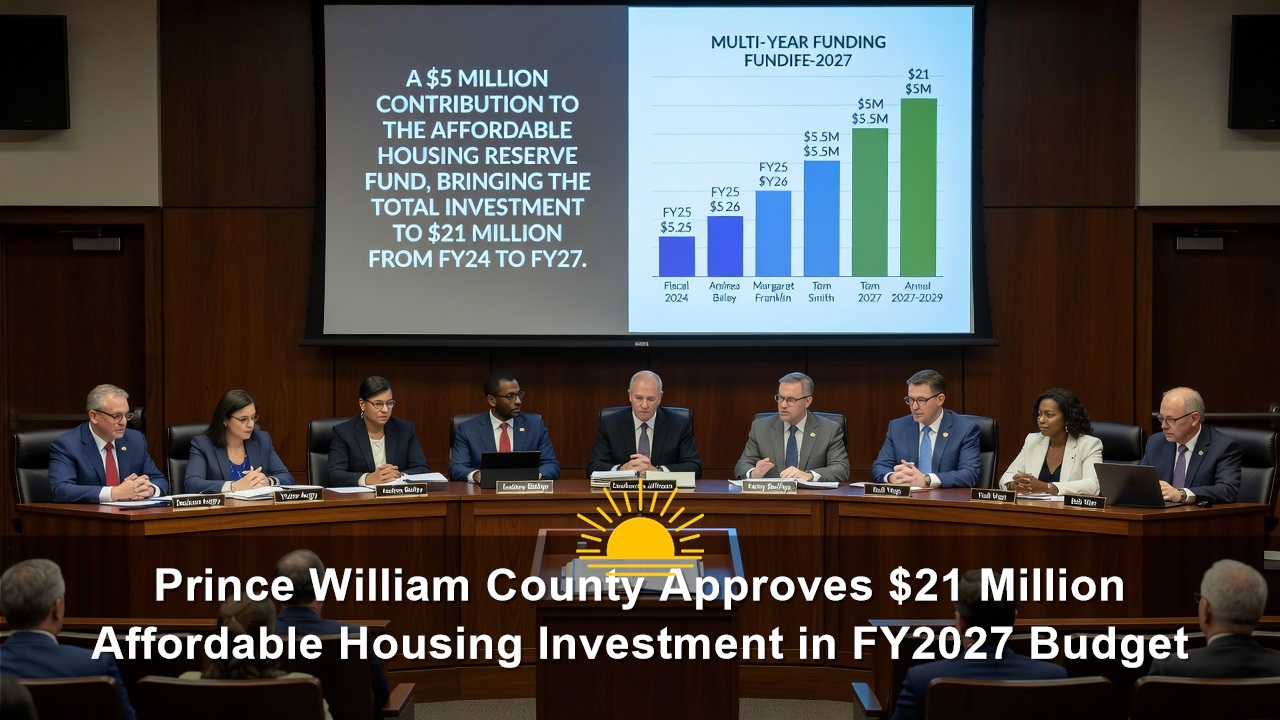
The Prince William County Board of County Supervisors recently approved a comprehensive municipal budget that includes a significant $5 million contribution to the local affordable housing reserve fund. This latest financial commitment brings the total county investment in affordable housing initiatives to $21 million spanning from fiscal year 2024 through fiscal year 2027. Local officials finalized this measure as part of the broader fiscal year 2027 budget, aiming to address growing housing accessibility challenges throughout the region. The decision marks a continued, multi-year effort by the local government to provide sustainable living options for residents facing rising economic pressures and a highly competitive real estate market.
Leadership and Deliberation
The current Prince William County Board of County Supervisors includes Chair Deshundra Jefferson, Victor Angry, Andrea Bailey, Kenny Boddye, Margaret Franklin, Tom Smith, Yesli Vega, and Bob Weir. These elected officials deliberated extensively over the complex budgetary allocations before reaching a consensus on the housing investments and other vital community priorities. Their public discussions centered on balancing the immediate needs of the community with long-term financial sustainability and the ongoing management of residential tax burdens. Ultimately, the board structured a forward-looking financial plan that reallocates municipal revenue streams to support both residential tax relief and critical community development projects.
Expanding Affordable Housing Initiatives:** The newly approved budget establishes a dedicated affordable housing office housed within the existing Office of Housing and Community Development. This structural administrative change is supported by direct allocations of $5.5 million in both fiscal years 2025 and 2026, followed by an ongoing commitment of $5 million annually from 2027 through 2029. By institutionalizing this specialized office, the county administration aims to streamline the development, funding, and preservation of affordable housing units across the community. The cumulative $21 million investment since 2024 represents one of the most substantial and targeted housing efforts in recent county history.
Negotiating Community Needs
Occoquan District Supervisor Kenny Boddye highlighted the difficult and nuanced negotiation process that ultimately led to the final budget approval. He noted that earlier versions of the fiscal plan fell significantly short of meeting community needs, particularly regarding educational funding and the expansion of essential public services. Following days of intense deliberation, markups, and active public engagement, the board successfully crafted a revised proposal that delivered more comprehensive support for local residents. Boddye publicly acknowledged that while the final budget document is not perfect, it represents meaningful and necessary progress for the people of Prince William County.
Residential Tax Relief
To fund these major community investments while simultaneously providing financial relief to homeowners, the board implemented strategic changes to local property tax rates. The real estate tax rate will see a noticeable reduction from its previous level of $0.906 to exactly $0.865 per $100 of assessed property value. This specific rate adjustment is projected to decrease the average residential property tax bill by $56 for local homeowners. The deliberate reduction is intended to ease the financial burden on residents amid broader national economic fluctuations and steadily rising local living costs.
Shifting the Tax Burden
To efficiently offset the municipal revenue lost from the residential real estate tax reduction, the county increased the specific tax rate levied on computer equipment and peripherals. This targeted commercial tax rate was raised from $4.15 to $4.50 per $100 of assessed valuation. The adjustment is explicitly designed to shift a larger portion of the overall county tax burden away from individual residents and onto the rapidly expanding data center industry. Prince William County has recently become a major global hub for data centers, making this equipment tax a highly lucrative source of sustainable municipal revenue.
Historic Educational Investments
Beyond housing initiatives and property tax adjustments, the fiscal year 2027 budget includes a massive transfer of operational funds to Prince William County Public Schools. The local public school system will receive $1.1 billion in funding, representing a 12.5 percent overall increase compared to the previous fiscal year. This historic funding boost equates to an additional $123.5 million directly added to the educational budget when compared to the fiscal year 2026 allocation. The substantial educational investment directly addresses the vocal concerns raised by board members and community residents regarding the absolute necessity of adequately supporting local students and teachers.
Funding Public Services
The approved budget also directs significant capital toward other essential municipal departments and vital public services that impact daily life. The Parks and Recreation department will benefit from a dedicated $20 million increase in capital investment to enhance local recreational facilities and preserve green spaces. Additional funding streams have been securely allocated for the Fire and Rescue department to maintain and upgrade emergency response capabilities across the rapidly growing county. Furthermore, the regional OmniRide transit system received crucial budgetary support to ensure continued, reliable public transportation access for daily commuters and local travelers.
Long-Term Community Impact
The comprehensive nature of the fiscal year 2027 budget reflects a multifaceted approach to local governance and long-term community planning. By prioritizing affordable housing, public education, and municipal infrastructure, the board has outlined a clear and actionable vision for the future development of the region. The strategic shift in commercial taxation demonstrates a political willingness to leverage commercial industry growth to directly subsidize residential tax relief. As these complex financial policies take effect over the coming years, county administrators will closely monitor their tangible impact on community well-being, housing availability, and overall economic stability.
Email the Prince William School Board at:
Babur B. Lateef, M.D. (Chairman At-Large) — blateef@pwcs.edu,
Richard M. Jessie (Vice Chairman, Occoquan District) — rjessie@pwcs.edu,
Erica C. Tredinnick (Brentsville District) — etredinnick@pwcs.edu,
Lisa A. Zargarpur (Coles District) — lzargarpur@pwcs.edu,
Jennifer T. Wall (Gainesville District) — jwall@pwcs.edu,
Tracy L. Blake (Neabsco District) — tblake@pwcs.edu,
Justin David Wilk (Potomac District) — jwilk@pwcs.edu,
Loree Y. Williams (Woodbridge District) — lwilliams@pwcs.edu,
Email the Prince William Board of Supervisors At:
Chair At-Large (Deshundra Jefferson) – djefferson@pwcgov.org,
Brentsville (Tom Gordy): tgordy@pwcgov.org,
Coles (Yesli Vega): yvega@pwcgov.org,
Occoquan (Kenny Boddye): kboddye@pwcgov.org,
Potomac (Andrea Bailey): abailey@pwcgov.org,
Woodbridge (Jeannie LaCroix): jlacroix@pwcgov.org,
General Board: bocs@pwcgov.org,
Prince William County Andrea Bailey Babur Lateef Bob Weir Budget Data Data Center Data Centers Deshundra Jefferson Education Erica Tredinnick Fire Housing Jeannie LaCroix Jennifer Wall Justin Wilk Kenny Boddye Lisa Zargarpur Loree Williams Margaret Franklin Prince William Prince William County School Board Public School Public Schools Richard Jessie School Schools Teachers Tom Gordy Tracy Blake Transportation Victor Angry Yesli Vega