Prince William Supervisors Unanimously Block $300M Vint Hill Switching Station
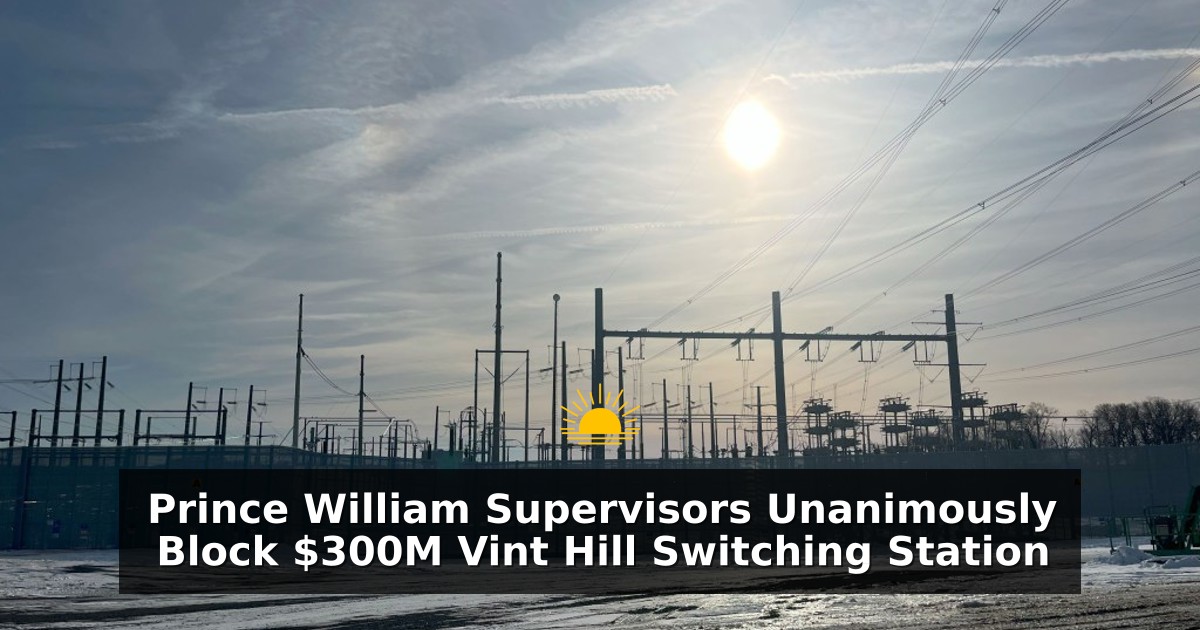
Prince William County supervisors on Tuesday unanimously rejected a Dominion Energy proposal for a roughly $300 million electrical switching station upgrade along Vint Hill Road, dealing a rare public defeat to a utility project framed as essential for keeping the Northern Virginia power grid ahead of soaring data-center demand.
The special use permit would have allowed Dominion to expand switching and substation capacity near Reid Lane, in a corridor where high-voltage transmission lines already converge and where thousands of new homes have been approved. Supervisors said residents and board members alike lacked a clear, credible explanation of which loads the station would primarily serve, and whether the true driver was neighborhood growth or another wave of hyperscale computing campuses north toward Gainesville.
Dozens of speakers from Braemar and nearby communities packed the hearing. Neighbors described a landscape already strained by construction traffic, noise, and the visual bulk of transmission infrastructure. They argued that placing a major utility compound across from established neighborhoods and amid newly entitled housing was incompatible with the county’s planning promises, and that Dominion’s public materials understated the project’s connection to data-center power needs.
Dominion’s Steve Precker, manager of electric transmission communications, told the board that load growth is exponential and that data centers are a primary driver. “The grid is under stress. Period,” he said, according to local reporting. Utility representatives cast the Vint Hill work as part of a broader transmission strategy meant to keep lights on for homes and businesses while serving industrial customers that consume electricity at a scale few localities planned for a decade ago.
Supervisors were unconvinced. Multiple members cited a transparency gap: Dominion would not specify which data centers would receive the additional power, even as county residents and planners tried to map the project against known campus proposals. That uncertainty, combined with the station’s proximity to roughly 3,000 homes planned along the Vint Hill corridor, drove a unanimous no vote that cut across typical political fault lines on land use.
The fight sits inside a larger Northern Virginia story. Loudoun, Prince William, and Fairfax have become the epicenter of U.S. data-center construction, drawing tax revenue and construction jobs while raising hard questions about electricity, water, diesel backup generation, and ratepayer exposure. Transmission upgrades that look technical on paper often become political flashpoints when neighbors realize the substations and switching yards are the visible edge of an industrial power system.
For Prince William, the Vint Hill denial also tests how far local zoning authority can shape regional energy infrastructure. Utilities argue that the State Corporation Commission and federal reliability rules constrain how much a county board can block needed grid work. Local governments counter that special use permits exist precisely so communities can reject projects that are poorly sited or inadequately disclosed.
Residents who opposed the permit said they were not anti-electricity; they wanted Dominion to prove the upgrade was sized and located for the loads the county had actually planned. Several speakers urged the utility to publish clearer load forecasts, identify customer classes, and explore alternatives farther from residential clusters. Others linked the proposal to a pattern in which data-center power needs arrive first in closed-door site plans and only later as public infrastructure fights.
County staff and supervisors also weighed visual and safety impacts along Vint Hill Road, where transmission corridors already dominate the skyline. The proposed station sat near Reid Lane at a convergence of high-voltage lines Dominion said were under stress. Opponents worried about property values, construction disruption, and the precedent of approving a $300 million industrial node without naming the end users.
Dominion can still pursue other regulatory avenues, redesign the project, or return with a revised application. Whether the company chooses negotiation, appeal, or a new site will shape how quickly additional capacity reaches Gainesville-area loads. In the meantime, the unanimous vote sends a signal that Prince William expects specificity when utilities ask for major footprints next to homes.
Statewide, Governor Abigail Spanberger’s recent data-center accountability package and related NDA debates have sharpened public attention on how localities review power-hungry campuses. The Vint Hill decision is local zoning, not a General Assembly bill, but it echoes the same transparency theme: communities want to know who is using the power, who pays for the wires, and what tradeoffs they are being asked to accept.
All Virginia News will continue to follow Dominion filings, any Prince William reconsideration, and the regional transmission projects that determine whether Northern Virginia’s housing boom and computing boom can share the same grid without leaving neighborhoods in the dark—or under new steel towers they never voted to host.
Email the Prince William Board of Supervisors At:
Chair At-Large (Deshundra Jefferson) – djefferson@pwcgov.org,
Brentsville (Tom Gordy): tgordy@pwcgov.org,
Coles (Yesli Vega): yvega@pwcgov.org,
Occoquan (Kenny Boddye): kboddye@pwcgov.org,
Potomac (Andrea Bailey): abailey@pwcgov.org,
Woodbridge (Jeannie LaCroix): jlacroix@pwcgov.org,
General Board: bocs@pwcgov.org,
Email the Prince William School Board at:
Babur B. Lateef, M.D. (Chairman At-Large) — blateef@pwcs.edu,
Richard M. Jessie (Vice Chairman, Occoquan District) — rjessie@pwcs.edu,
Erica C. Tredinnick (Brentsville District) — etredinnick@pwcs.edu,
Lisa A. Zargarpur (Coles District) — lzargarpur@pwcs.edu,
Jennifer T. Wall (Gainesville District) — jwall@pwcs.edu,
Tracy L. Blake (Neabsco District) — tblake@pwcs.edu,
Justin David Wilk (Potomac District) — jwilk@pwcs.edu,
Loree Y. Williams (Woodbridge District) — lwilliams@pwcs.edu,
Prince William County Abigail Spanberger Andrea Bailey Babur Lateef Data Data Centers Deshundra Jefferson Dominion Electric Electrical Electricity Energy Erica Tredinnick Fairfax Governor Grid Housing Jeannie LaCroix Jennifer Wall Jobs Justin Wilk Kenny Boddye Land Landscape Lisa Zargarpur Loree Williams Northern Virginia Power Prince William Prince William County School Board Richard Jessie State Corporation Commission Tom Gordy Tracy Blake Traffic Virginia Water Yesli Vega