Prince William Votes 8-0 to End By-Right Data Center Development Countywide
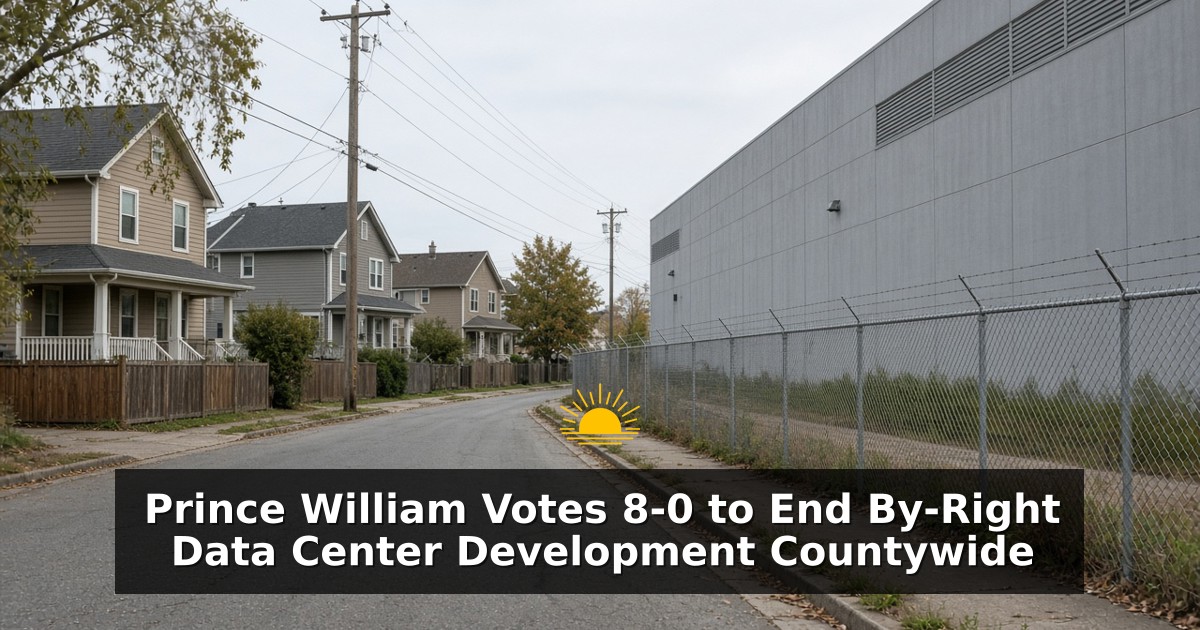
Prince William County supervisors on Tuesday voted 8-0 to end by-right data-center development countywide, approving a zoning text amendment that forces future projects through a special-use permit process. WTOP, republishing InsideNoVa, reported that the board accepted a 90-day grace period originally pushed by Brentsville Supervisor Tom Gordy after a tense afternoon that included an unusual mid-hearing closed session.
By-right zoning inside the data-center overlay historically allowed qualifying projects to proceed without a discretionary board vote. Ending that pathway shrinks the overlay’s practical reach from the form adopted in May 2016 and restores political accountability: every new proposal lands on the dais where residents can speak and supervisors must go on the record.
Chair Deshundra Jefferson called a closed session for legal guidance before the final tally, later telling InsideNoVa it was a tough vote and that she was glad the board reached a compromise on the grace period even though some members wanted it shorter or longer. She said she did not want a 4-4 deadlock or another delay.
Gainesville Supervisor George Stewart sought a substitute for a zero-day grace period, warning of a “gold rush” of applications during any window. That substitute failed 3-5, with Jefferson, Yesli Vega, Andrea Bailey, Victor Angry, and Jeannie LaCroix opposed. Gordy and Occoquan Supervisor Kenny Boddye joined Stewart in supporting zero days. The majority’s 90-day bridge is therefore a political settlement, not a technical optimum.
Planning Director Tanya Washington told the board that residential and school setback questions are not yet written into the zoning text. Staff are aiming for a November Planning Commission hearing on setbacks and a board hearing in January. That sequencing means Tuesday’s vote closes the by-right door while leaving buffer distances—often the hottest neighborhood issue—for a second fight.
The Planning Commission itself had struggled on Sept. 9 between pairs of options (180 days with a 500-foot buffer versus zero days with 2,500 feet) before Commissioner Raheel Sheikh switched to support a compromise at 120 days and 500 feet, sending a recommendation forward on a 5-3 vote. The board’s eventual 90-day grace period diverged from that 120-day commission figure, underscoring that elected supervisors—not appointees—set the final risk tolerance for a pre-deadline surge.
For the industry, the message is clear. Projects already built, under construction, or past a defined site-plan quality-control threshold remain in the overlay under Gordy’s March directive, but speculative by-right pursuits are over. Developers who want new campuses must persuade eight supervisors in public. That raises soft costs and timeline risk, which may push some proposals west or south into localities still offering clearer by-right paths.
For residents who packed hearings about noise, water, and transmission, the special-use requirement is a procedural win even before setbacks are adopted. It does not deny any particular campus; it guarantees a public veto point. Combined with separate infrastructure controversies elsewhere in the county, the amendment signals that Prince William’s political center of gravity has shifted from recruitment-at-all-costs toward conditional growth.
Regional spillover is inevitable. Fairfax, Loudoun, Fauquier, and Culpeper planners will watch whether Prince William’s SUP mandate redirects site selectors across county lines. Dominion Energy’s load forecasts may also shift if large projects slip. The grace period itself will be scrutinized: civic groups will catalog every application filed before the window closes, looking for evidence of the gold rush Stewart predicted.
Tuesday’s unanimity matters. An 8-0 final vote after a failed zero-day substitute shows a board that argued hard about transition rules yet agreed on the destination—no more by-right data centers. Jefferson’s closed session, whatever its confidential legal content, did not fracture the coalition on the underlying policy.
The next milestones are on the calendar: track applications filed during the 90 days, show up for the November setback hearing, and watch January’s board session write distance standards into code. Ending by-right development is the structural change. Buffers and conditions will decide how dense and how close the next wave of servers can get to Prince William neighborhoods.
Email the Prince William Board of Supervisors At:
Chair At-Large (Deshundra Jefferson) – djefferson@pwcgov.org,
Brentsville (Tom Gordy): tgordy@pwcgov.org,
Coles (Yesli Vega): yvega@pwcgov.org,
Occoquan (Kenny Boddye): kboddye@pwcgov.org,
Potomac (Andrea Bailey): abailey@pwcgov.org,
Woodbridge (Jeannie LaCroix): jlacroix@pwcgov.org,
General Board: bocs@pwcgov.org,
Email the Prince William School Board at:
Babur B. Lateef, M.D. (Chairman At-Large) — blateef@pwcs.edu,
Richard M. Jessie (Vice Chairman, Occoquan District) — rjessie@pwcs.edu,
Erica C. Tredinnick (Brentsville District) — etredinnick@pwcs.edu,
Lisa A. Zargarpur (Coles District) — lzargarpur@pwcs.edu,
Jennifer T. Wall (Gainesville District) — jwall@pwcs.edu,
Tracy L. Blake (Neabsco District) — tblake@pwcs.edu,
Justin David Wilk (Potomac District) — jwilk@pwcs.edu,
Loree Y. Williams (Woodbridge District) — lwilliams@pwcs.edu,
Prince William County Amendment Andrea Bailey Babur Lateef Data Data Center Data Centers Deshundra Jefferson Dominion Energy Erica Tredinnick Fairfax Jeannie LaCroix Jennifer Wall Justin Wilk Kenny Boddye Lisa Zargarpur Loree Williams Policy Prince William Prince William County School Board Richard Jessie School Tom Gordy Tracy Blake Victor Angry Virginia Water Yesli Vega