Loudoun Board Member Proposes Moving Summer School Before Fall Term
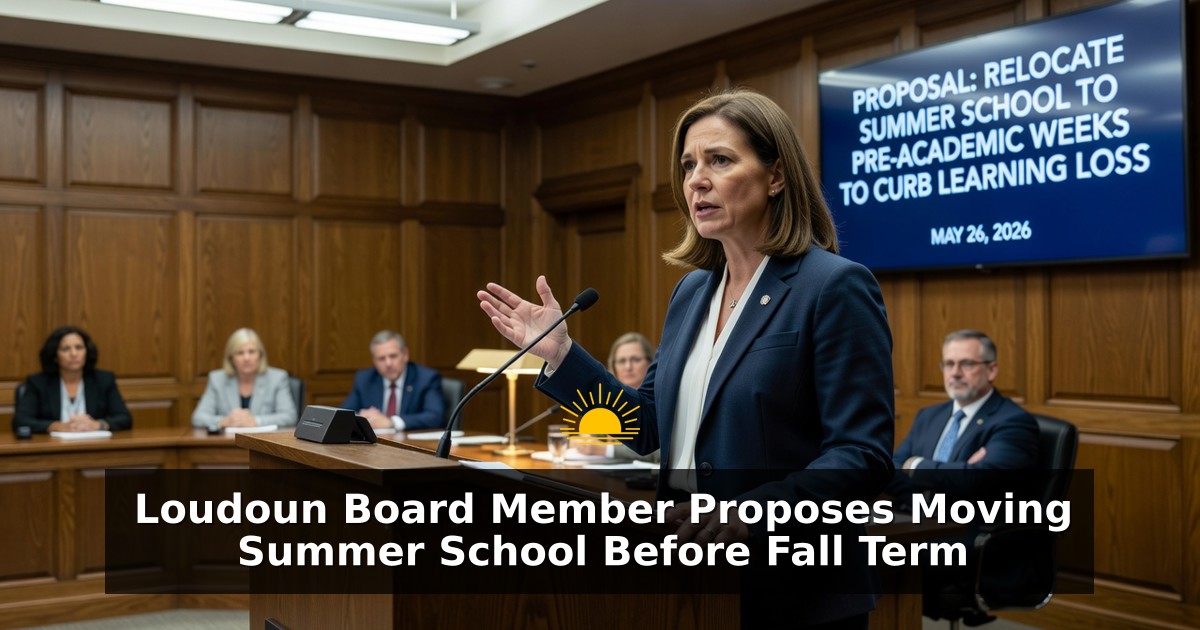
Loudoun County School Board member Kari LaBell presented a proposal during the board’s May 26, 2026, meeting to change the timing of summer school. She noted that students commonly forget large amounts of academic material over the extended summer break and experience what educators call backsliding. LaBell recommended shifting summer school from the period immediately after the regular school year ends to the weeks directly preceding the start of the new school year. The goal, she explained, is to help students recover lost ground and arrive on the first day better prepared for instruction.
The Loudoun County School Board governs public education for the county’s students and is composed of nine elected members. Current board members are Anne Donohue of the Algonkian District, Melinda Mansfield of the Blue Ridge District, April Chandler of the Broad Run District, Kari LaBell of the Catoctin District, Lauren Shernoff of the Dulles District, Beth Barts of the Leesburg District, Sumera Rashid of the Little River District, Arben Istrefi of the Sterling District, and Mandi Rodriguez in the at-large seat. These officials regularly review calendar policies, instructional programs, and student support services. LaBell’s remarks formed part of a larger conversation about how the academic calendar affects learning continuity.
## Addressing Documented Summer Learning Loss
Education researchers have long documented the phenomenon known as summer learning loss or the summer slide. Studies indicate that many students lose a portion of the gains made during the school year, particularly in mathematics and reading, when instruction pauses for two or more months. The effect tends to be more pronounced among students who lack access to enrichment activities or structured learning opportunities during the break. LaBell referenced this pattern when she observed that children often shut down mentally once the regular term concludes and turn their attention to vacations, camps, or time with friends.
Traditional summer school schedules place remedial or enrichment classes in the weeks right after dismissal in June. Attendance can suffer because students and families have already shifted into summer mode. By contrast, a session held in the final weeks of summer could function as a bridge program that reactivates academic habits just before classrooms reopen. LaBell suggested that such timing might improve both participation rates and the immediate usefulness of the material covered. She emphasized that the idea would require careful study and would not affect the upcoming summer session.
## Practical Considerations for Calendar Adjustments
Any change to summer school timing would involve coordination among school administrators, transportation staff, facility managers, and families. Staff contracts, building availability, and bus routes are typically planned around the existing post-year window. Moving the program would also require clear communication so parents can adjust childcare and vacation plans. Board members would need data on current summer school enrollment, completion rates, and subsequent academic performance to evaluate whether a pre-year model offers measurable advantages.
National research provides additional context for the discussion. Organizations that study seasonal learning patterns have found that short, focused programs offered close to the start of school can reinforce key skills and reduce the need for extensive review in September. Some districts elsewhere have experimented with “jump-start” or bridge academies that combine academics with orientation activities. Loudoun County officials would likely examine those examples, along with local pilot possibilities, before making any formal recommendation. LaBell asked colleagues only to give the concept further thought and to consider it for possible later discussion.
## Student Readiness and Instructional Continuity
Teachers frequently report spending the opening weeks of each school year reteaching material that students have forgotten. A summer program positioned immediately before opening day could lessen that review burden and allow new content to begin sooner. Students who struggle with specific subjects might enter the year with renewed confidence rather than facing an early deficit. Families seeking academic support would still have access to services, yet the services would align more closely with the moment when those skills are about to be needed again.
The proposal also intersects with broader calendar conversations that school boards across Virginia periodically undertake. Questions about the length of the school year, the placement of breaks, and the design of supplemental instruction all influence how much knowledge students retain. Loudoun County’s size and diversity mean that any schedule change must account for varied family needs, employment patterns, and community expectations. Board members routinely weigh these factors when updating policies that affect tens of thousands of learners.
## Next Steps and Ongoing Review
LaBell made clear that the suggestion is exploratory and not intended for implementation in the immediate summer term. She invited the full board to reflect on the concept and to determine whether a more detailed examination is warranted at a future meeting. Staff could be asked to compile attendance statistics, academic outcome data, and logistical assessments if the board decides to advance the idea. Public input from parents, teachers, and students would form an essential part of any subsequent review process.
Summer learning loss remains a persistent challenge for school systems nationwide, and local leaders continue to seek practical responses. By raising the timing question, LaBell added one more option to the set of strategies under consideration in Loudoun County. The board’s eventual decisions will rest on evidence, operational feasibility, and the shared objective of keeping students on track academically from one year to the next. Further discussion will clarify whether relocating summer school can deliver the readiness benefits outlined during the May meeting.
attend backslide beaches board camp discuss first day of school friends information Kids problem program readiness school calendars school ends school starts Students summer summer school thought timing vacations