Virginia Lawmakers Consider Expanded Privacy Shields for Hate Crime Victims
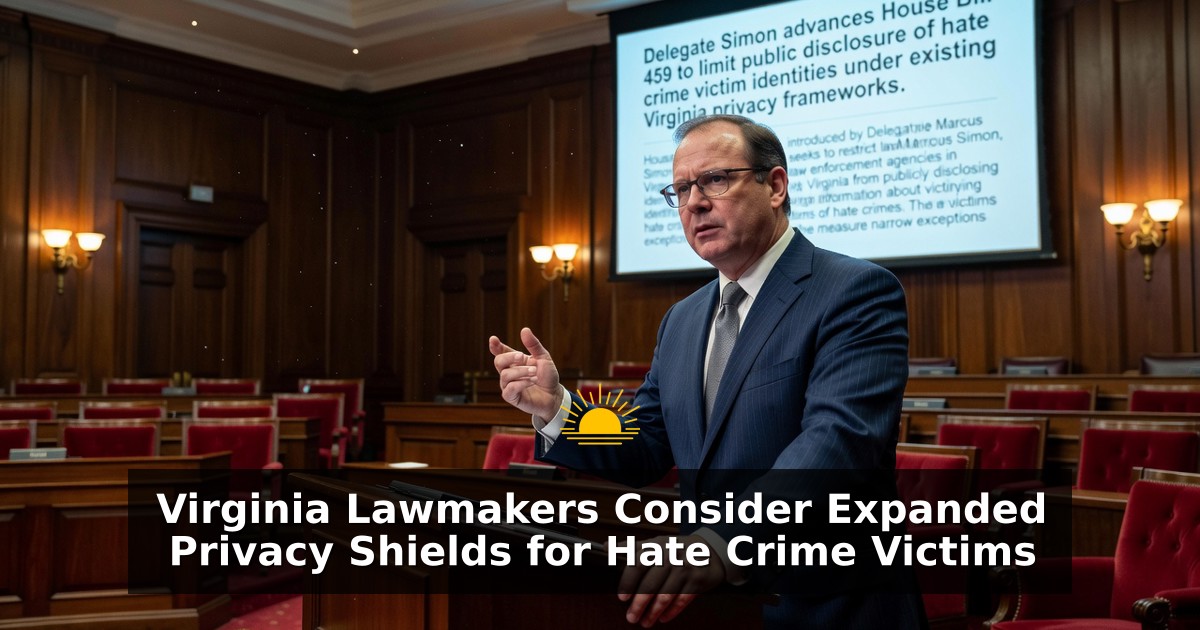
House Bill 459, introduced by Delegate Marcus Simon, seeks to restrict law enforcement agencies in Virginia from publicly disclosing identifying information about victims of hate crimes. The measure outlines narrow exceptions that would still allow release of the crime location, information required by other statutes, details needed for investigative purposes, or disclosures authorized by a court upon a finding of good cause. Supporters frame the proposal as a direct extension of longstanding Virginia statutes that already bar release of names and personal data for victims of sexual assault, sexual abuse, and family abuse offenses. Lawmakers and advocates note that the bill arrives amid ongoing discussions about barriers that keep many hate crime incidents from ever reaching official records.
Existing Virginia code already carves out strong confidentiality rules for certain categories of crime victims to reduce the risk of further harm. Those rules prevent routine public release of names through freedom-of-information channels or press statements unless specific legal thresholds are met. House Bill 459 would place victims of hate crimes into the same protected class, treating bias-motivated offenses with comparable seriousness. Officials familiar with the draft language emphasize that the change would not impede legitimate investigations or court proceedings. Instead, it would simply close a gap that currently leaves hate crime victims more exposed than victims of other sensitive offenses.
National and state data consistently show that only about one-third of hate crimes are ever reported to police. Victims frequently cite concerns that public identification could reveal private aspects of their lives, including sexual orientation, ethnicity, religion, or national origin, to employers, coworkers, or neighbors. Many also fear secondary victimization, in which the original bias-motivated attack is followed by additional harassment once their identity becomes widely known. These dynamics create a cycle in which underreporting leaves communities without accurate statistics and without the full range of protective services that flow from official documentation.
The legislation draws direct inspiration from research conducted by a high school student in Virginia Beach who examined local reporting patterns and victim reluctance. That student work highlighted how fear of exposure discourages individuals from coming forward even when physical or property damage has occurred. Delegate Simon has referenced the findings in public remarks as evidence that statutory privacy protections can encourage greater cooperation with law enforcement. By aligning hate crime victim treatment with existing sexual and family abuse safeguards, the bill aims to lower those barriers without altering the underlying definitions of hate crimes themselves.
Under the proposed framework, law enforcement would retain clear authority to share necessary information among agencies and with prosecutors. Courts would retain discretion to permit broader disclosure when a compelling reason is demonstrated. The site of an offense could still be identified so that communities remain informed about patterns of activity in specific neighborhoods. These calibrated exceptions are intended to balance victim privacy against the public’s legitimate interest in understanding crime trends and the operational needs of police departments across the commonwealth.
Virginia’s current hate crime statutes already enhance penalties when offenses are motivated by bias against protected characteristics. Adding identity protections would complement those penalty enhancements by addressing the reporting stage rather than solely the sentencing stage. Criminal justice researchers have long observed that accurate data collection depends on victims feeling secure enough to engage with the system. House Bill 459 therefore positions confidentiality as a practical tool for improving both individual safety and the quality of statewide crime statistics.
Local governments and police chiefs would need to update internal policies and training materials if the bill advances through committee and reaches the House floor. Records custodians who respond to freedom-of-information requests would apply the new exemption in the same manner they already apply exemptions for sexual assault and family abuse cases. Consistency across victim categories is expected to simplify rather than complicate administrative practice once personnel receive clear guidance. Fiscal impact statements prepared for similar privacy measures in prior sessions have generally shown minimal direct cost to localities.
Community organizations that serve populations frequently targeted by bias-motivated incidents have monitored the bill’s introduction with interest. They point to the documented reluctance of many victims to report and argue that statutory anonymity can reduce that reluctance. At the same time, open-government advocates stress the importance of retaining the listed exceptions so that transparency is not wholly sacrificed. The text of House Bill 459 attempts to navigate that tension by enumerating precise circumstances under which limited information may still enter the public domain.
As the measure moves into subcommittee review, legislators will examine how the language interacts with Virginia’s Freedom of Information Act and with existing victim-notification protocols. Testimony is expected to include perspectives from prosecutors, defense counsel, victim-witness staff, and civil rights groups. The high school research that helped prompt the bill may also be referenced as an example of student civic engagement informing legislative priorities. Whatever the ultimate fate of the proposal, its introduction has already focused attention on the gap between the number of hate crimes that occur and the number that appear in official tallies.
Delegate Simon’s office has described the bill as a straightforward parity measure rather than a sweeping rewrite of criminal procedure. By grafting hate crime victims onto an established privacy regime, the legislation avoids creating an entirely new administrative apparatus. Supporters contend this approach increases the likelihood of passage while still delivering meaningful protection. Critics, if any emerge during hearings, are likely to focus on whether the good-cause court exception is sufficiently flexible or whether additional reporting requirements should accompany the new confidentiality rules.
The broader context includes continued state-level efforts to track bias incidents more accurately and to ensure that victims receive culturally competent support services. Privacy protections form one component of that larger strategy. When victims trust that their personal details will not be broadcast, they become more willing to supply the statements and evidence that enable successful prosecutions. House Bill 459 therefore links an individual safeguard to the collective goal of safer public spaces across Virginia’s cities and counties.
In practical terms, a victim of a bias-motivated assault or vandalism would gain the same default anonymity already afforded to survivors of sexual violence. Media outlets and members of the public seeking records would encounter the same statutory barriers that currently apply in those other cases. Law enforcement could still release general descriptions of an incident and its location to alert residents or seek witnesses. The net effect, according to the bill’s proponents, would be greater dignity for victims without sacrificing investigative effectiveness or community awareness.
Observers note that similar privacy expansions in other states have correlated with modest increases in reporting rates over time. Whether Virginia would experience the same pattern remains an empirical question that can be answered only after implementation and subsequent data collection. For now, the General Assembly has before it a concrete proposal grounded in both existing state law and documented underreporting statistics. The coming weeks of committee scrutiny will determine whether House Bill 459 advances toward a floor vote and potential enactment.
confidentiality court co-worker crime site disclosure employer ethnicity family abuse hate crime House Bill identity Law Enforcement law enforcement purposes national origin public information second victimization sexual abuse Sexual Assault sexuality victims Virginia Virginia law