Virginia Advances House Bill 131 for Campus Religious Accommodations
Updated
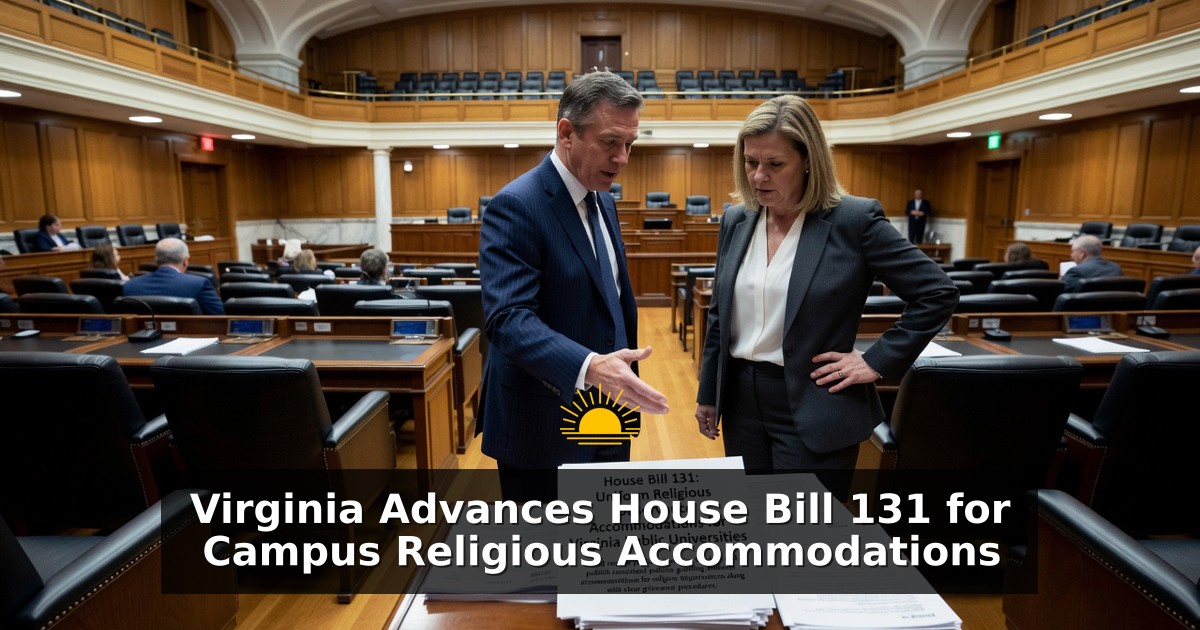
House Bill 131 under consideration in the Virginia General Assembly would establish uniform requirements for public universities to accommodate students who miss academic obligations due to religious observances. The measure directs institutions to create consistent policies, publish them in both student and faculty handbooks, and maintain formal grievance procedures for students who believe they have faced discrimination. Lawmakers described the legislation as a response to documented cases in which students suffered academic penalties after observing major religious holidays. Supporters framed the bill as a step toward educational equity that protects the rights of students of all faiths while giving faculty clear guidance.
The legislation draws directly from the experience of Kira Schneiderman, a former Virginia Tech student body president who testified before lawmakers. Schneiderman, an active and high-achieving student, received a lowered grade in a public speaking course after she was absent on Yom Kippur to observe the Jewish holy day. Her professor declined to offer any accommodation for the missed presentation date, resulting in an academic penalty that affected her final grade. That episode illustrated how the absence of clear, published rules can leave individual instructors free to deny relief even when a student follows a sincerely held religious practice.
Background of the Student Experience
Schneiderman later appeared before a House subcommittee to recount the incident and to urge consistent statewide standards. She had already demonstrated leadership on campus and had testified on other higher-education matters, giving her account particular weight with legislators. The case highlighted a gap between general statements of nondiscrimination and the day-to-day decisions made inside individual classrooms. Without written policies and an accessible appeal path, students risk absorbing grade reductions simply for observing holidays that fall on scheduled class or exam days.
Yom Kippur, the Day of Atonement in Judaism, requires fasting and attendance at religious services and is widely recognized as one of the most significant observances in the Jewish calendar. Similar scheduling conflicts arise for students observing Eid, Diwali, Good Friday, or other faith-based holy days that do not align with the academic calendar. House Bill 131 seeks to address these recurring conflicts by removing ambiguity and placing responsibility on institutions rather than on individual faculty members who may lack guidance.
Core Requirements of the Proposed Law
Under the bill, every public university in Virginia would be required to adopt a written policy explaining how religious absences will be handled. That policy must appear in the official student handbook and in the faculty handbook so that both groups operate from the same set of expectations. Institutions must also establish a grievance procedure that allows a student to challenge a denial of accommodation and to seek correction when a published rule is not followed. The combination of transparency and an enforcement mechanism is intended to prevent the kind of unilateral grade penalty Schneiderman encountered.
Lawmakers emphasized that the measure does not dictate the precise form of every accommodation. Instead, it mandates that each university develop and publicize its own consistent approach, whether that involves makeup examinations, alternative presentation dates, or other reasonable academic adjustments. By requiring publication in handbooks, the bill ensures that incoming students and new faculty members can locate the rules without relying on informal advice or departmental custom. The grievance process then supplies a structured route for resolving disputes before they escalate into formal complaints or litigation.
Implications for Campus Equity and Administration
Proponents argue that uniform policies promote real educational equity by treating religious observance as a legitimate basis for temporary academic flexibility rather than as an optional courtesy. Students from minority faith traditions often face greater scheduling pressure because major Christian holidays already align with many institutional breaks. Clear rules reduce the burden on those students to negotiate individually with every instructor and lessen the risk that personal bias or simple oversight will produce unequal outcomes. Faculty members, for their part, gain predictable standards that protect them from accusations of favoritism or discrimination.
Virginia’s public higher-education system includes research universities, comprehensive institutions, and community colleges that together enroll hundreds of thousands of students. A single statewide expectation for religious accommodation policies would create baseline consistency while still allowing each campus to tailor implementation details to its academic calendar and governance structure. Administrators would need to review existing handbook language, train faculty on the new requirements, and designate offices responsible for hearing grievances. Those administrative steps are presented as modest investments that yield clearer rights and fewer ad-hoc conflicts.
Broader Legal and Educational Context
Federal law already prohibits religious discrimination in education programs that receive public funds, yet the practical application of those protections often depends on institutional policy. House Bill 131 translates broad nondiscrimination principles into concrete operational duties for Virginia universities. By mandating publication and grievance channels, the legislation reduces reliance on after-the-fact complaints and encourages proactive compliance. Similar policy frameworks exist in other states that have sought to balance academic rigor with respect for diverse religious practices.
Educational researchers note that students who feel their religious identity is respected tend to report higher levels of belonging and persistence. Conversely, unexplained grade penalties tied to holy-day absences can undermine trust and discourage open identification with faith communities. The bill’s supporters contend that transparent accommodation rules therefore serve both individual fairness and institutional climate goals. Critics of overly detailed mandates sometimes worry about administrative burden, yet the present measure leaves the design of specific accommodations to each university so long as the rules are written, published, and subject to appeal.
Implementation and Next Legislative Steps
If enacted, House Bill 131 would require universities to update handbooks ahead of subsequent academic years and to communicate the changes to faculty and student affairs staff. Monitoring compliance could fall to existing diversity, equity, and student-conduct offices already familiar with handbook revision cycles. The grievance procedures envisioned by the bill would likely mirror other academic appeal processes already in place for grade disputes or disability accommodations, thereby fitting within familiar administrative pathways.
The legislation remains subject to the ordinary committee and floor process in the Virginia House of Delegates and would need concurrence from the Senate and the governor before taking effect. Its sponsors have invited questions and indicated willingness to refine language so that the final statute is both workable for institutions and protective of students. Whatever the ultimate statutory text, the underlying facts of the Schneiderman case and the call for published, consistent policies have placed religious accommodation firmly on the higher-education policy agenda in Virginia.
House Bill 131 thus represents a focused effort to convert an individual student’s adverse experience into systemic safeguards. By requiring every public university to state its rules in advance and to provide a remedy when those rules are ignored, the measure aims to ensure that no student loses academic standing solely for observing a sincerely held religious practice. The outcome will shape how Virginia campuses balance the demands of the academic calendar with the diverse faith commitments of the students they serve.
Accommodations bill consistent creates ensures fair House Legislation observances policies Public Speaking receive religion Religious Students treatment university Virginia Virginia Tech yom kippur