Fairfax Resident Flags Displacement Risks Near Tysons Development
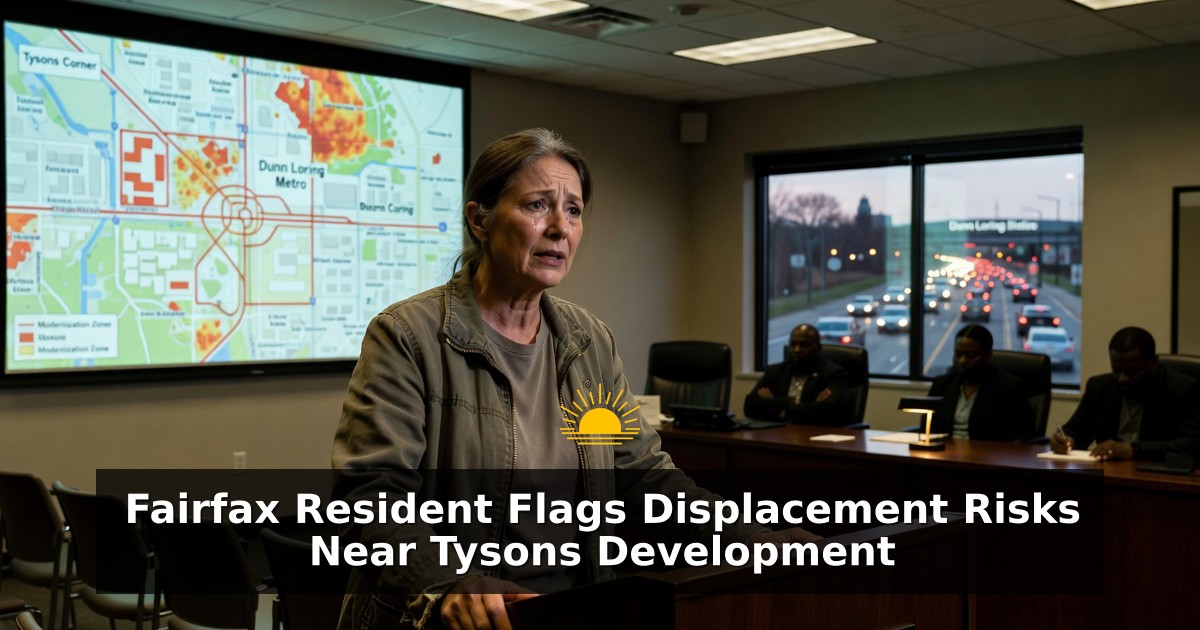
A Fairfax County resident appeared before the Planning Commission on July 22, 2026, to describe growing unease among neighbors about potential displacement tied to ongoing modernization around the Tysons area. The speaker explained that daily commutes into Tysons already rank among the most congested stretches within a ten-mile radius, underscoring how rapid change is affecting everyday life. Co-workers, former colleagues, and friends living in the Dunn Loring Station apartments view current proposals as a form of displacement that could force them from familiar housing. A general sense of anxiety has settled over that community as expansion plans advance. Officials heard that even positive elements such as park expansions only partially ease those worries.
The testimony centered on the human impact of denser development in one of Northern Virginia’s busiest commercial corridors. Residents who have long rented near the Dunn Loring Metro station now confront the possibility that redevelopment will raise costs or alter the character of their buildings. The speaker noted that many of these individuals work in or near Tysons and already navigate severe traffic each day. That congestion, described as a nightmare, illustrates the strain that unchecked growth can place on existing neighborhoods. Planning commissioners received a clear message that infrastructure and housing stability must be considered together.
Traffic Congestion Along the Tysons Corridor
Daily travel between residential pockets near Dunn Loring and employment centers in Tysons remains a persistent challenge for thousands of Fairfax County workers. The resident emphasized that the route ranks as one of the most jammed segments in the immediate region, adding stress to already complicated housing decisions. Longtime renters weigh the convenience of Metro access against the reality of gridlock that consumes hours each week. County transportation data have long shown elevated volumes on roads feeding Tysons, a pattern that intensifies during peak periods. Any further intensification of land use therefore raises legitimate questions about whether road and transit capacity can keep pace.
Local observers note that Tysons has evolved from a suburban retail hub into a dense mixed-use district anchored by multiple Metro stations. That transformation has brought jobs, restaurants, and new housing towers, yet it has also increased competition for moderately priced apartments. Families and workers who settled in older complexes near Dunn Loring Station now watch neighboring parcels redevelop at higher densities. The resulting pressure on rents and lease renewals fuels the displacement fears voiced at the hearing. County planners have repeatedly stated that balancing growth with livability remains a core objective of the comprehensive plan.
Housing Stability and Community Anxiety
Anxiety among apartment residents stems from uncertainty over how modernization will affect existing leases and neighborhood cohesion. The speaker reported that friends and colleagues interpret current proposals as signals that their buildings may eventually give way to newer, more expensive projects. Even when public amenities such as expanded parkland are promised, the underlying worry about losing one’s home persists. Fairfax County has experienced similar tensions in other transit-oriented districts where older garden apartments face redevelopment pressure. Maintaining a supply of workforce housing close to job centers continues to challenge local policy makers.
Park enhancements referenced during the meeting offer partial reassurance by preserving green space amid rising density. Residents acknowledge that additional recreational areas can improve quality of life for those who remain. Still, the core concern revolves around whether current tenants will be able to stay long enough to enjoy those improvements. Housing advocates across Northern Virginia have documented cases in which redevelopment leads to relocation of lower- and moderate-income households. The Planning Commission therefore faces the task of weighing economic development goals against the stability of established residential communities.
Broader Development Context in Fairfax County
Fairfax County’s comprehensive planning framework encourages higher-density growth near Metrorail stations to reduce sprawl and capture tax revenue. Tysons stands as the most prominent example of that strategy, with office, residential, and retail space expanding steadily over the past decade. Dunn Loring Station sits along the same Orange Line corridor and shares many of the same market dynamics. Property owners and developers frequently propose mixed-use projects that replace aging structures with taller buildings containing fewer affordable units. County staff routinely evaluate such applications for consistency with adopted land-use maps and urban design guidelines.
Public hearings provide the primary avenue for residents to insert lived experience into technical reviews. The July 22 session illustrated how personal stories of commuting hardship and housing insecurity can humanize abstract planning documents. Commissioners customarily receive written and oral comments before making recommendations to the Board of Supervisors. In this instance, the resident’s account linked traffic congestion directly to fears of displacement, creating a single narrative about the costs of rapid change. That linkage may influence how future traffic-impact studies and housing-mitigation measures are framed.
Economic and Demographic Pressures
Northern Virginia’s strong job market continues to draw new workers into Fairfax County, intensifying demand for housing near employment hubs. Tysons alone hosts tens of thousands of jobs in technology, defense contracting, and professional services. Many of those employees seek apartments within a short Metro or bus ride, placing older complexes at Dunn Loring under heightened market pressure. When redevelopment occurs, replacement units often command higher rents that exceed the budgets of current tenants. The resulting turnover can erode social networks that have formed over years of shared residency.
Demographic data show that Fairfax County’s population has grown steadily, with notable increases in households earning moderate wages. These residents frequently rely on multifamily housing stock built several decades ago. As land values rise around transit stations, the economic incentive to redevelop that stock becomes stronger. County programs aimed at preserving affordable units exist, yet their scale sometimes lags behind the pace of private investment. Testimony such as that offered on July 22 underscores the gap many residents perceive between policy intentions and on-the-ground outcomes.
Planning Responses and Next Steps
The Planning Commission’s role is to examine whether proposed changes align with the comprehensive plan and to forward recommendations accordingly. Members heard that park expansions and similar amenities help offset some community concerns but do not eliminate the fear of displacement. Future staff reports may therefore need to address relocation assistance, tenant-notification requirements, or inclusionary zoning more explicitly. Traffic analyses will also remain central, given the resident’s description of daily congestion between residential areas and Tysons. Coordinated review by transportation and housing planners could produce more integrated mitigation packages.
Residents who spoke or submitted comments expect transparent follow-up as specific applications move forward. The record of the July 22 meeting now contains a clear statement linking modernization, traffic, and housing insecurity. That statement joins a larger body of public input accumulated over years of Tysons and Merrifield planning efforts. County officials have emphasized that continued community engagement remains essential to refining development standards. How effectively those standards protect existing renters will shape public confidence in the planning process for years to come.
Balancing growth with neighborhood stability presents an enduring challenge for one of Virginia’s largest localities. The concerns articulated about Dunn Loring Station apartments reflect broader regional debates over equity in transit-oriented development. By placing personal experiences of anxiety and congestion on the public record, the resident contributed a grounded perspective to technical deliberations. Planning commissioners and, ultimately, the Board of Supervisors must now consider those human stakes alongside economic and infrastructure metrics. The outcome will influence whether longtime community members can remain in the evolving landscape around Tysons.
Anxiety clip Concerns Displacement drafting Fairfax I'm Moved Moved Out post Resident short social summary text type vertical Video Voices