Fairfax County Weighs Restoration of School Crossing Guards Over Safety Risks
Updated
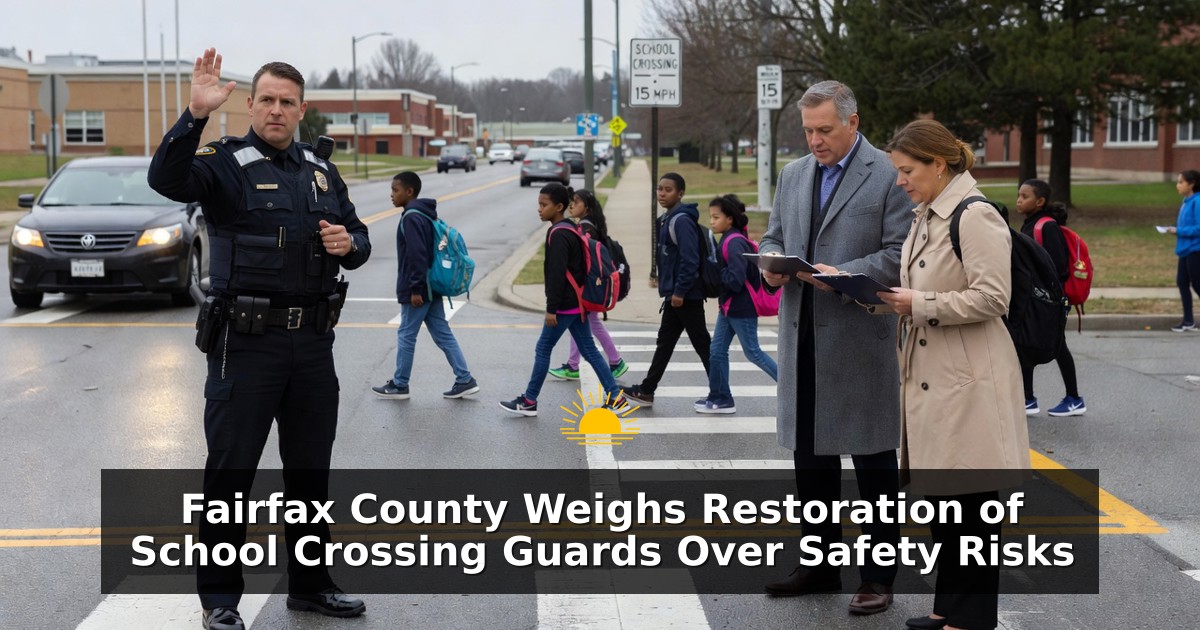
Fairfax County officials are examining the restoration of crossing guards at local schools following heightened safety concerns raised during a recent budget policy committee session. Officers assigned to traffic direction duties have described the work as excessively hazardous, particularly during overtime shifts at certain high schools. At the same time, children face elevated risks when crossing busy roadways without adult supervision. The discussion centers on identifying high-risk locations for immediate guard reinstatement while ensuring equitable resource distribution across the county school system. Long-term planning also contemplates whether high school crossing guards will remain necessary in future years.
The Fairfax County Board of Supervisors oversees these budget and safety deliberations as part of its broader responsibilities for public services. Current members of the board are Chairman Jeff McKay, James Walkinshaw, Jimmy Bierman, Walter Alcorn, Rodney Lusk, Andres Jimenez, Daniel Storck, Dalia Palchik, Kathy Smith, and Patrick Herrity. Their committee work on September 1 addressed competing demands between law enforcement workload and student protection. Participants noted that traffic conditions near schools create genuine peril for both uniformed personnel and young pedestrians. Balancing these factors requires careful evaluation of available funding and staffing levels.
Officer Safety Concerns at High-Traffic School Sites
Law enforcement representatives have reported that directing traffic near schools has become too dangerous for regular assignment. West Springfield officers specifically indicated strong reluctance toward overtime details because of the inherent risks involved in managing vehicle flow during peak arrival and dismissal times. These conditions include heavy congestion, distracted drivers, and limited visibility that elevate the chance of incidents. Officials acknowledged that such hazards cannot be ignored when scheduling personnel for school support roles. The feedback has prompted closer review of which locations truly require dedicated crossing assistance.
Children walking or biking to school encounter parallel dangers when guards are absent from intersections. Busy corridors surrounding Fairfax County campuses often lack sufficient traffic controls for unsupervised crossings by students of varying ages. Parents and educators have long emphasized that adult presence at critical points reduces the likelihood of accidents during morning and afternoon rushes. Restoring guards in the most vulnerable spots is viewed as an urgent step to mitigate those exposures. Committee members stressed that inaction could leave families facing unacceptable daily risks.
Resource Allocation Across Fairfax Schools
Determining how to spread limited crossing guard resources remains a central challenge for county planners. Not every school experiences identical traffic volumes or roadway configurations, so prioritization of high-risk sites is essential. Decision makers must weigh factors such as student enrollment numbers, proximity to major arteries, and historical incident data when assigning personnel. Equitable coverage aims to avoid leaving any campus underserved while concentrating support where dangers are greatest. This approach seeks to maximize safety outcomes within existing budgetary constraints.
Long-term strategies under consideration include the possibility of eventually eliminating crossing guards at high schools. Some participants expressed openness to that outcome if infrastructure improvements, signal enhancements, or changed traffic patterns reduce the need for human direction. Intermediate measures would still focus on maintaining or restoring positions at elementary and middle schools where younger students predominate. Any phase-out would depend on demonstrated reductions in risk rather than simple cost-cutting motives. Ongoing assessment will guide whether such a transition proves feasible.
Broader Implications for County Budget Planning
The budget policy committee session underscored the intersection of public safety expenditures and educational support services. Funding for crossing guards competes with other priorities such as additional officers, road improvements, and school infrastructure projects. Transparent discussion of these trade-offs helps ensure that decisions reflect community values around child welfare and employee protection. Stakeholders continue to call for data-driven identification of the intersections and campuses most in need. Implementation timelines will likely hinge on the next round of budget approvals.
Community members expect clear communication about which schools will regain or retain crossing guard coverage in the near term. Coordination between the police department, school administration, and board offices is necessary to align schedules and training for any restored positions. Monitoring of traffic patterns after changes take effect will provide feedback for further adjustments. The emphasis remains on practical steps that address immediate hazards without overlooking sustainable staffing models. Fairfax County residents will watch closely as these safety measures evolve.
Continued attention to both officer well-being and student crossing conditions defines the path forward. Officials recognize that temporary overtime solutions have proven unsustainable given the documented dangers. Permanent or semi-permanent guard placements at priority locations offer a more stable response. Evaluation of pilot restorations could inform wider rollout decisions in subsequent budget cycles. The overarching goal is a safer environment for everyone navigating school zones throughout the county.
Amid Concerns Crossing crossing guards dangerous directing Fairfax find Guards next Officer safety officers public safety resource allocation Restoring safety school safety Traffic traffic safety what's
All Virginia News is published by ALL VIRGINIA NEWS, LLC. How we're funded · Corrections · Ethics
