Virginia Lawmakers Advance HB850 on Contractor Safety and Apprenticeship Rules
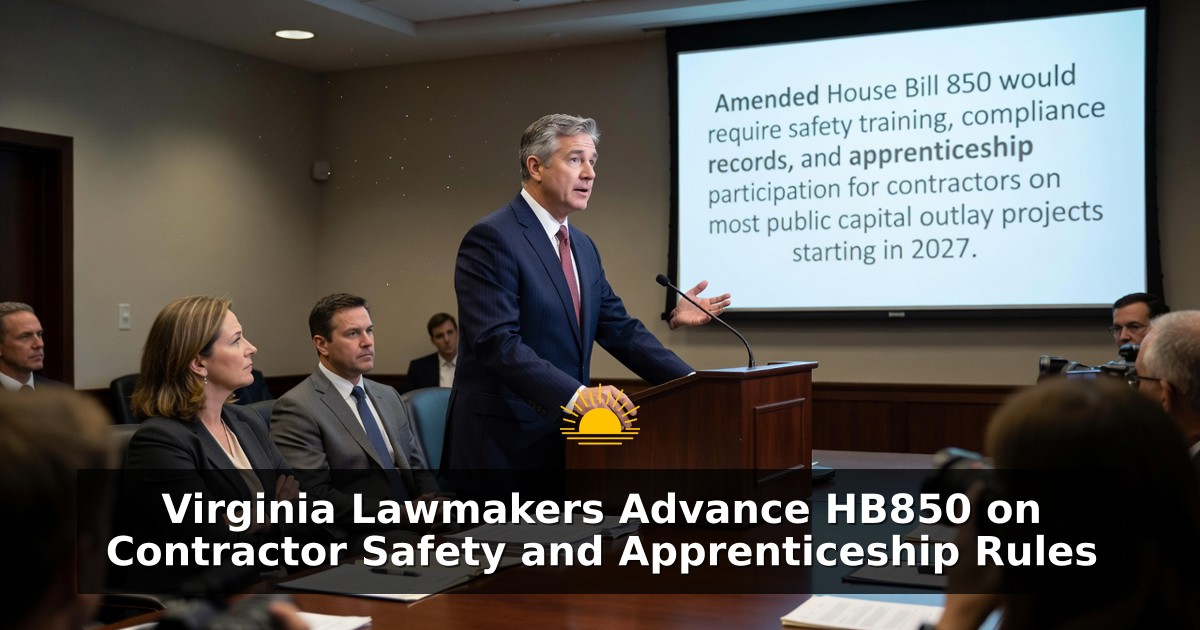
Virginia lawmakers are moving forward with amended House Bill 850, a measure that would require public bodies to ensure contractors and subcontractors complete designated safety training programs on capital outlay projects. The legislation also directs those firms to maintain records showing compliance with applicable laws and to take part in approved apprenticeship training programs. Supporters of the approach describe it as a step toward stronger worker protections on publicly funded construction. The bill now carries a delayed effective date of July 1, 2027, giving agencies and industry time to prepare.
Capital outlay projects covered by the measure generally involve major construction, renovation, or improvement work financed with public dollars. Under the amended language, the public body overseeing each project must build the new obligations into its contracts. Contractors and their subcontractors would need to finish the specified safety courses before or during the work. They would also keep documentation proving they follow relevant statutes and regulations. Participation in recognized apprenticeship programs forms the third core requirement.
Exemptions Built into the Legislation
The bill includes carefully drawn exemptions intended to address practical barriers. One exemption applies when apprentices are simply unavailable in a given trade or region. Another covers situations in which the added costs of meeting the apprenticeship mandate would prove excessively high. These carve-outs aim to keep projects moving while still advancing the overall training goals. Officials reviewing the substitute version noted that the exemptions provide necessary flexibility without gutting the central protections.
Transportation-related construction projects that exceed $250,000 are no longer covered by the bill’s requirements. Earlier drafts had swept those larger highway and transit jobs into the same framework. The amended text removes them, narrowing the scope to other categories of capital outlay. This change reflects feedback from agencies that manage extensive transportation portfolios and from contractors who specialize in that sector. The remaining projects will still face the full set of safety, record-keeping, and apprenticeship rules once the law takes effect.
Subcommittee Action and Next Steps
A legislative subcommittee reviewed the substitute version of HB850 and voted 7-3 to report the bill and refer it to the appropriations committee. The referral recognizes that the new mandates could carry fiscal implications for public bodies and for the contractors they hire. Appropriations members will examine potential costs related to training, record systems, and any administrative oversight. The delayed effective date of July 1, 2027, was retained so that budget planners and project managers can incorporate the changes into future fiscal cycles.
Public bodies across Virginia, including state agencies and local governments, routinely manage capital outlay work ranging from school renovations to office expansions and utility upgrades. Once HB850 becomes law, these entities will need to update bid documents and contract templates. They will also have to verify that selected contractors and lower-tier subcontractors satisfy the training and apprenticeship conditions. Record-retention rules will require firms to produce documentation upon request, creating an auditable trail of compliance.
Safety training programs referenced in the bill typically cover topics such as fall protection, hazard communication, equipment operation, and emergency response. Industry groups and state workforce agencies already offer many of these courses. The apprenticeship component builds on existing registered programs that combine paid on-the-job learning with classroom instruction. By tying public contracts to participation in approved programs, the legislation seeks to expand the pipeline of skilled trades workers while reinforcing job-site safety culture.
Implementation Timeline and Industry Preparation
Because the effective date sits more than a year after expected enactment, contractors have a window to enroll workers in qualifying courses and to affiliate with apprenticeship sponsors. Public bodies can use the same period to train procurement staff and to develop verification checklists. The exemptions for apprentice shortages and high costs will require clear guidance so that project managers apply them consistently. Agencies are expected to issue clarifying materials well before July 2027.
The removal of larger transportation projects from coverage means the Virginia Department of Transportation and similar entities will continue operating under their current contractor qualification systems for those jobs. Other capital programs, however, will operate under the new framework. This distinction allows the Commonwealth to test the safety and apprenticeship requirements on a defined set of projects before any broader expansion is considered. Lawmakers emphasized that the phased approach reduces disruption while still delivering measurable gains in worker preparation.
Observers note that construction remains one of the higher-risk sectors for workplace injuries. Mandating standardized safety instruction and structured apprenticeship pathways is presented as a data-driven response to that reality. At the same time, the cost and availability exemptions acknowledge that rural areas or specialized trades sometimes face genuine shortages of training slots. Balancing those competing considerations produced the compromise language now advancing through the General Assembly.
Fiscal and Administrative Considerations
Referral to appropriations signals that lawmakers want a full picture of any state or local expenses tied to enforcement or to higher bid prices. Some public bodies may need modest additional staff time to review compliance packets. Contractors might pass training costs through in their proposals, potentially affecting project budgets. The 2027 start date gives the money committees opportunity to monitor early implementation and to recommend adjustments if unexpected burdens appear.
HB850 as amended represents a targeted update to the rules governing public construction in Virginia. It focuses on three concrete obligations—safety training completion, legal-compliance record keeping, and apprenticeship participation—while carving out exceptions for practical difficulties and excluding major transportation work. The subcommittee’s 7-3 vote to report the substitute and send it onward keeps the bill alive for further scrutiny. If ultimately enacted, the measure will reshape contractor qualifications on covered capital outlay projects beginning in the summer of 2027.
Stakeholders on all sides are expected to remain engaged as the appropriations review proceeds. Industry associations can supply data on training capacity, while public agencies can outline verification procedures. The final shape of any accompanying budget language will help determine how smoothly the transition occurs. For now, the amended bill stands as a clear statement that Virginia intends to link public construction dollars to elevated standards of workforce safety and skill development.
applicable laws apprenticeship training programs appropriations capital outlay project contractor delayed effective date exemptions HB850 high costs ISO July 1st 2027 lack of availability of apprentices mr chairman public body records of compliance safety training programs subcontractors subcudemy report substitute transportation related construction projects Virginia