Virginia Senate Bill 169 Sets Earlier Deadlines for Election Signature Challenges
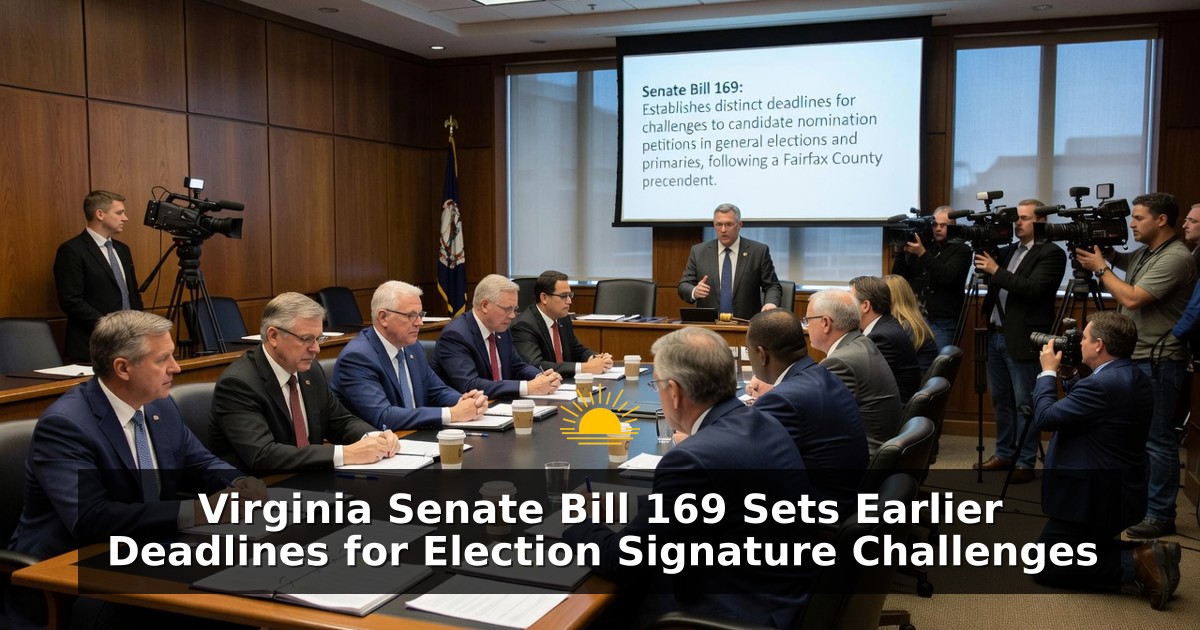
Virginia lawmakers advanced Senate Bill 169 during a recent Privileges and Elections Committee meeting to address the timing of challenges to candidate nomination petitions. The legislation establishes distinct date requirements for general elections compared with primaries and includes specific procedures for districts that cross multiple local jurisdictions. Sponsors framed the measure as a response to situations in which challenges arise only after voting has already begun. The bill leaves intact the ability to question a candidate’s basic eligibility to hold office while focusing on procedural deadlines for signature and petition disputes. Committee members heard a brief presentation and then moved to report the bill after no questions or opposition speakers came forward.
The stated purpose of Senate Bill 169 is to prevent last-minute objections that surface once early voting or Election Day balloting is underway. Under current practice, some challenges to petition signatures have been filed so late that voters already cast ballots for candidates whose qualifications remained under review. The new framework seeks to front-load those disputes so that election administrators and courts can resolve them before ballots are finalized and distributed. Officials noted that the change would apply uniformly across the Commonwealth while still recognizing the different calendars that govern primary contests and November general elections. By clarifying these timelines, the bill aims to reduce uncertainty for candidates, local registrars, and the voting public.
Origins of the Measure in Fairfax County
Senate Bill 169 draws directly from a real-life case that unfolded in Fairfax County. In that instance, questions about petition signatures emerged after voting had started, creating administrative complications and public confusion. Local election officials and candidates found themselves navigating incomplete challenges at a point when ballots were already in the hands of voters. The episode highlighted gaps in existing statutes regarding when signature challenges must be lodged and how multi-jurisdictional districts should handle competing filings. Lawmakers cited the Fairfax experience as evidence that clearer statutory deadlines are needed to protect the integrity of the nomination process without unduly restricting legitimate challenges.
Fairfax County, as one of Virginia’s largest localities, frequently manages complex ballot access issues because of its size and the number of overlapping districts. The case that prompted the legislation underscored how delays in raising signature objections can cascade into broader problems for canvass procedures and potential recounts. By anchoring the bill in that concrete example, sponsors sought to demonstrate that the proposed changes address documented practical difficulties rather than theoretical concerns. The committee discussion referenced the Fairfax matter only briefly, yet it remained the clearest illustration of the problem the legislation intends to solve.
Differing Deadlines for Primaries and General Elections
A central feature of Senate Bill 169 is its recognition that primary elections and general elections operate on separate calendars and therefore require tailored challenge windows. Primary contests often occur months earlier and involve party-specific nomination rules, while general elections follow a more standardized statewide schedule. The bill sets earlier cutoff dates for filing signature challenges in each context so that election officials have adequate time to verify petitions, notify candidates, and allow for any necessary court review. These staggered deadlines are designed to align with existing statutory milestones for ballot printing and absentee ballot distribution.
Provisions also address the practical reality that many Virginia legislative and congressional districts span more than one city or county. When a district crosses jurisdictional lines, challenges could previously be filed in different localities at different times, producing inconsistent outcomes. Senate Bill 169 creates coordinated procedures so that a single challenge timeline applies across all localities within the district. This coordination is intended to prevent forum shopping and to ensure that all affected registrars operate from the same set of facts and deadlines. The multi-jurisdiction language forms a technical but essential component of the overall reform.
Candidate Eligibility Challenges Remain Available
Importantly, the legislation does not restrict challenges based on a candidate’s fundamental eligibility to serve in office. Questions involving age, residency, felony status, or other constitutional qualifications may still be raised according to existing law. Senate Bill 169 confines its new timing rules to disputes over petition signatures and related ballot-access formalities. By drawing this distinction, the bill preserves avenues for substantive eligibility contests while closing the window on purely procedural signature objections that arrive after voting begins. Committee members received assurance that the measure would not shield unqualified candidates from legitimate scrutiny.
Election administrators have long noted that signature verification is labor-intensive and time-sensitive. Petitions must contain a minimum number of valid signatures from qualified voters within the district, and each signature is subject to review for completeness and authenticity. When challenges arrive late, staff must divert resources from other critical Election Day preparations. The earlier deadlines in Senate Bill 169 are expected to allow registrars to complete verification work well before ballots are locked for printing. Supporters argue this sequencing improves both efficiency and public confidence in the candidate list that ultimately appears before voters.
Committee Process and Next Steps
During the Privileges and Elections Committee session, the bill’s presentation covered the differing date requirements, the multi-jurisdiction provisions, and the Fairfax County origin. No committee members posed questions, and no individuals signed up to speak in opposition. The absence of debate allowed the panel to move promptly to a motion to report the legislation. Reporting the bill advances it to the next stage of Senate consideration, where it may be scheduled for floor action or further refinement. The straightforward committee disposition indicated broad procedural acceptance of the concept even if detailed amendments could still emerge later.
Virginia’s election calendar is already densely packed with statutory deadlines for candidate filings, petition submissions, and ballot preparation. Adding clearer challenge windows fits within that existing structure rather than creating an entirely new regulatory regime. Local electoral boards and general registrars will need to update internal checklists and public notices once the bill becomes law, ensuring that candidates and potential challengers understand the revised timelines. Training materials and website guidance are likely to be revised to reflect the new cutoffs for both primary and general election cycles.
Broader Context for Ballot Access Rules
Candidate qualification rules serve dual purposes: they guarantee that only serious contenders appear on the ballot and they protect the right of qualified citizens to seek office. Signature requirements have historically balanced those goals by demanding a demonstrable level of support without imposing insurmountable barriers. When challenges to those signatures are delayed until after voting starts, the balance tips toward uncertainty and potential disenfranchisement of voters who supported a later-disqualified candidate. Senate Bill 169 attempts to restore predictability by requiring disputes to be aired early enough for orderly resolution.
The measure also reflects ongoing attention in Virginia to the mechanics of election administration. Lawmakers periodically revisit petition thresholds, residency verification methods, and challenge procedures in light of practical experience. The Fairfax County episode supplied a concrete data point that illustrated how existing language left room for strategic delay. By closing that gap, the General Assembly seeks to reduce the likelihood of similar disruptions in future cycles. The bill’s narrow focus on timing, rather than on altering signature quantities or eligibility standards, keeps the reform targeted and incremental.
Implementation will require coordination among the State Board of Elections, local registrars, and circuit courts that hear election contests. Clear statutory language should minimize conflicting interpretations across localities. Because the bill already distinguishes between primary and general election calendars, administrative regulations can be drafted with those distinctions in mind. Candidates and campaign staff will likewise need to monitor the new deadlines closely when circulating petitions and when deciding whether to contest an opponent’s filings.
Senate Bill 169 therefore represents a procedural adjustment grounded in a specific local experience and designed to produce statewide consistency. Its advancement out of committee without opposition suggests that the underlying problem of late signature challenges is widely recognized. As the legislation continues through the Virginia Senate, attention will turn to ensuring that the final language delivers workable deadlines while preserving legitimate avenues for both ballot access and accountability. The outcome will shape how candidates qualify for the ballot and how disputes are resolved before voters begin casting ballots in coming election cycles.
candidate qualification challenges committee date requirements district eligibility to serve Fairfax County general elections moved and seconded multiple jurisdictions primaries real life case report Senate bill 169 Senate bill Senate Bill 169 Senator signature speak against speak in favor voting started