Virginia Senate Amendment Targets Faster Absentee Ballot Handling on Election Day
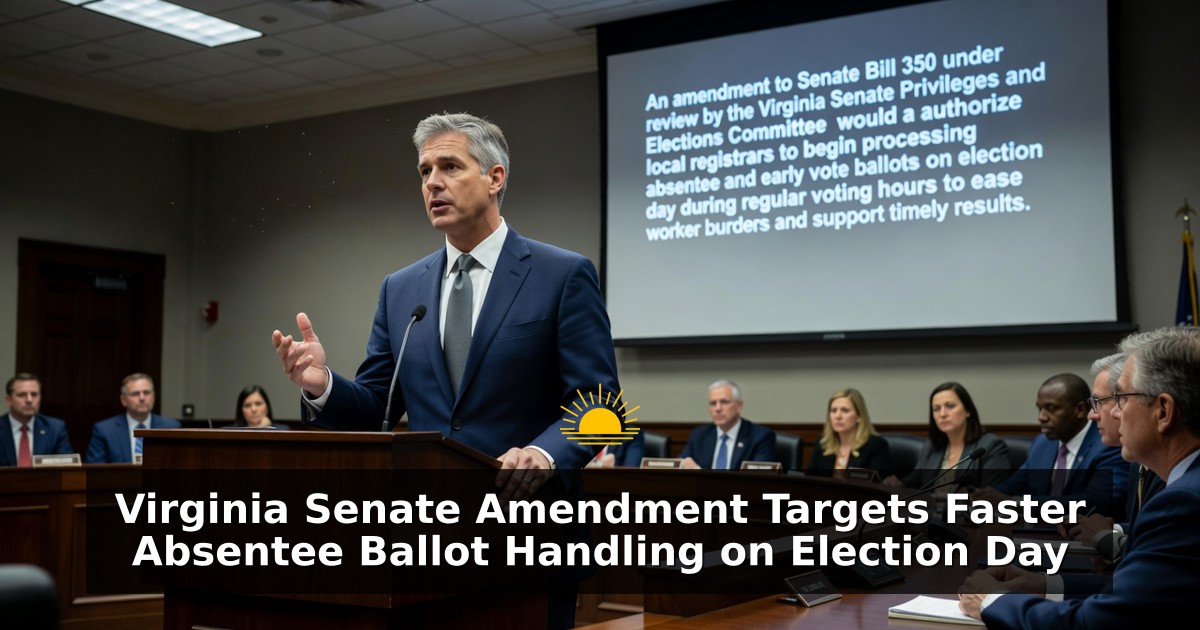
An amendment to Senate Bill 350 under review by the Virginia Senate Privileges and Elections Committee would authorize local registrars to begin processing absentee and early vote ballots on election day during regular voting hours. Senator Rome presented the measure during a committee session as a practical adjustment to existing procedures. The change focuses solely on the timing of preparatory and counting steps rather than any modification to how votes are tallied or reported. Election administrators across the commonwealth have long managed heavy workloads on the final day of voting, and this proposal seeks to address that pressure directly. Officials note that the amendment leaves transmission and final reporting protocols unchanged.
Local registrars in Virginia oversee the full range of election operations within their localities, including the intake and verification of absentee ballots returned by mail or cast during the early voting period. Under current practice, these ballots typically remain sealed or unprocessed until polls close on election night. Workers then face a concentrated surge of activity that extends well into the evening or early morning hours. The proposed language in Senate Bill 350 would open a window for processing while in-person voting continues at precincts. This sequencing aims to distribute labor more evenly throughout the day and reduce the intensity of post-closing tasks.
Election day staff in Virginia routinely handle multiple responsibilities that include voter check-in, provisional ballot management, and equipment oversight. Adding the full volume of absentee and early ballots only after closing compounds the physical and mental demands placed on these teams. Senator Rome emphasized that the amendment would help shorten the overall workday for these individuals without compromising accuracy. By starting the counting process earlier, registrars could complete more of the mechanical steps while polls remain open. The result, according to the explanation offered in committee, would be a more manageable close-out period once voting ends.
Timely reporting of results remains a central concern for election administrators and the public alike in every Virginia locality. Prolonged counting after polls close has in past cycles contributed to later-than-desired releases of unofficial tallies on election night. The amendment to Senate Bill 350 is framed as one tool to mitigate those delays by front-loading eligible processing work. No alteration would occur in the actual determination of winners or in the secure transmission of data to state systems. Observers of Virginia election administration point out that smoother logistics can support public confidence when results appear within expected time frames.
Virginia law already provides structured early voting opportunities and absentee ballot options that generate substantial volumes of ballots before election day itself. General registrars must maintain chain-of-custody standards, signature verification where required, and secure storage until the appropriate moment for tabulation. The pending amendment would insert an earlier start time for those final processing stages on the day of the election. Committee members heard that the adjustment carries no impact on the integrity of the count or on the sequence of official canvass activities that follow. It simply realigns the work schedule to better match available staffing resources.
Supporting the men and women who staff polling places and central election offices forms a recurring theme in discussions of election administration improvements. Many of these workers serve long shifts that begin before dawn and stretch past midnight under existing rules. Allowing processing of absentee and early ballots during daytime voting hours would enable staggered task assignments and potentially earlier release times for some personnel. Senator Rome described the current waiting period until poll closing as an unnecessary extension of an already demanding day. The amendment therefore positions itself as both an operational and a workforce-support measure.
Broader context within Virginia shows continued legislative attention to the mechanics of conducting elections efficiently while preserving security. Localities vary widely in size and ballot volume, from densely populated urban centers to smaller rural jurisdictions, yet all share the same statutory framework for when counting may begin. Senate Bill 350 as amended would create uniform permission for registrars statewide to initiate processing on election day. That consistency could simplify training and planning for the thousands of temporary and permanent election staff employed each cycle. Clearer expectations around timing also assist in coordinating with party representatives and independent observers who monitor the process.
Concerns about extended vote-counting periods often center on the practical strain they place on facilities, technology, and human endurance rather than on questions of outcome validity. The amendment explicitly maintains existing rules for how results are finalized and communicated once processing concludes. Election night reporting timelines matter to candidates, media outlets, and voters who seek prompt unofficial tallies. By enabling an earlier start, the measure seeks to compress the post-closing window without rushing any verification steps. Virginia’s decentralized system of local control would still leave implementation details to each registrar operating under the new authority.
Committee consideration of the amendment occurred as part of routine review of election-related legislation during the session. Senator Rome’s remarks clarified that the sole purpose is to let counting begin sooner on election day itself. No provisions in the described change would affect ballot eligibility determinations already completed or the secure handling protocols already in force. The focus remains on workflow redesign that acknowledges the reality of modern ballot volumes driven by expanded early and absentee participation. Lawmakers weighing the language can evaluate it against the documented experiences of registrars who manage these logistics every November and in special elections.
Adoption of such procedural flexibility has been examined in various forms across multiple election cycles as voting patterns evolve. In Virginia the combination of no-excuse absentee options and extended early voting periods has increased the share of ballots cast before election day. That shift places greater emphasis on central office capacity to process those ballots efficiently once the legal window opens. The Senate Bill 350 amendment responds by moving the opening of that window to coincide with voting hours rather than waiting for their conclusion. Supporters of streamlined operations view the change as a modest but meaningful update to statute.
Election workers themselves often cite the length of election day as one of the more challenging aspects of service. Shifts that run twelve to sixteen hours or longer test concentration and increase the chance of simple fatigue-related errors in administrative tasks. Providing an avenue to complete portions of absentee and early ballot processing earlier in the day offers a direct response to those conditions. The amendment does not reduce the total work required; it redistributes it across a longer available period. In doing so it aligns human factors with the statutory goal of accurate and reasonably prompt results.
Public understanding of election processes benefits when administrative steps are explained in straightforward terms. The description provided for the Senate Bill 350 amendment stresses that outcomes and reporting channels stay identical to current practice. Only the clock for beginning the counting work would move forward into election day proper. Local registrars would retain full responsibility for compliance with all remaining legal requirements governing observation, security, and documentation. This clarity helps separate operational timing questions from broader debates about voting access or verification standards.
As the Privileges and Elections Committee continues its examination of pending bills, the amendment stands as a targeted proposal addressing a specific logistical bottleneck. Senator Rome’s account highlighted the human element of election administration and the value of practical relief for those on the front lines. Virginia’s network of registrars and electoral boards would gain an additional tool for managing peak workloads if the language advances. The measure’s narrow scope—limited to the start time for processing—keeps the discussion centered on efficiency and worker support. Further legislative steps will determine whether the adjustment becomes part of the commonwealth’s election code.
Accurate and timely administration of elections remains foundational to public trust in Virginia’s democratic institutions. Measures that ease avoidable strain on the system while leaving core safeguards untouched contribute to that foundation. The amendment to Senate Bill 350 illustrates one approach focused on the calendar of tasks rather than the substance of ballot rules. By permitting processing during normal voting hours, it seeks to produce earlier completion of counting without any change to results transmission. Continued neutral review of such proposals allows the General Assembly to refine procedures in light of operational experience.
absentee ballots allow Amendment bill committee critical early voting election process Elections Explained explains introduced Privileges Process Rome Senate Senate Bill 350 Senator Senator Rome