Virginia Advances Senate Bill 418 on Pharmacist Therapeutic Drug Substitutions
Updated
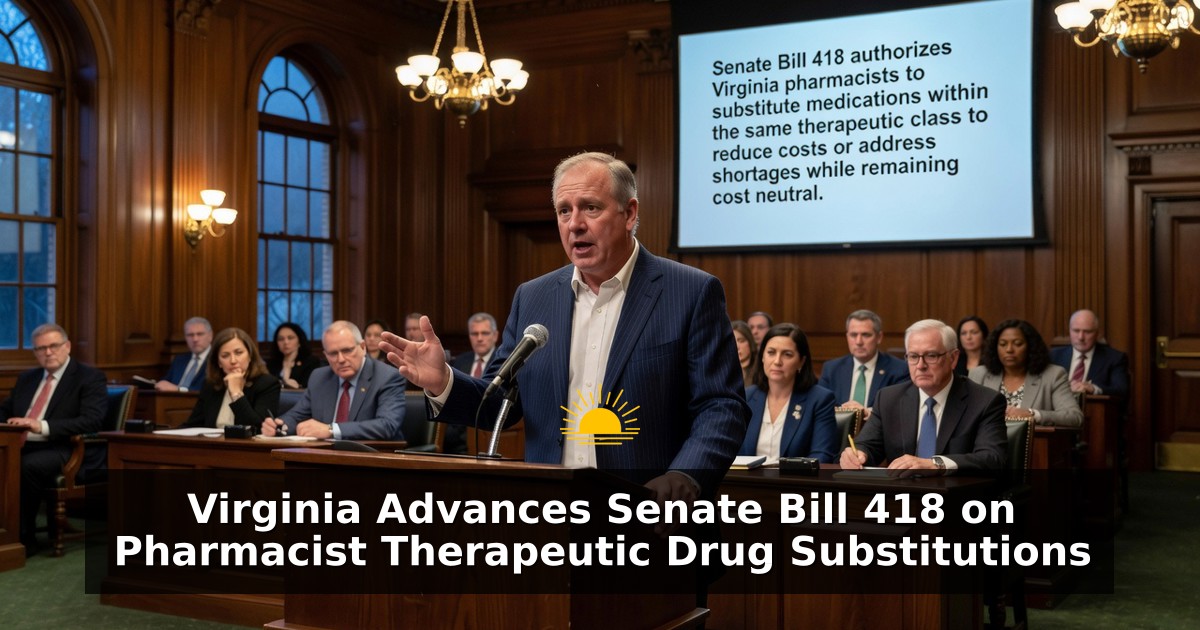
Virginia lawmakers advanced Senate Bill 418 during a regular legislative session on February 27, 2026, authorizing pharmacists to substitute one medication for another within the same therapeutic class under specific conditions. The measure focuses on situations where the change lowers overall costs for patients and remains cost neutral to the system. It also permits such substitutions during periods of drug shortages to help maintain access to needed treatments. Doug from Henrico presented the bill and moved for its passage, after which the motion carried successfully.
Therapeutic class substitutions, sometimes called therapeutic interchange, involve replacing a prescribed drug with another that belongs to the same broad category of medications used to treat a particular condition. These drugs share similar mechanisms of action or clinical effects even if they are not chemically identical. Supporters of the approach note that it can expand options when a specific brand or formulation becomes expensive or unavailable. The bill requires that any substitution achieve lower costs while preserving cost neutrality across the transaction.
Cost neutrality means the overall expense associated with the substituted medication does not increase financial burdens for patients, insurers, or public programs beyond the original prescription. Pharmacists would evaluate pricing data and availability before making a change. This framework aims to keep prescriptions more affordable for Virginians facing rising pharmaceutical expenses. During shortages, the flexibility could prevent treatment interruptions by allowing ready alternatives from the same class.
Drug shortages have affected multiple therapeutic categories in recent years, ranging from antibiotics to chronic disease medications. Supply chain disruptions, manufacturing delays, and increased demand often contribute to limited availability. By permitting pharmacists to select another agent in the same class, Senate Bill 418 seeks to mitigate those impacts without requiring patients to return immediately to their prescribers for a new order. The legislation maintains professional standards by limiting substitutions to clinically comparable options.
Legislative Progress and Sponsorship Details
Doug from Henrico played a central role in moving Senate Bill 418 forward during the session. He outlined the core provisions authorizing substitutions that lower costs and remain cost neutral, along with the shortage-related authority. After presenting the measure, he formally moved that the bill pass. The motion carried, marking a key step in the legislative process for the proposal. The discussion occurred as part of regular session business addressing health care access and affordability.
Pharmacy practice acts across many states already include limited substitution authority, primarily for generic equivalents of brand-name drugs. Therapeutic class substitutions go a step further by allowing interchange among different molecules that treat the same condition. Virginia’s bill adds explicit cost-saving and shortage criteria to guide those decisions. Observers of pharmacy policy note that clear statutory language helps pharmacists act confidently while protecting patient safety and continuity of care.
Implications for Patients and Health Systems
Patients in Virginia could see reduced out-of-pocket spending when a lower-cost alternative within the same class becomes available. Individuals managing long-term conditions such as hypertension, diabetes, or high cholesterol often face ongoing medication expenses that strain household budgets. The cost-neutral requirement is intended to ensure that savings realized by one party do not simply shift expenses elsewhere in the system. During shortages, timely access to an alternative may reduce the need for emergency department visits or disease progression.
Health systems and pharmacies would need to update protocols and inventory practices to implement the new authority effectively. Staff training on therapeutic equivalence, pricing tools, and documentation standards would support consistent application. Communication with prescribing clinicians remains important so that medical records accurately reflect the dispensed medication. The bill does not eliminate the prescriber’s role but provides an additional pathway for addressing cost and supply challenges at the point of dispensing.
Insurance plans and pharmacy benefit managers already employ formularies that encourage preferred agents within therapeutic classes. Senate Bill 418 aligns pharmacy-level decisions more closely with those existing cost-management strategies. By embedding the authority in statute, the measure creates a uniform statewide standard rather than relying solely on private contracts or voluntary programs. Cost neutrality language seeks to prevent unintended premium increases or coverage gaps that could offset patient savings.
Broader Context of Pharmaceutical Affordability Efforts
Pharmaceutical pricing and availability continue to rank among top concerns for state policymakers nationwide. Multiple jurisdictions have examined tools ranging from importation programs to enhanced generic substitution rules. Therapeutic interchange policies represent one targeted method for introducing competition and flexibility inside established drug classes. Virginia’s approach ties the authority directly to documented cost reduction and shortage conditions, providing measurable triggers for action.
Public health data regularly show that medication nonadherence rises when patients encounter high costs or empty pharmacy shelves. Interruptions in therapy for chronic illnesses can lead to preventable complications and higher downstream medical spending. By equipping pharmacists with clearer substitution tools, Senate Bill 418 aims to support adherence and continuity. The legislation’s passage motion indicates legislative interest in practical steps that operate within existing clinical frameworks.
Implementation will likely involve regulatory guidance from the state board of pharmacy and collaboration with medical and pharmacy associations. Clear definitions of therapeutic class, cost calculation methods, and shortage verification processes will help ensure consistent application. Monitoring of outcomes, including actual savings realized and any reported clinical issues, can inform future refinements. The bill’s focus on remaining cost neutral underscores an intent to balance affordability gains with system-wide fiscal responsibility.
As the measure moves through remaining procedural steps, stakeholders will examine operational details and potential interactions with federal requirements. Pharmacists already counsel patients on medication options and side effects; the new authority expands the range of choices they may offer under defined circumstances. Patients retain the ability to discuss preferences with their health care providers. The overall framework positions cost savings and shortage response as complementary goals rather than competing priorities.
Senate Bill 418 reflects ongoing efforts to adapt pharmacy practice to contemporary economic and supply realities. By authorizing substitutions within the same therapeutic class when they lower costs and stay cost neutral, or when shortages occur, the legislation provides a structured mechanism for improving access. Doug from Henrico’s motion and the subsequent passage of that motion advanced the proposal during the February 27, 2026, regular session. Continued attention to implementation standards will determine how effectively the authority translates into tangible benefits for Virginians seeking affordable and reliable medications.
bill passage cost neutral cost savings drug availability drug shortage drug substitution health and human services healthcare costs Henrico Legislation medication access pharmacists pharmacy Regular Session SB418 Senate Bill 418 session 2026 therapeutic class therapeutic interchange Virginia Senate