Virginia Senate Advances Bill Raising Vehicle Lien Cap to $75,000
Updated
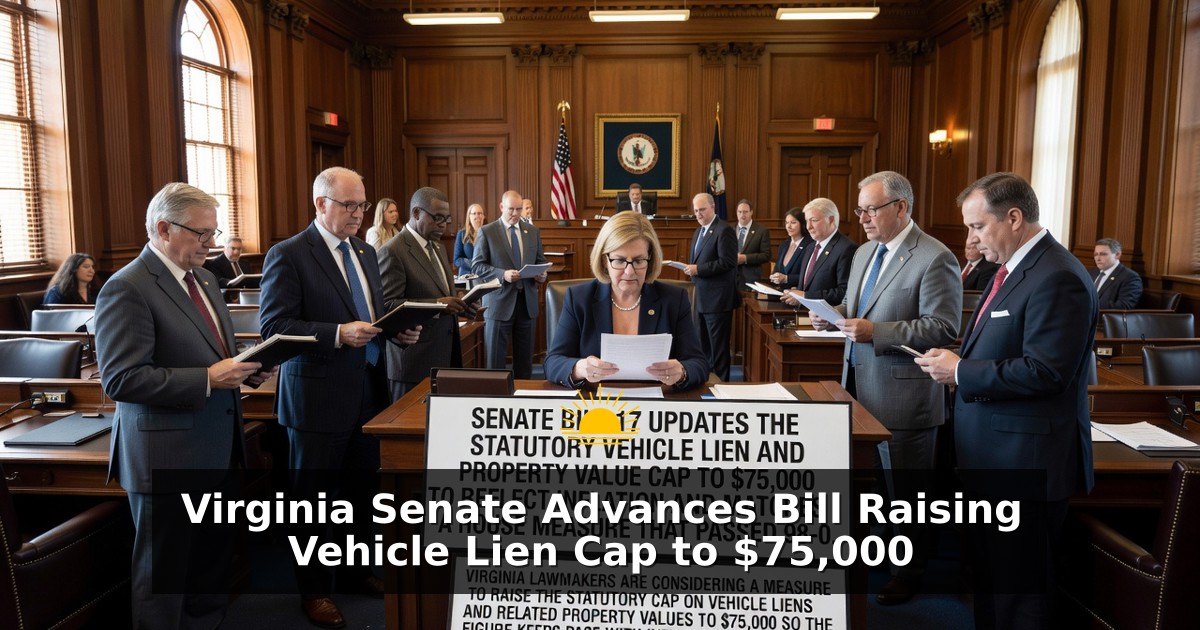
Virginia lawmakers are considering a measure to raise the statutory cap on vehicle liens and related property values to $75,000 so the figure keeps pace with inflation. Senate Bill 17 amends the code section that governs enforcement of liens against vehicles, ensuring the threshold better matches current market costs faced by residents. The legislation was presented during a regular session of the General Assembly as a straightforward update rather than a broad overhaul of lien procedures. Officials noted that vehicle prices have climbed markedly in recent years, rendering older caps less practical for everyday transactions and enforcement actions. The bill’s sponsor asked the full body to approve the change so that lien rules remain aligned with economic conditions across the commonwealth.
The proposal is identical to House Bill 1226, which cleared the House of Delegates unanimously on a vote of 98 to zero. That decisive margin demonstrated wide agreement that the existing limit no longer reflected real-world automobile values. By matching the House language exactly, Senate Bill 17 avoids discrepancies between the two chambers and streamlines final enactment if approved. After presenting the vehicle-cap update, the sponsor indicated the chamber would next turn to Senate Bill 184 within the same legislative block. The parallel tracks in both houses underscore a coordinated effort to modernize this narrow but important provision of state law.
Purpose of the Lien Cap Adjustment
Statutory caps on vehicle values serve to define the point at which certain enforcement remedies or exemptions apply when liens are asserted. In practice these limits affect financing companies, repair facilities, judgment creditors, and vehicle owners who may face competing claims against an automobile. When the dollar threshold lags behind actual market prices, ordinary residents can find their primary transportation exposed to collection actions that the original statute never intended. Raising the figure to $75,000 restores the protective balance that lawmakers originally struck while acknowledging sustained increases in both new and used vehicle costs. The adjustment therefore functions as an inflation-indexing step rather than an expansion or contraction of substantive lien rights.
Inflation has exerted particular pressure on the automotive sector through higher manufacturing expenses, supply-chain disruptions, and elevated consumer demand. Average transaction prices for passenger vehicles have risen substantially over the past several budget cycles, pushing many commonplace models above prior statutory ceilings. Without periodic recalibration, the code risks creating uneven outcomes in which identical lien situations are treated differently solely because of the calendar year in which a vehicle was purchased. Senate Bill 17 addresses that drift by resetting the cap at a level intended to remain relevant for the near term. Lawmakers described the change as technical yet necessary to preserve fairness for Virginians who rely on personal vehicles for work and daily life.
Legislative Context and Unanimous House Support
The unanimous House vote on the companion measure signals that the update attracted no organized opposition from either party or from major stakeholder groups. Such consensus is relatively uncommon on fiscal or property-related bills and suggests the revision was viewed as a housekeeping correction rather than a policy shift. Senate consideration now offers the upper chamber an opportunity to concur and send a single, consistent text to the governor. Because the two bills are described as identical, any Senate approval would eliminate the need for a conference committee and accelerate final passage. Procedural efficiency of this kind is often prized during busy regular sessions when calendars fill with higher-profile proposals.
Observers of the General Assembly note that inflation adjustments appear periodically across multiple titles of the Virginia Code, from homestead exemptions to certain fee schedules. Vehicle-related caps receive attention when data show clear divergence between statutory numbers and documented market values. The current proposal follows that established pattern by focusing solely on the dollar threshold and leaving intact the underlying enforcement mechanisms. No alterations to notice requirements, priority rules among competing lienholders, or judicial sale procedures are included in the described text. The narrow scope helped secure the lopsided House tally and is expected to ease Senate review as well.
Implications for Vehicle Owners and Creditors
For individual Virginians, an updated cap can mean greater predictability when financing a purchase or when confronting a repair lien or judgment. Owners whose equity sits near the former limit may gain clearer protection once the higher figure takes effect, reducing the chance that a modestly valued family car becomes fully vulnerable to seizure. At the same time, creditors retain the ability to enforce claims against value exceeding $75,000, preserving legitimate collection avenues for larger or luxury vehicles. The net result is a recalibrated equilibrium that tracks contemporary price levels without eliminating either debtor safeguards or creditor remedies. Dealers, lenders, and title clerks will simply apply the new number once it is codified, minimizing administrative disruption.
Market analysts have documented multi-year climbs in both sticker prices and average loan amounts, confirming that a $75,000 reference point more closely approximates today’s mid-range and upper-mid-range segments. Used-vehicle values have likewise remained elevated relative to pre-inflation baselines, extending the relevance of the adjustment beyond new-car buyers. By acting now, the legislature reduces the likelihood that another corrective bill will be required in the immediate future. The measure therefore contributes to statutory stability while still allowing future General Assemblies to revisit the figure should economic conditions shift again. Residents evaluating their next vehicle purchase or refinancing decision will encounter lien rules that more accurately mirror the prices they actually pay.
Next Steps in the Legislative Process
Following the floor presentation, Senate Bill 17 awaits formal consideration and a recorded vote by the full Senate. If the chamber concurs with the House position, the enrolled bill will proceed to the governor for signature or other executive action under standard constitutional timelines. Implementation would then occur according to the effective-date clause contained in the final text, giving state agencies and the public clear notice of the transition. Because the underlying policy enjoys demonstrated bipartisan backing, prospects for enactment appear favorable barring unforeseen procedural obstacles. The subsequent agenda item, Senate Bill 184, will be taken up once the vehicle-cap measure is disposed of, keeping the session’s block of bills moving forward in orderly fashion.
In sum, the legislation represents a targeted response to documented inflation in the vehicle market and continues a routine practice of keeping dollar thresholds current. Its identical House counterpart already proved the concept acceptable to a unanimous lower chamber, setting a clear path for Senate concurrence. Once adopted, the $75,000 cap will guide lien enforcement and property-value determinations in a manner consistent with present-day economic realities for Virginia motorists and the businesses that finance or service their automobiles. The General Assembly’s attention to this detail illustrates ongoing stewardship of the code sections that ordinary residents encounter whenever they buy, sell, or encumber a vehicle.
20-0 vote bill passage cap update code section Delegate Wiley economic adjustment enforcement February 27 2026 House Bill identical bill inflation legislation amendment legislative block property value Regular Session SB 184 Senate bill speaker request Transportation unanimous vote vehicle cap vehicle liens