Virginia Delegate Backs Bill Curbing Commercial Use of Location Data
Updated
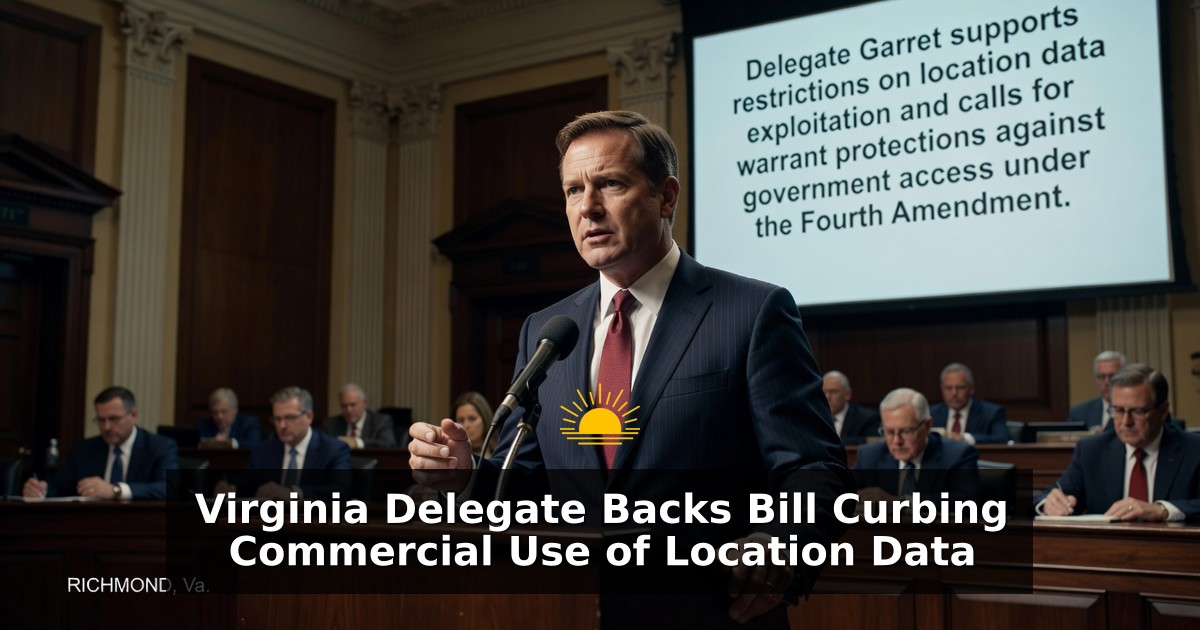
RICHMOND, Va. — Delegate Garret offered strong support for legislation restricting the commercial exploitation of personal location data during a meeting of the Virginia House Communications, Technology and Innovation Committee. The delegate stated clear approval of the measure under consideration and framed location tracking as an issue that transcends party lines. Remarks focused on preventing private entities from profiting off individuals’ movements collected through everyday applications. The discussion occurred on February 23 as lawmakers weighed the scope of privacy safeguards in the digital era. Location data has become a valuable commodity for advertisers, data brokers, and analytics firms that compile detailed profiles of where people live, work, and travel.
Garret emphasized that no one in the committee room, regardless of political affiliation, believes citizens should have their location information exploited so others can generate revenue. The delegate described the practice as inherently unsettling and noted that companies facing potential financial losses would ordinarily appear to defend their interests. Those firms lack a persuasive defense for monetizing such sensitive details, according to the comments delivered that day. Commercial collection often occurs through smartphone apps that request permission for location services and then share or sell the resulting records. This marketplace has expanded rapidly with the growth of mobile technology and location-based services across Virginia and the nation.
Commercial Restrictions and Immediate Privacy Gains
The bill under review targets the profit-driven side of location data handling by imposing limits on how businesses can acquire, use, or transfer precise geolocation information. Supporters view these limits as a necessary response to widespread tracking that many consumers do not fully understand when they accept app permissions. Data brokers routinely package anonymized or identified location histories and offer them for sale to marketers, insurers, and other buyers. Such transactions can reveal patterns about medical visits, religious attendance, political gatherings, or daily routines without the individual’s ongoing awareness. Virginia lawmakers have examined similar consumer protection questions in prior sessions as part of broader data privacy efforts.
Garret praised the current proposal while signaling that its commercial focus represents only a starting point. The delegate indicated a preference for future legislation that would extend comparable rules beyond private industry. This stance reflects documented concerns that location records remain accessible through purchase even when direct legal process is unavailable. Public reporting and court records in recent years have shown law enforcement agencies in multiple states obtaining location information from commercial sources rather than through traditional warrants. The practice raises questions about consistency with constitutional standards that govern searches of personal effects and papers.
Expanding Protections to Government Access
Taking the argument further, Garret asserted that government entities should not obtain location data from applications without first securing a search warrant. The delegate tied this view to a straightforward interpretation of the Fourth Amendment, which guards against unreasonable searches and seizures. From the original 1791 understanding applied to contemporary technology in 2026, officials should not examine a person’s whereabouts unless wrongdoing is suspected and proper legal process is followed. Once suspicion exists, authorities retain the means to investigate and enforce the law through established channels. This reading draws on established Supreme Court guidance that certain digital location records receive Fourth Amendment protection.
Legal scholars and privacy advocates frequently reference the principle that prolonged or precise tracking of an individual’s movements can reveal intimate details of private life. Cell-site location information and app-derived GPS data both fall into categories that courts have scrutinized closely. Requiring a warrant creates an independent check before such records are accessed, ensuring that generalized curiosity or bulk collection does not replace particularized suspicion. Garret described unrestricted access as alarming and outside the legitimate business of government. The comments stopped short of criticizing specific agencies and instead focused on the structural need for judicial oversight.
Constitutional Context and Broader Implications
A reasonable application of the Fourth Amendment, as outlined in the committee remarks, treats modern location tracking as the functional equivalent of continuous physical surveillance that would have been impossible in the founding era. Technology now enables inexpensive, retrospective mapping of a person’s travels over weeks or months. Without warrant requirements, the balance between public safety and individual security can shift toward unchecked observation. Virginia residents generate location data constantly through navigation apps, social platforms, fitness trackers, and retail services. Protecting that stream of information therefore affects daily life for millions of people across urban, suburban, and rural localities in the commonwealth.
The delegate closed by thanking the bill’s patron and expressing willingness to support the measure while cautioning against a party-line vote that could endanger its progress. Garret suggested that colleagues consider advancing related legislation in a subsequent session to address government access more directly. The remarks portrayed the present bill as a solid foundation rather than a complete solution. Committee members heard the arguments in the context of ongoing work on technology policy, innovation incentives, and consumer safeguards. Location privacy continues to intersect with economic interests, law enforcement needs, and constitutional doctrine in ways that demand careful calibration.
Why the Measure Matters for Everyday Virginians
Precise location histories can expose sensitive associations and habits that individuals reasonably expect to keep private. When commercial entities sell this data, the information may circulate far beyond the original app provider and reach parties the user never contemplated. Government acquisition of the same records without warrants bypasses the judicial filter that the Fourth Amendment traditionally supplies. Together these pathways create cumulative risks to personal autonomy and security. Legislation that begins with commercial restrictions can reduce the overall volume of data available for secondary uses and set expectations for responsible handling.
Lawmakers in Virginia and other states have increasingly recognized that existing notice-and-consent models often fail to give users meaningful control. Lengthy privacy policies rarely convey the full downstream consequences of enabling location services. Clear statutory limits supply a backstop when individual bargaining power proves insufficient. The committee discussion illustrated how one delegate sought both immediate commercial curbs and longer-term alignment with constitutional search standards. Future sessions may revisit the warrant question as technology and case law continue to evolve. For now the focus remains on the bill that restricts profit-driven exploitation of location data while inviting further examination of government practices.
Observers note that balanced privacy rules can coexist with legitimate investigative tools once probable cause is shown and a warrant is obtained. The remarks delivered on February 23 underscored that distinction by affirming law enforcement’s role when wrongdoing is indicated. At the same time they rejected routine or warrantless inspection of app-derived location records. This approach seeks to preserve both public safety capabilities and the right of residents to move freely without constant digital monitoring. The Communications, Technology and Innovation Committee’s consideration of the measure forms part of Virginia’s wider effort to adapt legal protections to contemporary data practices.
apps bill of rights commercial use communications committee constitution creepy data exploitation data privacy fourth amendment government access innovation committee location data mr chairman party line vote Patron privacy search warrant seizure Senator surveillance technology committee unreasonable search