Seven Rural Virginia Community Colleges Share $5.93 Million to Train Nurses and Behavioral Health Workers
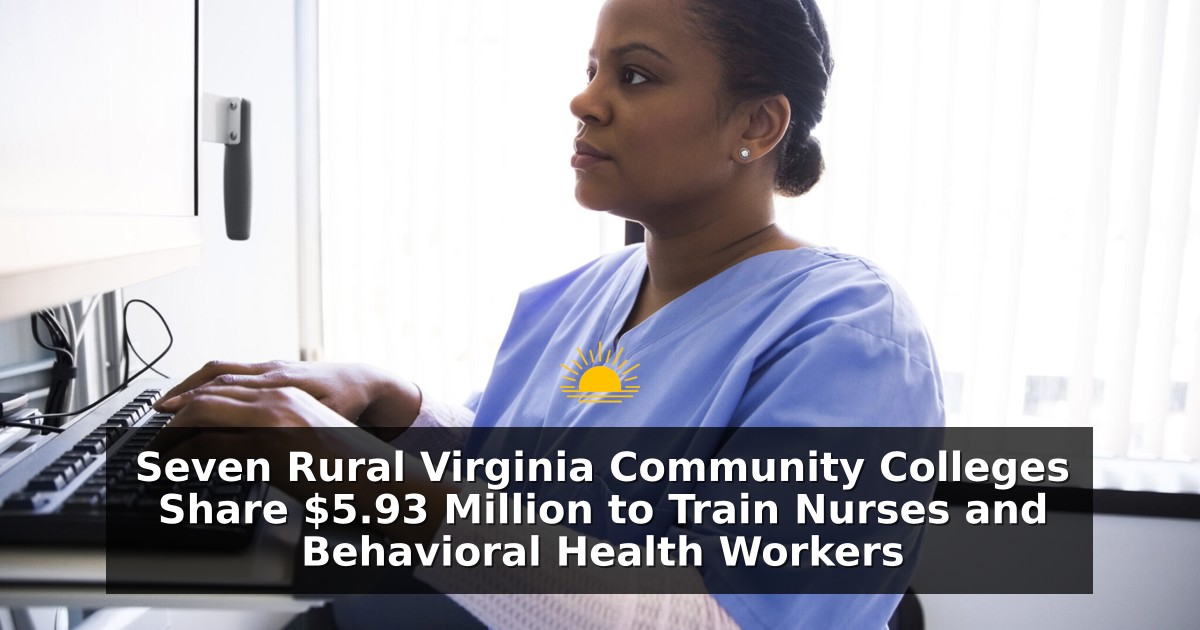
RICHMOND — Seven community colleges across Virginia’s rural horseshoe will share $5.93 million in Rural Health Transformation Fund dollars to expand nursing, behavioral health, and related training pipelines that hospitals say they cannot fill locally.
The Virginia Community College Association identifies eighteen colleges in a crescent running from the Eastern Shore through Southside and Southwest Virginia toward the Winchester area. Ten applied in the first funding wave; seven won awards: Germanna, Laurel Ridge, Mountain Gateway, Patrick & Henry, Paul Camp, Rappahannock, and Virginia Highlands community colleges.
Statewide, Virginia has disbursed about $122 million of a $198 million Rural Health Transformation Fund pool to associations, foundations, health systems, and the state Health Department. Blueprint goals include workforce development, telehealth and mobile clinics, upgraded clinical technology, chronic disease management, and “food as medicine” programs. Community colleges were prioritized because they are often the first rung for rural students who later stay to practice nearby.
Patrick & Henry Community College plans to add a part-time Licensed Practical Nurse track and an LPN-to-RN bridge for working parents who cannot pause full-time jobs. President Greg Hodges said nursing school is already demanding, and stacking it atop work and childcare is “very, very challenging.” The college partners with Sovah Health Martinsville for clinical hours, and Hodges noted graduates who leave the immediate area still often staff other rural hospitals facing the same shortages.
Mountain Gateway Community College in Clifton Forge will aim its award at behavioral health pathways. Vice President for Academic Affairs Ben Worth said many mental health careers require bachelor’s or master’s degrees, but Transfer Virginia lets students complete foundations locally before moving credits to four-year programs. The college intends to hire instructors, launch dual-enrollment awareness for high schoolers, and schedule flexible coursework so incumbent health workers can finish degrees without quitting their jobs.
Worth said regional community service boards and hospitals asked for the behavioral health focus. “When we think of healthcare, we don’t always immediately think of mental health needs,” he said, welcoming their inclusion in eligible Rural Health Transformation uses. Mountain Gateway’s portion has been described locally as roughly $50,000 within the broader $5.93 million package, with additional waves expected.
Virginia Highlands Community College in Abingdon earlier received a highlighted $127,500 grant to expand Licensed Practical Nursing seats, course sections, and instructional support under the Homegrown Health Heroes banner. Governor Abigail Spanberger used that campus visit to argue that training providers in place is the surest way to keep them in Southwest Virginia clinics and hospitals.
A second funding phase closed applications on September 14, 2026, with awards expected by the end of next month. Association leaders say the next wave will again emphasize nursing, behavioral health, and physical therapist assistant programs, while also looking at radiologic technology, sonography, and dental hygiene startups or expansions.
The grants arrive alongside federal reconciliation changes that rural leaders fear could erase some of the gains. Coverage shifts could remove thousands of lawful immigrants from Medicaid and place hundreds of thousands of Virginians at risk of losing coverage, while hospital payment changes and SNAP cost-shifts strain safety-net clinics and student households. Secretary of Health and Human Resources Marvin Figueroa has cautioned that Rural Health Transformation dollars help but may not fully offset those ripples.
Worth noted that Mountain Gateway students often face food, housing, transportation, and childcare insecurity — needs that SNAP cuts worsen. Hodges likewise flagged “concerns down the road” about federal health policy while calling the current grants a chance to innovate and maximize technology in training labs.
For employers from Martinsville to Abingdon to the Eastern Shore, the immediate test is seats and clinical slots. Part-time LPN cohorts only work if hospitals can supervise students after hours. Behavioral health pipelines only ease emergency-room boarding if graduates can transfer cleanly into bachelor’s programs and find paid practicum sites. College presidents say the grants buy faculty time and equipment; retention still depends on wages and housing in thin rural markets.
All Virginia News will watch the second-wave award list and whether General Assembly budget writers add matching state dollars for clinical faculty in the 2027 session. For now, seven rural campuses have new money to turn interest in health careers into certificated workers — a narrow but concrete response to shortages that no single hospital can solve alone.
Email Abigail Spanberger at:
abigail.spanberger@governor.virginia.gov
Martinsville Richmond City Aaron Rawls Abigail Spanberger Ali Faruk Andrew Breton Anne Holton Budget Cheryl Burke College Community College Cynthia Newbille Eastern Shore Ellen Robertson Emmett Jafari Food Governor Grants Health Hospitals Housing Jobs Julian Mei Katherine Jordan Kathryn Ricard Kathy Carter Kathy Lawson Kenya Gibson LC Jones Martinsville City Council Martinsville School Board Matthew Percival Medicaid Michael Williamson Mobile Nekia Blackwell Nicole Jones Parents Policy President Rappahannock Rayshaun Gravely Reva Trammell Richmond Richmond City Council Richmond School Board Sarah Abubaker School Shavonda Fernandez Stephanie Lynch Stephanie Rizzi Technology Telehealth Tony Jones Transportation Virginia Virginia House of Delegates Virginia Senate Wesley Hedgepeth Yvonne Givens