Spanberger declares drought emergency to speed hay deliveries for Virginia livestock
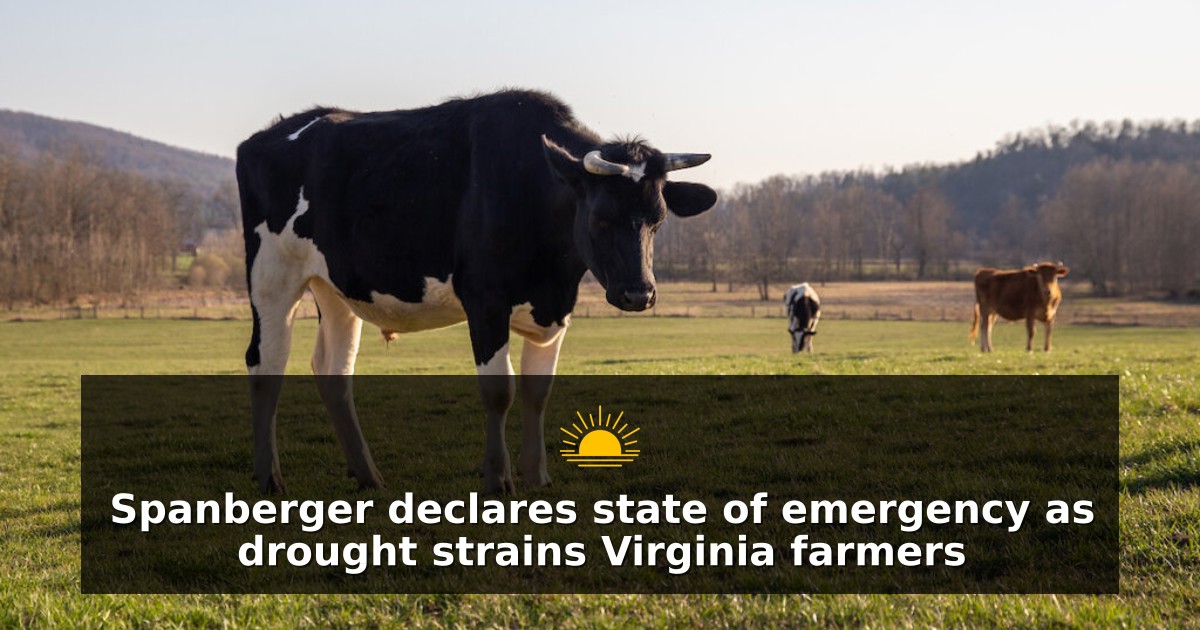
Gov. Abigail Spanberger declared a statewide drought emergency Wednesday to help livestock producers facing a severe hay shortage, temporarily easing trucking rules so larger loads of feed can reach farms before winter.
Executive Order 21, issued Sept. 16, authorizes over-width exemptions and related emergency waivers for carriers moving hay anywhere in Virginia. Spanberger’s office said persistent drought has left the Commonwealth short about 500,000 tons of hay — roughly a billion pounds — after pastures failed to recover through the grazing season.
“This waiver will help us move critical hay resources more quickly so farms can prepare for the months ahead, feed livestock, and sustain their operations,” Spanberger said in a statement announcing the order.
Virginia Cooperative Extension estimates statewide hay yields are down about 35 percent, with some regions reporting losses approaching 70 percent. From the start of the grazing season through June, many producers had to feed hay on at least 30 of 90 days because drought-parched pastures could not carry herds. That early draw on stored forage is now colliding with winter planning.
Southern Virginia along the North Carolina border remains under emergency drought designations from the Department of Environmental Quality even as other regions have seen partial improvement. Cattle producers say thin pastures forced them to buy replacement hay earlier and at higher prices than a normal year.
“Extreme drought conditions across the commonwealth have left cattle producers without the forage stocks needed to support many of our herds this winter,” said Brandon Reeves, executive director of the Virginia Cattlemen’s Association.
The transportation piece is designed to cut cost and delay. Over-width loads can move more hay per trip, which matters when diesel prices spike and out-of-state hay already costs far more than hay grown on Virginia farms. Extension veterinarian Dr. John Currin of Virginia Tech has said hay that might cost about $150 a ton to produce locally has been running $200 to $300 a ton when purchased elsewhere and trucked in. Fuel costs on those hauls have at times topped $6 a gallon.
Under the governor’s order, the over-width waiver begins Oct. 1 and runs 30 days. Federal rules generally limit that class of emergency transportation relief to a month, so the administration built in a mid-September start for the broader emergency declaration to give farmers time to line up sellers and carriers before the trucking window opens. The executive order itself lasts 45 days unless amended or rescinded.
VDOT and DMV guidance makes clear the waiver is not a blank check. Gross and axle weight limits remain in force. Loads generally may not exceed 12 feet in overall width or 14 feet in height, and carriers still must follow safety rules tied to the emergency authorization. Hours-of-service relief for drivers engaged in hay drought response is part of the coordinated package, alongside temporary registration and licensing flexibilities for qualifying carriers.
“Farmers are very resilient and innovative, and this transportation waiver will shorten the timeline for hay deliveries and also save significant trucking costs for producers purchasing supplemental hay as part of their overall drought management strategy,” Virginia Cooperative Extension’s Dan Goerlich and Stephanie Cornnell said in a joint statement.
The emergency declaration also activates broader coordination tools. State agencies can implement emergency plans, unlock certain emergency funding pathways, and enforce price-gouging protections while drought stress continues. Those authorities matter if hay markets tighten further or if a hard winter arrives before pastures recover.
Producers say weather between now and first frost will decide how bad the winter feed bill becomes. Fall rain can still grow grass that delays the start of full hay feeding. A mild winter stretches limited stocks. A long stretch of snow cover, by contrast, could force daily hay feeding for months and empty barns that are already light.
That uncertainty is why farm groups welcomed even a narrow trucking waiver. Moving feed is only one part of drought response, but it is the part state government can change quickly without waiting for Congress or federal disaster designations. Spanberger’s order does not create new hay. It tries to make the hay that exists cheaper and faster to deliver.
Livestock beyond beef cattle are in the same bind. Dairy herds, horses, sheep, and goats all depend on stored forage when pastures brown out. Regions that normally sell surplus hay into neighboring states are instead competing to import it, flipping the usual trade pattern and bidding up prices.
For rural local governments, the emergency also foreshadows secondary impacts: stressed farm income, higher demand for agricultural loan programs, and potential livestock liquidations if feed stays scarce. County extension offices have been counseling producers on early weaning, culling decisions, and stretching rations while they wait for trucking relief to kick in October.
Spanberger framed the order as a bridge through the next month and a half, not a cure for the climate pattern that caused the shortage. Whether that bridge is enough will show up in farm ledgers this winter — and in whether Virginia herds enter spring with breeding stock intact or sold off to survive the feed crunch.
Abigail Spanberger Congress Dairy Drought Executive Order Farm Farms Governor Grants Rain Stocks Transportation VDOT Virginia Virginia Tech