Spanberger’s EO 22 Rewrites Virginia’s Data-Center Rules Without Declaring a Moratorium
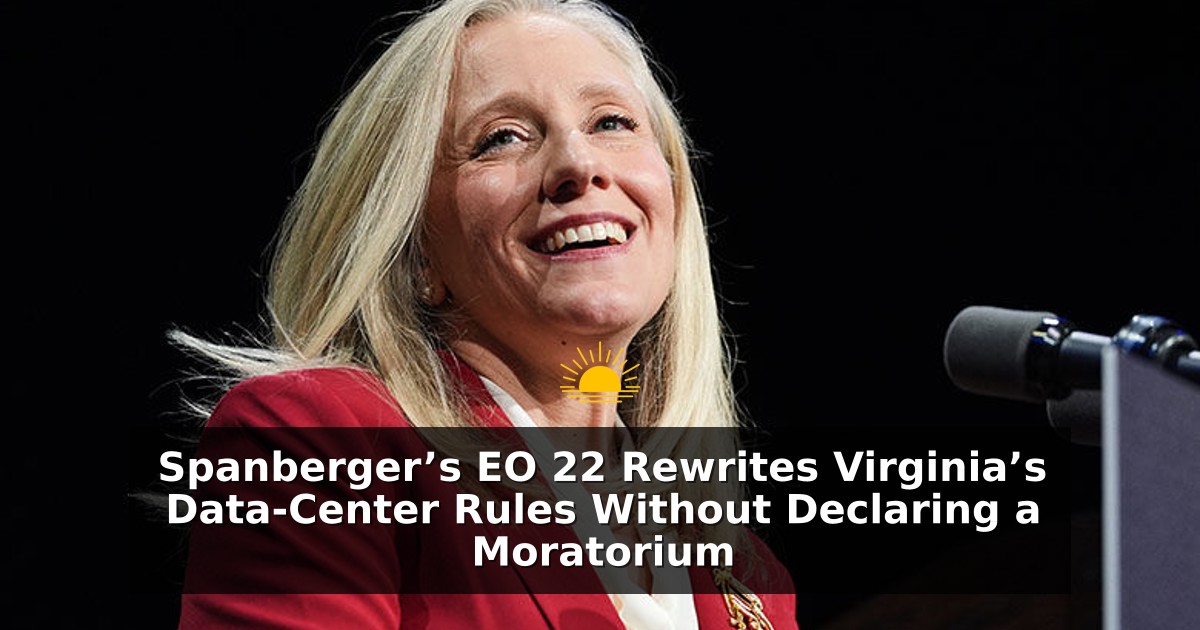
Gov. Abigail Spanberger’s Executive Order 22 does not slam the brakes on Virginia’s data-center boom. It builds a state framework around transparency, environmental review, energy-cost allocation, clean-power goals, and workforce standards—and it rescinds former Gov. Glenn Youngkin’s Executive Order 30 and Executive Directive 5 while leaving some EO 30 standards in place until replaced. WSLS reported the order’s immediate limits on certain state assistance and new nondisclosure agreements after Spanberger cast the package as “the highest standards in America.”
Virginia already hosts roughly one-third of the world’s data centers, with Loudoun County’s Data Center Alley as the global reference point. EO 22’s premise is that growth can continue only if communities, natural resources, and the electric grid are protected. The governor organized the framework around five requirements: increasing transparency, strengthening environmental protections, lowering energy costs, bolstering the clean-energy economy, and delivering a better deal for Virginia workers.
The sharpest near-term change is on nondisclosure agreements. State executive-branch agencies, boards, commissions, and other entities under the governor’s supervision may not enter into or require new NDAs that hide material information about proposed commercial data-center projects—including public incentives, anticipated resource demands, and community impacts. Former U.S. Attorney John Fishwick told WSLS the ban on state NDAs is immediate and significant, but it does not currently bind local governments that often negotiate directly with developers.
That locality carve-out will shape Northern Virginia politics. Loudoun, Prince William, Fairfax, and increasingly Southside and Southwest localities still control zoning, special-use permits, and many incentive conversations. Residents who have spent years filing FOIA requests for water-use and load numbers may see more daylight from state agencies, yet still hit closed doors at the county administration building unless boards voluntarily adopt the same transparency norms.
EO 22 also directs the Office of the Chief Energy Officer to produce a Data Center Planning and Community Engagement Toolkit within 120 days. The toolkit is meant to give local governments model questions on electricity demand, water and wastewater, backup generation, air emissions, noise, traffic, public services, and community-benefit agreements. If staffed and publicized well, it could standardize the interrogation that citizen groups already attempt ad hoc at planning commission hearings.
On economic development, the order immediately restricts Virginia Economic Development Partnership assistance through the Virginia Business Ready Sites Program, expedited permitting, and similar discretionary state site-readiness or expedited-review programs for new data-center projects with anticipated peak demand of at least 25 megawatts. Existing approvals are not expressly canceled. Fishwick noted that whether future statutes reach projects already underway will depend on legislative language—prospective versus retroactive.
Environmental directives are equally concrete. Agencies are told to accelerate state noise regulations for data centers and to review the cumulative impacts of diesel and other backup generators—counting units, fuel types, operating hours, geographic concentration, and air-quality effects, while considering cleaner technologies and stronger permitting, monitoring, and public disclosure. Virginia Energy must develop criteria for cooling-water scarcity areas; the Eastern Virginia Groundwater Management Area is designated as one under the order. Agencies are also pushed to explore reclaimed water and waste-heat reuse.
Cost allocation sits at the center of the household politics. The framework says data centers should pay their fair share of generation, transmission, distribution, and related public investments. The chief energy officer is directed to work with utilities, the State Corporation Commission, and PJM Interconnection on shielding residential customers from data-center-driven infrastructure costs. That conversation lands squarely in SCC dockets Virginians already watch when monthly bills spike.
Workforce language calls for standards and reporting on local hiring and procurement, responsible contractor standards, apprenticeships, and consideration of project labor agreements. The Southwest Virginia Data Center Transparency Alliance welcomed the order but said it does not stop projects already in motion, including a proposed Google campus in Botetourt County, and called for a special session and a moratorium—neither of which EO 22 creates. Spanberger’s office instead plans to codify pieces of the framework in the 2027 General Assembly session.
EO 22 also stands up a rapid-response Virginia Artificial Intelligence Task Force on workforce displacement, privacy, and cybersecurity, and the governor urged federal AI regulation. Sen. Tim Kaine told WSLS that when technology creators themselves ask for rules, Congress should listen—without letting industry write the statute. For Loudoun and other host localities, the immediate homework is practical: inventory open NDAs at the local level, prepare to use the forthcoming toolkit, and track which 25-megawatt-plus prospects lose state site-readiness help. The order took effect Sept. 18. It is a framework, not a moratorium—and that distinction will dominate the next zoning fight and the next SCC hearing alike.
Abigail Spanberger Artificial Intelligence Bills Congress Data Data Center Data Centers economy Electric Electricity Energy Executive Order Fairfax Glenn Youngkin Google Governor Grid Labor Legislation Loudoun County Northern Virginia Politics Power Prince William SCC State Corporation Commission Technology Tim Kaine Traffic Virginia Virginia Business Water