Loudoun Staff Member Details Equity Council Progress Toward Student Support
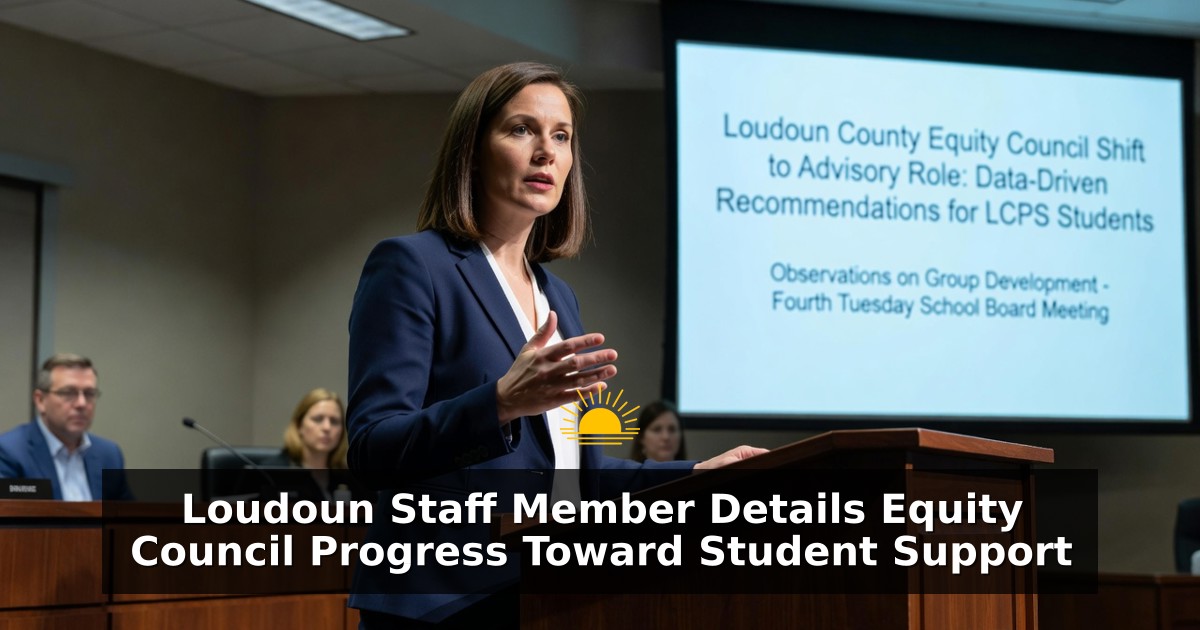
Cassidy Kavanaugh, a staff member serving on the Loudoun County Equity Council, shared observations about the group's development during the fourth Tuesday meeting of the local school board. She described how the council has moved from an informal ad hoc committee into a formal advisory body that contributes to division-level discussions. Kavanaugh stressed the importance of structured input aimed at strengthening academic and social-emotional supports across Loudoun County Public Schools. Her remarks centered on practical steps the council takes to relay community perspectives to leadership.
The Loudoun County School Board received the update as part of its regular review of advisory group activities. Current board members are Atoosa Reaser, Deana Griffiths, John Beatty, Tiffany Polifko, Sumera Rashid, Kari Weston, Jeff Morse, Ian Serotkin, and Harris Mahedavi. These elected officials oversee policy and operational direction for the division while considering recommendations from bodies such as the Equity Council. Meetings routinely allocate time for staff and community representatives to present findings that may inform future actions.
Evolution of the Advisory Structure
Kavanaugh noted that the Equity Council now operates with clearer pathways for contributing to decision-making processes inside Loudoun County Public Schools. The transition from an ad hoc arrangement has allowed members to establish consistent methods for gathering and reviewing information. She explained that the group prioritizes transparent, two-way communication that reaches across varied communities within the county. This approach helps ensure that observations about student experiences reach Superintendent Dr. Aaron Spence in an organized manner.
Members treat their positions as carrying both opportunity and responsibility, according to the account provided. Kavanaugh characterized participants as agents of change who listen to concerns raised by families and educators. The council then examines those concerns alongside available information before shaping suggestions. Such steps are intended to keep the focus on measurable improvements rather than abstract discussion alone.
Communication Channels and Data Review
Transparent exchange of information forms a core practice of the Equity Council, Kavanaugh stated. Council members work to inform stakeholders, amplify relevant student experiences, and examine both academic performance patterns and social-emotional indicators. These efforts produce material that can be relayed directly to division leadership for consideration. The process relies on steady dialogue rather than one-directional reporting.
Targeted data analysis complements the community feedback the council collects. By reviewing specific metrics, members develop recommendations designed to raise outcomes for every student enrolled in Loudoun County Public Schools. Kavanaugh underscored that the same analysis also seeks to identify and assist learners who require additional resources. The combination of qualitative input and quantitative review aims to ground suggestions in observable conditions inside classrooms and schools.
Focus on Broad Student Improvement
The council's stated goal remains the enhancement of educational results across the entire student population. Kavanaugh linked this objective to the practical work of hearing concerns and converting them into actionable proposals. She indicated that members understand their role includes supporting those students who face the greatest barriers while still advancing conditions that benefit all learners. Recommendations therefore address both system-wide practices and targeted interventions.
Loudoun County Public Schools serves a large and diverse enrollment, making consistent advisory input a recurring feature of governance. The Equity Council's emphasis on academic and social-emotional dimensions reflects the range of factors that influence daily student life. Kavanaugh's description positioned the group as one mechanism among several that supply leadership with grounded perspectives. Continued use of two-way communication is expected to keep the flow of information current and relevant.
Responsibility and Ongoing Contributions
Membership on the Equity Council carries an explicit duty to act in the interest of students, Kavanaugh observed. Participants value the chance to shape discussions that reach the superintendent and, by extension, the broader administrative team. The shift to advisory status has clarified how those contributions enter formal channels. Regular examination of student experiences supplies the evidence base for whatever proposals the council advances.
Board members evaluate such advisory material alongside other data sources when weighing division priorities. The process remains iterative, with councils revisiting topics as new information becomes available. Kavanaugh's remarks illustrated how staff participants view their service as directly connected to classroom-level realities. Maintaining open lines of communication helps sustain that connection over successive meeting cycles.
Looking ahead, the Equity Council is positioned to keep supplying informed recommendations rooted in both community voice and data review. Kavanaugh framed the work as a sustained effort rather than a series of isolated actions. The focus stays on practical steps that can improve learning conditions throughout Loudoun County. School board oversight ensures that advisory output is weighed within the larger framework of division accountability and resource allocation.
In summary, the perspective offered by the staff member highlighted a council structure now oriented toward clear communication, careful analysis, and student-centered proposals. The evolution into an advisory body has created defined routes for input to reach decision makers. Loudoun County Public Schools continues to incorporate such perspectives while the elected board maintains statutory responsibility for final policy direction. Further updates from advisory groups are likely to appear on future agendas as the division monitors progress on academic and support goals.
academic experiences ad hoc committee advisory committee agents of change communities constituency data analysis decision making process Dr. Aaron Spence Dr. Spence Education elected official equity committee equity council LCPS LCPS community lifting voices public school system recommendations social emotional experiences student learning Students superintendent two-way communication voice and agency