Virginia Lawmakers Weigh HB290 on Parental School Residency Rules
Updated
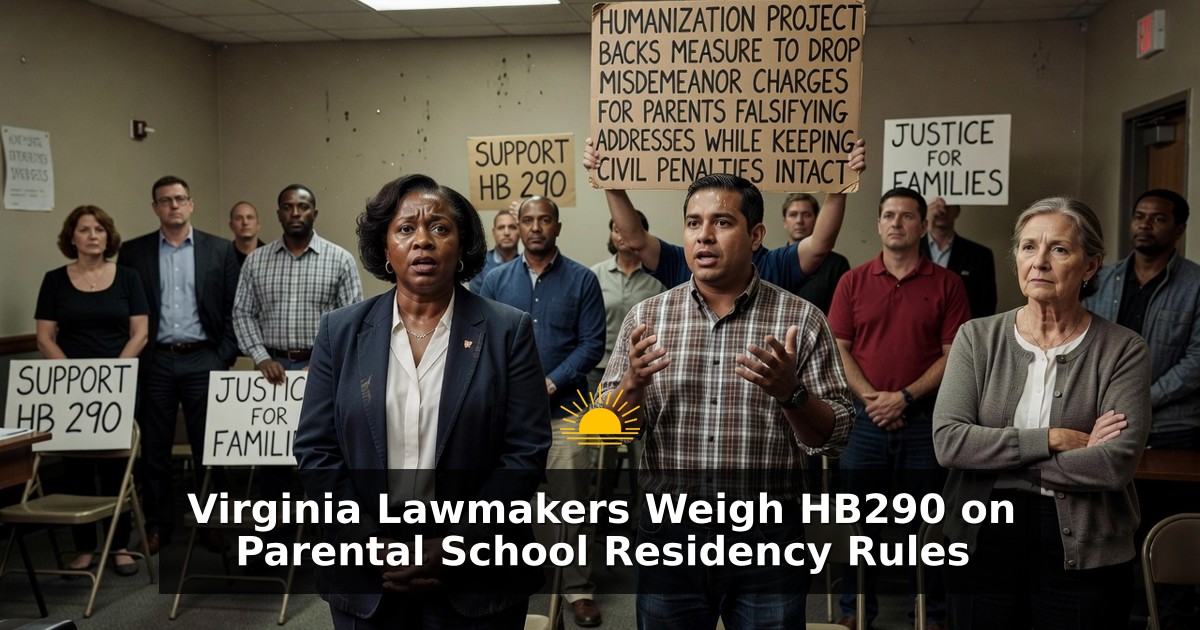
Supporters of House Bill 290 appeared before a Virginia Criminal Subcommittee to urge passage of legislation that would remove criminal misdemeanor penalties for parents who provide false residency information to enroll children in different public schools. Sean Winnett of the Humanization Project told lawmakers the measure preserves a civil penalty for the underlying conduct while eliminating the lasting personal costs that accompany a criminal conviction. The discussion centered on families who cross district lines in search of stronger academic programs, safer campuses, or specialized services unavailable in their home zones. Officials noted that current statutes treat such residency misrepresentations as criminal offenses that can trigger court records and secondary restrictions. Advocates framed the proposal as a targeted adjustment rather than a repeal of accountability standards.
The bill leaves financial and administrative sanctions in place so school divisions retain tools to recover costs and deter repeated violations. Winnett emphasized that the civil framework already addresses the fiscal impact on receiving districts without imposing a permanent criminal label. Subcommittee members heard that a misdemeanor on a parent’s record can interfere with routine family activities long after any fine is paid. One concrete example raised during testimony involved restrictions that sometimes bar individuals with certain convictions from chaperoning school field trips or volunteering in classrooms. Proponents argued these downstream effects extend punishment beyond the original residency issue and into everyday parental involvement.
Collateral Consequences of Misdemeanor Records
Criminal convictions, even at the misdemeanor level, generate a range of collateral consequences recognized across Virginia’s legal and social service systems. Background checks for employment, housing applications, and professional licensing frequently surface such records and can limit opportunities years later. Parents who already face economic pressure may find that a conviction compounds difficulties when they seek better-paying work or stable housing near higher-performing schools. Education officials have long documented that family instability itself correlates with lower student outcomes, creating a cycle the bill’s backers hope to interrupt. Removing the criminal designation while retaining civil liability is presented as a way to maintain deterrence without amplifying those broader hardships.
Virginia law currently requires students to attend schools based on the bona fide residence of their parents or legal guardians, a rule designed to allocate local funding and classroom seats fairly. Enforcement actions have historically included both civil recovery of tuition-equivalent costs and criminal referrals in cases of deliberate falsification. Data from prior legislative sessions show that residency disputes arise most often in regions where adjacent districts display wide gaps in test scores, extracurricular offerings, or student-teacher ratios. Families cite overcrowding, limited advanced coursework, or safety concerns as primary motivations for seeking enrollment elsewhere. HB290 does not alter the underlying residency requirement; it recalibrates only the punitive response once a violation is established.
Advocacy Perspective and Legislative Balance
The Humanization Project described its support as grounded in the principle that parents acting to improve a child’s educational trajectory should not automatically face criminalization. Winnett stated that the organization believes accountability remains essential yet can be achieved through civil channels that avoid the stigma and practical barriers of a misdemeanor. He requested that the subcommittee report the bill favorably so the full legislative process can consider the distinction between civil and criminal remedies. No opposing testimony was detailed in the available record of the hearing, leaving the focus on the proponents’ cost-benefit analysis. Lawmakers customarily weigh such measures against concerns that reduced penalties might encourage more frequent violations or strain district budgets.
Broader Context of School Choice Pressures
Across the Commonwealth, demographic shifts and uneven resource distribution continue to fuel debates over how strictly residency rules should be policed. Urban and suburban divisions often experience enrollment pressures when nearby localities offer magnet programs, career academies, or newer facilities. Civil penalties can include repayment of per-pupil expenditures, which in Virginia vary by locality but commonly reach several thousand dollars annually. Retaining those financial consequences under HB290 is intended to protect taxpayers while acknowledging that a criminal record may hinder a parent’s ability to support the very child the enrollment decision sought to help. Researchers who study education access note that housing costs near high-performing schools frequently exceed the means of working families, prompting some to risk residency violations.
Policy analysts observing similar proposals in other states report mixed outcomes when criminal sanctions are lowered. Some jurisdictions have shifted emphasis toward administrative hearings and graduated civil fines, finding that compliance rates remain stable when detection and cost-recovery mechanisms stay robust. Virginia’s approach under the pending bill would align with that model by keeping investigative authority and monetary remedies intact. The legislation does not create new enrollment rights or expand formal school-choice programs; it simply adjusts the severity of consequences for an existing prohibited act. Stakeholders on all sides agree that accurate residency data underpins equitable funding formulas and facility planning.
Potential Implementation Questions
If enacted, school divisions would continue to verify addresses through standard documentation and investigative protocols already in use. The change would affect charging decisions by prosecutors and the subsequent court processing of cases that today can result in misdemeanor dockets. Parents confronting civil actions would still face financial liability and possible enrollment denial or removal, preserving a clear disincentive. Advocates maintain that this structure better matches the nature of the offense, which centers on administrative and fiscal integrity rather than violence or theft. Subcommittee review represents an early step; any final statute would require alignment with existing education and criminal codes to avoid ambiguity in enforcement.
Closing Considerations for Families and Districts
The core argument advanced for HB290 rests on proportionality: civil penalties can enforce rules and recover costs without attaching lifelong collateral damage to parents motivated by educational improvement. Testimony underscored that a misdemeanor conviction can restrict participation in school life, employment prospects, and other civic activities that indirectly benefit children. By separating the penalty structure from the criminal code, the bill seeks to keep responsibility centered on the residency violation itself. Virginia’s legislative process will determine whether the distinction between civil and criminal responses gains broader support in subsequent committee and floor votes. Observers note that clarity in final language will be essential so both families and school administrators understand the revised boundaries of enforcement.
actions better Children Crime criminalizing Decriminalizing Education Field Trip HB290 keeps opportunities Parental Parents prevent say School seek Support Supporters Virginia