Virginia Committee Hears Push to Reform Failure-to-Appear Laws
Updated
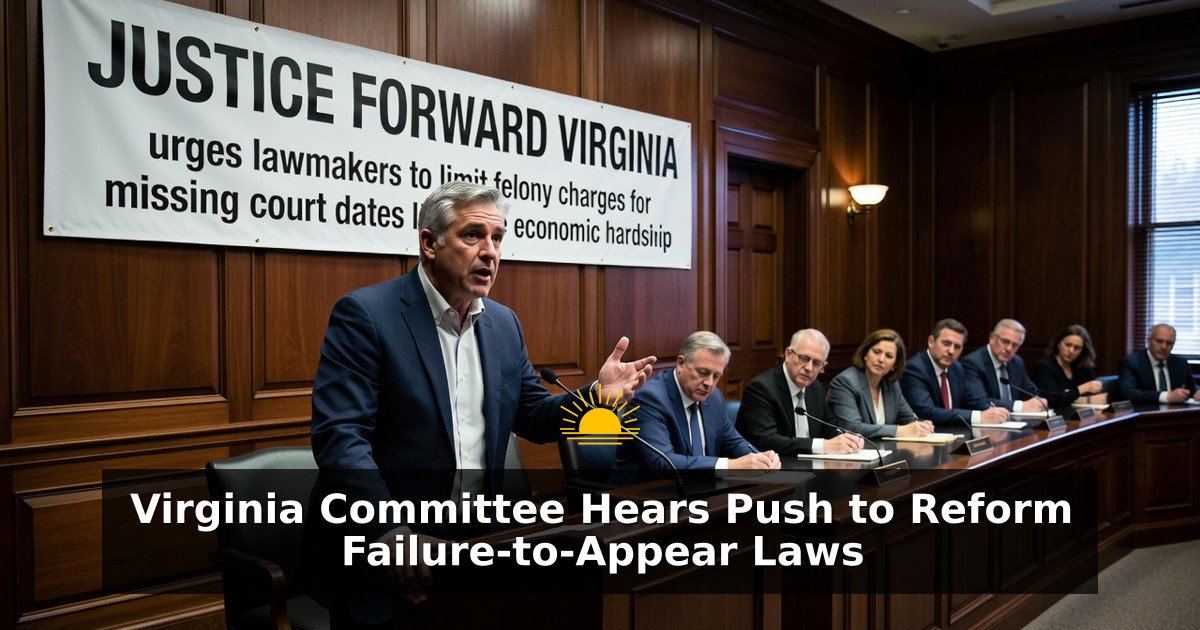
Rob Hogan of Justice Forward Virginia appeared before the Senate of Virginia Courts of Justice committee to urge support for legislation that would reform failure-to-appear laws across the Commonwealth. Speaking during the February 11, 2026, session, Hogan framed the measure as a practical step toward reducing the ways the justice system penalizes people living in poverty. He told lawmakers that individuals facing economic hardship routinely miss court dates for reasons beyond their control, turning logistical struggles into new criminal charges. The testimony highlighted how poverty intersects with transportation gaps, health barriers, and other daily obstacles that make punctual court attendance difficult.
Hogan stressed that poverty itself generates conditions that lead to missed appearances. Health problems become more frequent and harder to manage when resources are scarce, while reliable transportation remains out of reach for many low-income residents. Mental health challenges and substance-use issues are often intensified by financial stress, further disrupting schedules. Social science research consistently documents these connections, and Hogan noted that his organization’s direct work with clients living in poverty confirms the same patterns every day in Virginia communities.
Under current practice, a failure to appear can escalate into a separate felony charge even when the underlying case involves only a misdemeanor or minor matter. Hogan argued that this approach effectively criminalizes poverty by layering additional penalties onto people already struggling to meet basic needs. The proposed bill would limit the use of felony failure-to-appear charges, reduce the severity of punishments for misdemeanor versions of the offense, and require judges to weigh extenuating circumstances before entering a guilty finding. These changes, he said, would prevent the justice system from compounding economic disadvantage with new criminal records.
Background on Failure-to-Appear Enforcement
Failure-to-appear statutes exist to ensure defendants honor court summonses and to maintain the orderly administration of justice. In Virginia, missing a scheduled hearing can result in a bench warrant, additional fines, or elevated charges that carry lasting consequences for employment, housing, and future court outcomes. Critics of the status quo have long observed that these rules fall hardest on people without stable transportation, flexible work schedules, or access to childcare. When a single missed bus or an unexpected medical issue triggers a new criminal count, the original case can become secondary to the accumulating legal burdens.
Data from justice-system analyses across multiple states show that economic instability strongly correlates with higher rates of nonappearance. Individuals who lack private vehicles or live far from courthouses face longer travel times and higher costs simply to comply with a summons. Chronic health conditions more prevalent in low-income populations can flare without warning, making it impossible to appear on a given day. Hogan pointed to these realities as evidence that the current framework does not adequately distinguish willful evasion from circumstances rooted in poverty.
Details of the Proposed Reforms
The legislation under discussion would narrow the circumstances in which a failure to appear rises to felony level. It would also scale back available penalties for misdemeanor failure-to-appear convictions, reducing the long-term collateral damage such records can inflict. A further provision would direct judges to consider documented hardships—such as medical emergencies, lack of transportation, or verified family crises—before deciding guilt. Hogan described the package as a targeted correction rather than a wholesale repeal of accountability measures.
Supporters maintain that the bill leaves intact the core tools courts already possess to address deliberate flight or repeated noncompliance. Hogan specifically addressed concerns that the changes might encourage defendants to ignore court dates in hopes that cases would weaken over time. He noted that such incentives already exist under present law and that the proposal does not enlarge them. Instead, he said, the measure simply removes the forced choice between absorbing a new felony charge and watching an underlying case deteriorate while a defendant remains unable to appear.
Broader Context of Poverty and Justice System Contact
Virginia’s courts handle thousands of failure-to-appear matters each year, many of them tied to traffic offenses, minor misdemeanors, or preliminary hearings. When poverty-related barriers convert these matters into additional criminal cases, jail populations and court dockets both expand. Research on justice involvement repeatedly finds that even short periods of incarceration or the mere existence of an open warrant can disrupt employment, interrupt medical care, and deepen financial instability. Reform advocates argue that interrupting this cycle at the failure-to-appear stage offers a cost-effective way to reduce unnecessary system contact.
Justice Forward Virginia works directly with clients navigating these pressures and has documented repeated instances in which transportation breakdowns or health crises—not intentional defiance—led to new charges. Hogan’s testimony placed those client experiences alongside established social-science findings to underscore that the problem is structural rather than individual. By requiring consideration of extenuating circumstances, the bill would give judges clearer authority to distinguish unavoidable absence from willful disregard.
Committee Considerations and Next Steps
Members of the Senate Courts of Justice committee heard the presentation as part of ongoing review of criminal-procedure measures. The discussion touched on the balance between ensuring court appearance and avoiding the creation of new offenses that primarily capture economic hardship. Hogan closed by reiterating that the legislation would not worsen existing incentives for delay; it would merely prevent the automatic escalation of poverty-driven absences into felony exposure. Lawmakers are expected to weigh the proposal alongside other justice-system bills during the session.
Observers note that similar reforms in other jurisdictions have focused on reminder systems, transportation assistance, and graduated responses before criminal charges are filed. Virginia’s measure centers on charging thresholds and judicial discretion rather than new support programs, keeping the fiscal footprint limited while still addressing the core critique. Whether the bill advances will depend on further committee deliberation and floor consideration in the weeks ahead.
The testimony underscored a central tension in contemporary criminal justice policy: how to maintain the integrity of court processes without converting the symptoms of poverty into additional crimes. By limiting felony failure-to-appear charges, moderating misdemeanor penalties, and mandating attention to extenuating circumstances, the proposal seeks a narrower, more proportionate response. Hogan’s appearance before the committee added a practitioner’s perspective to the legislative record, grounding abstract policy questions in the daily realities faced by low-income Virginians who must navigate courthouses across the Commonwealth.
advocates appear argue bill Courts of Justice decriminalization Decriminalize economic hardship failure failure to appear Justice Forward Virginia justice reform legal reform limiting poverty Rob Hogan Senate systemic issues Virginia