Advocacy Group Backs Virginia Bill Expanding Plug-In Solar Access
Updated
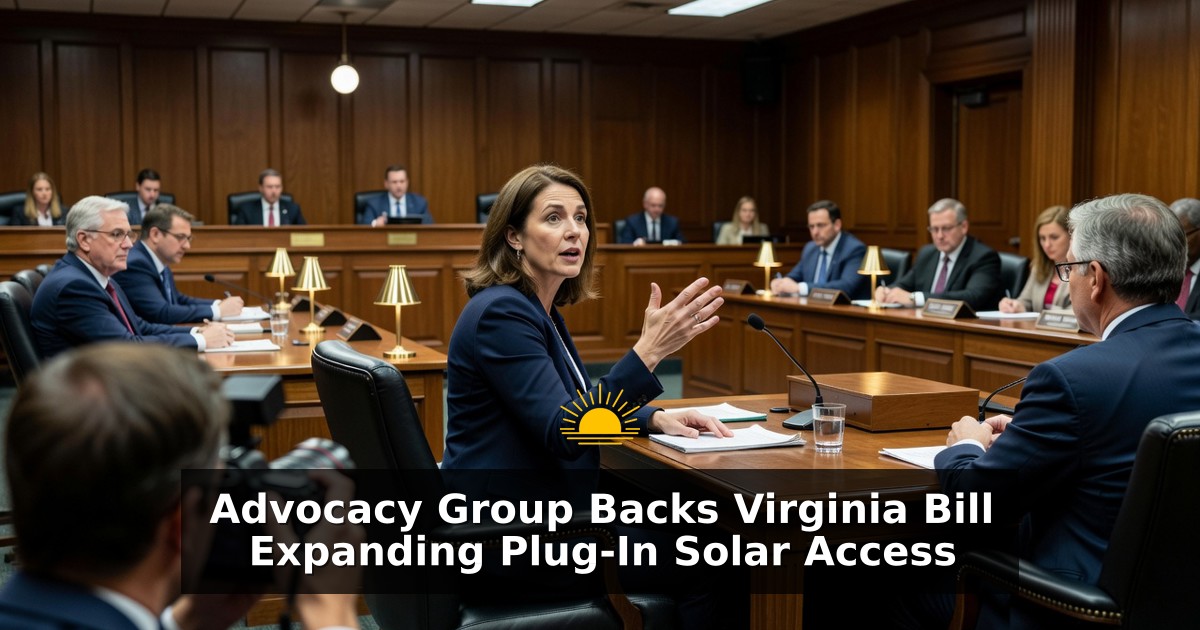
A representative from the Climate Action Network Action Fund recently expressed support for House Bill 395 during a Virginia Labor and Commerce Subcommittee hearing focused on energy policy. Victoria Higgins told lawmakers the measure would make clean energy more affordable, accessible, and practical for everyday residents across the commonwealth. She emphasized that the legislation centers on plug-in solar systems as a key tool for households facing higher utility costs. These systems are positioned as an option particularly suited to people who cannot pursue conventional rooftop installations. The testimony underscored broader goals of expanding renewable energy participation without requiring major home ownership investments.
Plug-in solar systems function as compact, consumer-oriented devices that connect directly into standard household electrical outlets. Unlike traditional rooftop arrays, they typically require no structural alterations, extensive wiring, or large capital outlays for mounting hardware. Manufacturers design many of these units with built-in safety features and third-party certifications to meet basic electrical standards. Users can place them on balconies, patios, or other available outdoor spaces to generate modest amounts of electricity. Proponents note that such simplicity lowers barriers for individuals who rent their homes or lack suitable roof conditions.
Rising electricity expenses have placed growing pressure on household budgets throughout Virginia in recent years. Many families report difficulty absorbing incremental rate adjustments tied to fuel costs, infrastructure upgrades, and seasonal demand. Low- and middle-income residents often experience a higher energy burden, meaning a larger share of monthly income goes toward utility payments. Renters face additional constraints because they usually cannot authorize permanent modifications to properties they do not own. Plug-in solar options aim to give these groups a pathway to produce some of their own power and reduce net consumption from the grid.
Energy equity remains a central theme in discussions surrounding clean power adoption. Homeowners with sufficient credit, roof space, and disposable income have historically captured most of the benefits from solar incentives and net-metering programs. By contrast, apartment dwellers and residents of multi-family housing frequently remain excluded from those same opportunities. Advocates argue that portable or plug-in technologies can begin to close that gap by offering scalable, lower-cost entry points. House Bill 395 is framed by supporters as one step toward distributing renewable energy advantages more evenly across income levels and housing types.
Safety and consumer protection form another pillar of the case presented for the legislation. Higgins described plug-in solar products as simple and safe tools that carry consumer certifications. Regulatory frameworks in various jurisdictions already address interconnection standards, anti-islanding protections, and labeling requirements for small-scale generation devices. Clear statutory language can help utilities, local inspectors, and residents understand how these systems interact with existing electrical infrastructure. Establishing consistent rules may also encourage responsible manufacturers to expand product availability within the Virginia market.
Broader clean energy trends in the commonwealth provide additional context for the proposal. Virginia has steadily increased its solar generating capacity through utility-scale projects and distributed rooftop installations over the past decade. State energy plans have outlined targets for reducing carbon emissions from the power sector while maintaining reliability. Distributed resources such as small plug-in units can complement larger facilities by supplying power close to where it is consumed. This localized generation may ease strain on distribution circuits during peak afternoon periods when solar output is highest.
Economic considerations extend beyond individual bill savings. When households generate even modest amounts of electricity on-site, they reduce the volume of power that must be purchased from retail suppliers. Over time, widespread adoption of small systems could influence overall demand patterns and contribute to more stable wholesale market conditions. Local installers, retailers, and certification bodies might see new service opportunities tied to the technology. Policymakers weighing the bill must balance these potential gains against any administrative costs associated with updating interconnection procedures or consumer education materials.
Practical implementation questions will likely shape the final form of any enacted measure. Lawmakers typically examine how utilities would credit or account for energy injected by plug-in devices, whether size limits are appropriate, and what disclosure requirements should apply at the point of sale. Technical standards bodies already publish guidelines covering inverter performance and grid compatibility for small generators. Aligning state statute with those established benchmarks can reduce uncertainty for both consumers and grid operators. Continued stakeholder input from consumer advocates, utilities, and housing organizations often refines such details during the legislative process.
Public interest in affordable renewable options continues to grow as climate and cost concerns intersect. Surveys of Virginia residents frequently show support for policies that expand clean energy choices while protecting household budgets. Plug-in solar systems occupy a niche between fully portable battery kits and permanent rooftop arrays, offering an intermediate solution. Their relative ease of use may appeal to younger renters, retirees on fixed incomes, and families in transitional housing situations. Supporters contend that removing unnecessary regulatory friction around these products can accelerate voluntary adoption.
The subcommittee hearing provided a formal venue for organizations to place their positions on the record. Higgins concluded her remarks by reiterating the Climate Action Network Action Fund’s endorsement of the bill on grounds of affordability, accessibility, and practicality. Other witnesses and written comments customarily address complementary or opposing perspectives during the same session. Committee members then weigh the accumulated testimony against fiscal impact statements and existing code provisions. The process reflects the deliberative approach Virginia’s General Assembly applies to energy-related legislation each session.
Looking ahead, the trajectory of House Bill 395 will depend on further committee action, potential amendments, and floor consideration in both chambers. Similar proposals in other states have sought to clarify the legal status of small plug-and-play solar devices and to streamline any required notifications to utilities. Outcomes vary according to local grid characteristics, existing net-metering rules, and consumer protection statutes. Virginia’s decision will add to the growing body of state-level experience with distributed solar innovations. Observers will monitor whether the final language successfully balances expanded access with operational safeguards.
In summary, the endorsement delivered by the Climate Action Network Action Fund highlights an effort to broaden participation in clean energy through technology suited to renters and cost-sensitive households. Plug-in solar systems are presented as certified, user-friendly tools capable of offsetting portions of electric bills. The discussion forms part of ongoing policy work aimed at aligning Virginia’s energy mix with affordability and equity objectives. Continued examination of technical, economic, and regulatory factors will determine how effectively the proposed framework serves residents across diverse housing and income circumstances.
affordable energy Clean Energy clean energy access Climate Action Network electric bills energy costs energy equity energy legislation energy solutions HB 395 low income households renewable energy Renters solar access solar affordability solar bill solar systems Victoria Higgins Virginia Virginia General Assembly Virginia legislation