Virginia Lawmakers Advance Tax on Fantasy Contest Revenues
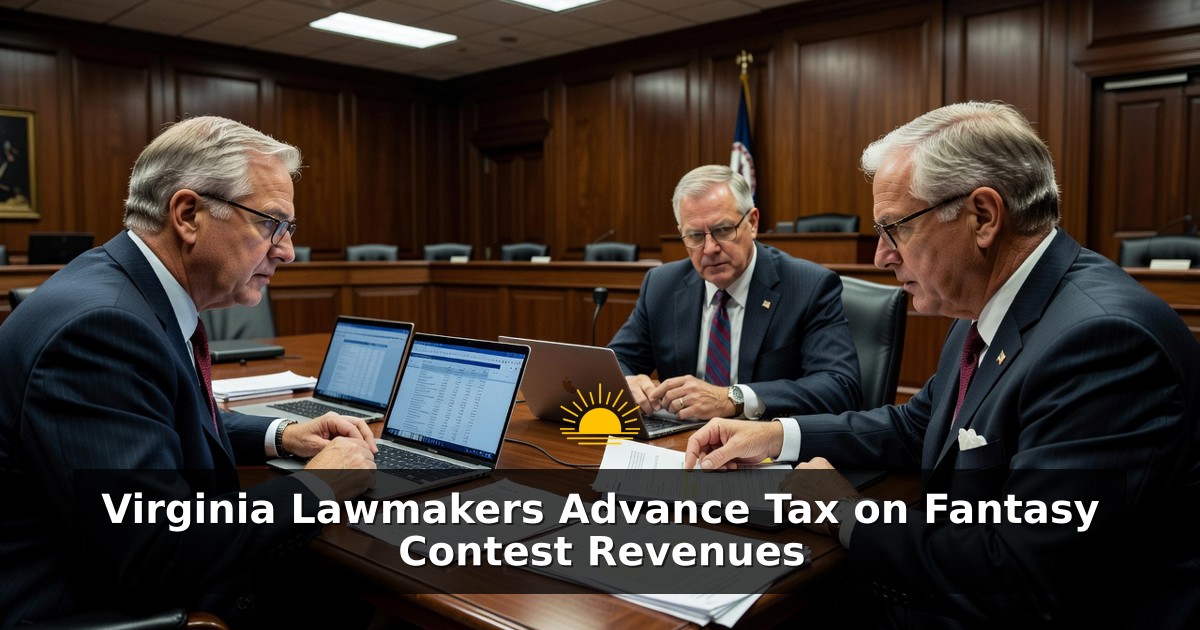
Virginia legislators are moving forward with a measure that would place a new tax on the growing fantasy contest industry operating within the commonwealth. House Bill 145 proposes a 10 percent tax on fantasy contest operator revenue as a means of both regulating the sector and generating public funds. The legislation directs 5 percent of the resulting tax revenue to the problem gaming treatment and support fund while sending the remaining 95 percent to the general fund. Committee action on the bill reflected broad agreement, with members unanimously reporting the measure and referring it to the appropriations committee for further review.
Fantasy contests have become an established part of the entertainment and gaming landscape in Virginia over the past decade. These contests typically involve participants assembling virtual teams of real athletes and competing for prizes based on statistical performance. State officials have long recognized the need for clear rules that protect consumers while allowing legitimate operators to conduct business. House Bill 145 builds on that foundation by introducing a dedicated revenue mechanism tied directly to operator earnings rather than relying solely on registration fees or other administrative charges.
The structure of the proposed tax is straightforward yet carefully balanced. Operators would calculate the levy against their fantasy contest revenue generated from Virginia participants. Of every dollar collected under the 10 percent rate, five cents would flow into programs that address problem gaming. The bulk of the proceeds, ninety-five cents of each tax dollar, would enter the general fund to support a wide range of state services. Lawmakers designed the split to ensure that the social costs sometimes associated with gaming receive dedicated attention without diverting the majority of new revenue from core public needs.
Legislative Path and Committee Action
Members of the General Laws committee gave House Bill 145 unanimous approval before sending it onward. The referral to appropriations signals that fiscal details will receive close examination in the coming weeks. Appropriators customarily review revenue estimates, administrative costs, and interactions with existing gaming statutes. Because the bill cleared its first hurdle without opposition, observers expect a focused discussion on implementation timelines and reporting requirements rather than a debate over the basic concept of taxation.
Virginia already maintains a problem gaming treatment and support fund financed in part by other forms of legalized gaming. Adding a stream from fantasy contest revenue would expand the resources available for counseling, public awareness campaigns, and research into gambling-related harm. Health officials and nonprofit providers have repeatedly noted that early intervention services reduce long-term social costs. By earmarking a fixed percentage of the new tax, the bill creates a predictable funding source that can grow alongside the industry itself.
Context of Fantasy Gaming Oversight in the Commonwealth
The commonwealth first established a formal regulatory framework for fantasy contests several years ago. That framework requires operators to register, maintain fair play standards, verify participant ages, and segregate player funds. Taxation under House Bill 145 would complement those consumer-protection rules by ensuring the state shares in the economic activity the contests generate. Similar approaches have been applied to sports betting and casino gaming, producing a consistent policy posture across different segments of the industry.
Operators would need to adjust accounting systems to track Virginia-sourced revenue separately and remit the tax on a schedule set by the Department of Taxation or another designated agency. Compliance costs are expected to be modest for larger platforms already accustomed to multi-state reporting. Smaller or emerging operators might face a steeper initial learning curve, yet the uniform 10 percent rate offers clarity that many businesses prefer over complex tiered structures. The bill does not alter existing registration fees or consumer-protection mandates, keeping the focus narrowly on revenue.
Public discussion surrounding the measure has centered on the twin goals of industry accountability and support for residents who experience gaming-related difficulties. Advocates for the treatment fund emphasize that even a small percentage of tax collections can underwrite hotlines, outpatient counseling, and training for clinicians. At the same time, general-fund advocates point out that fantasy contest activity draws discretionary consumer spending that can reasonably contribute to schools, transportation, and public safety budgets. The 5-to-95 split attempts to honor both priorities simultaneously.
Potential Effects on the Marketplace and State Finances
If enacted, the tax would apply uniformly to all licensed fantasy contest operators offering services to Virginia residents. Revenue projections will depend on participation levels, prize pools, and the overall popularity of professional and college sports seasons. Because the industry has shown steady growth, even conservative estimates suggest a meaningful addition to state coffers over time. Lawmakers will likely request updated fiscal impact statements once the appropriations committee begins its work.
The bill also reinforces Virginia’s reputation for measured regulation of emerging entertainment sectors. Rather than prohibiting fantasy contests or leaving them entirely untaxed, the General Assembly continues to refine a middle path that legalizes the activity, imposes consumer safeguards, and captures a share of the proceeds for public benefit. House Bill 145 fits squarely within that tradition. Its unanimous committee report indicates that members view the proposal as a logical next step rather than a controversial departure.
Further hearings will give operators, treatment providers, and budget analysts opportunities to comment on technical details. Topics likely to arise include the precise definition of taxable revenue, audit procedures, and coordination with multi-state operators. Drafting refinements may occur, yet the core architecture—a 10 percent tax with a dedicated slice for problem-gaming services—appears to enjoy solid support. The appropriations referral ensures that any final version aligns with broader fiscal plans for the coming biennium.
As the legislative session progresses, House Bill 145 will serve as a test of how Virginia balances innovation, consumer protection, and revenue responsibility in the digital entertainment space. The measure’s early success in committee suggests that lawmakers are prepared to treat fantasy contest revenue like other forms of regulated gaming. Residents, operators, and service providers will watch closely to see how the final language shapes both the marketplace and the resources available to address problem gaming across the commonwealth.
ABC subcommittee allocation appropriation bill Chair Torian contest fantasy fantasy contest operator fantasy contest revenue General Fund House bill 145 move Mr. Chair operator problem gave me treatment and support fund revenue Six bills subcommittee tax tax revenue Vice Chair vote of -0