Virginia Bill HB 1238 Draws Support for Local Pet Shop Puppy Sale Rules
Updated
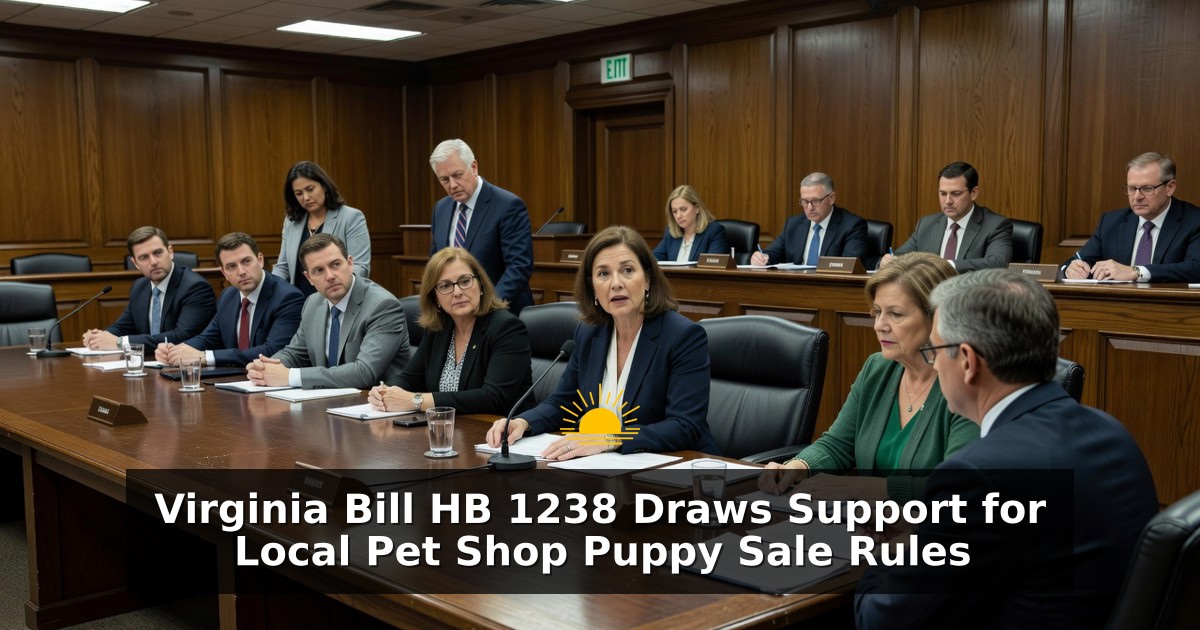
Advocates for animal welfare appeared before a Virginia legislative committee to express support for House Bill 1238, a measure focused on the sale of puppies in commercial pet shops. Cheryl Crow of Humane World for Animals delivered testimony outlining the case for the proposal and its potential benefits for communities across the commonwealth. The legislation is designed to give local governments greater authority to set standards addressing both animal welfare and consumer protection concerns. Supporters described the bill as a practical step that builds on policies already operating successfully in multiple other states. They noted that the approach has drawn interest from a wide range of political perspectives within Virginia.
Crow kept her remarks concise in order to allow additional advocates time to speak during the hearing. She highlighted that eight states have already prohibited the retail sale of puppies in pet shops, with neighboring Maryland counted among them. Delaware lawmakers are reviewing a comparable measure in the current session, according to the testimony. Crow stated that organizations such as Humane World for Animals would welcome Virginia joining those jurisdictions in adopting stronger statewide direction while still preserving local options. The hearing provided an opportunity for detailed discussion of how HB 1238 could function in practice.
Existing State Policies and Regional Context
Several states have moved in recent years to restrict or eliminate the sale of young dogs through traditional pet store channels. Maryland’s ban has been cited frequently by supporters as a nearby example that Virginia could examine closely. Proponents of HB 1238 argue that these existing laws have reduced the flow of animals from large-scale commercial breeding facilities into retail settings. They contend that the change has encouraged more adoptions from shelters and rescues while giving consumers clearer information about animal origins. Virginia’s consideration of similar authority for its cities and counties reflects growing regional attention to the issue.
Delaware’s pending legislation was referenced as further evidence of momentum along the Mid-Atlantic corridor. Advocates pointed out that the pattern of state-level action creates a natural point of comparison for Virginia policymakers. Local governments in the commonwealth currently operate under a patchwork of ordinances that vary widely in scope and enforcement. HB 1238 is presented as a vehicle for clarifying and expanding the tools available to those localities. Supporters maintain that the bill does not impose a single statewide mandate but instead enables tailored responses based on community needs.
Local Flexibility and Government Authority
A central feature of the proposal is the flexibility it would grant to counties, cities, and towns. Testimony emphasized that local elected officials are often best positioned to assess conditions in their own pet retail markets and animal shelter systems. By authorizing clearer regulatory options, the bill aims to help governments address documented problems with animal health, overcrowding, and consumer complaints. Crow and other speakers framed this local-control element as a strength that could appeal across partisan lines. They argued that communities of differing sizes and political leanings have already expressed interest in stronger oversight of commercial puppy sales.
Animal welfare organizations have long tracked the conditions under which many puppies enter the retail pipeline. Large commercial breeding operations, sometimes called puppy mills, have been the subject of repeated investigations revealing inadequate veterinary care, poor sanitation, and limited socialization. Pet shops that source from such facilities can inadvertently pass health and behavioral problems on to new owners. HB 1238 supporters say local governments need reliable statutory backing to set sourcing standards or to prohibit certain sales outright. The measure is described as one way to close gaps that currently leave both animals and buyers vulnerable.
Consumer Protection Dimensions
Beyond animal welfare, the bill is linked to everyday consumer safeguards. Families purchasing a puppy often invest significant time and money and expect the animal to be healthy. When puppies arrive with undisclosed illnesses or genetic issues, owners face unexpected veterinary costs and emotional strain. Advocates told the committee that clearer local rules could require better disclosure of breeding sources and health histories. They suggested that such transparency would reduce disputes between buyers and sellers while encouraging more responsible commercial practices.
Virginia residents already navigate a variety of local animal ordinances covering licensing, noise, and dangerous-dog designations. Adding authority over retail puppy sales would fit within that existing framework of community-level decision making. Supporters noted that some localities have attempted to act on their own only to encounter questions about the precise scope of their powers. HB 1238 is intended to resolve those ambiguities and provide a firmer legal foundation. The result, according to testimony, would be more consistent protection for the public without removing all commercial options.
Broad Political Resonance
The caption and testimony both underscored that the bill has attracted interest from a spectrum of political communities. Animal welfare measures sometimes bridge traditional divides because they touch on shared values of responsibility and compassion. Local control provisions further broaden the appeal by respecting the preferences of different regions within Virginia. Rural counties and urban cities may choose different approaches under the flexibility the legislation contemplates. That adaptability was presented as a reason the proposal could advance with bipartisan consideration.
Humane World for Animals and allied advocates used the hearing to place Virginia’s debate in a national context. With eight states already operating under bans and another neighbor actively deliberating, the commonwealth faces a clear set of working examples. Crow’s organization indicated it stands ready to assist localities that wish to craft ordinances once enabling authority is clarified. Other speakers reinforced the message that the time is appropriate for Virginia to modernize its approach. The collective testimony painted HB 1238 as a measured response rather than an abrupt overhaul.
Implementation Considerations for Localities
If enacted, the bill would require careful coordination between state guidance and local drafting of ordinances. Counties and cities would need to examine their current pet-shop licensing systems and shelter capacities. Public education campaigns could help residents understand any new sourcing rules or sales restrictions. Enforcement mechanisms would likely rely on existing animal-control officers and health departments already familiar with commercial animal facilities. Supporters expressed confidence that these practical steps are manageable given the experience of other states.
Shelter and rescue groups operating in Virginia have reported steady demand for adoptable dogs of many breeds and ages. Reducing commercial puppy volume in pet shops could, in the view of advocates, redirect more families toward those nonprofit channels. At the same time, responsible local breeders who sell directly to the public would remain unaffected under the models used elsewhere. The distinction between retail pet-shop sales and direct breeder transactions is a common feature of the laws already in force in the eight states cited. HB 1238 appears designed to preserve that same distinction while empowering local choice.
Ongoing Legislative Discussion
Committee members heard the testimony as part of the broader review of measures affecting counties, cities, and towns. The presence of multiple advocates signaled organized interest in moving the bill forward during the session. Cheryl Crow’s decision to shorten her own remarks so that additional voices could be heard illustrated the depth of support assembled for the hearing. Each speaker reinforced the core themes of animal welfare, consumer protection, and local flexibility. Together they presented a coherent case grounded in the experience of neighboring jurisdictions.
Virginia’s animal-related statutes have evolved gradually over many sessions to reflect changing public expectations. HB 1238 continues that pattern by focusing on a specific commercial practice that has drawn scrutiny nationwide. The bill’s emphasis on enabling rather than mandating local action differentiates it from stricter statewide bans adopted elsewhere. Advocates believe this balanced design increases the likelihood of durable implementation once localities begin to use the new tools. Continued dialogue between lawmakers, local officials, and animal-welfare groups will shape the final form of any enacted language.
As the legislative process continues, the facts presented in testimony remain straightforward. Eight states including Maryland already prohibit puppy sales in pet shops, Delaware is weighing similar steps, and Virginia advocates seek comparable authority for their own communities. House Bill 1238 is offered as the vehicle to supply that authority while respecting the diversity of local conditions across the commonwealth. The hearing record now contains clear statements of support from Humane World for Animals and fellow advocates who see the measure as both timely and practical. Further committee work will determine how the proposal advances in the weeks ahead.
annual inspection bill Cheryl Krow committee Daphne Neckman Delaware food and water HB1238 Humane World for Animals Legislation local governments local option Maryland paperwork People for the Ethical Treatment of Animals pet shops puppies puppy selling record keeping registration Senate state regulatory process Virginia