Franklin City School Board Examines Textbook Budget Stability
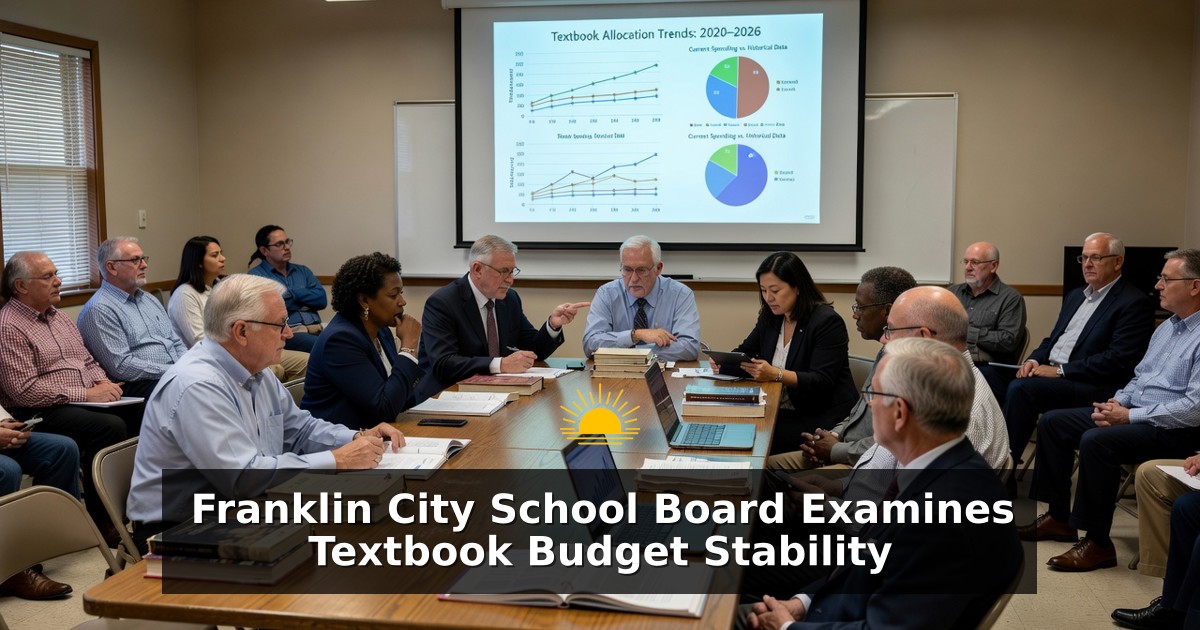
The Franklin City School Board in Virginia held a meeting on July 16, 2026, to review allocations for instructional materials with a focus on textbooks. Board members sought clarity on how current spending compared with prior fiscal years and what that meant for classroom resources. Officials noted the existence of a dedicated textbook fund while acknowledging that precise figures from the immediately preceding year were not available during the session. The discussion underscored the importance of stable funding streams for ensuring students have access to up-to-date learning materials aligned with state standards.
Franklin City is an independent city in southeastern Virginia, and its school board oversees Franklin City Public Schools. The current members of the Franklin City School Board are Melvin Boone, Jeanette Parker, Robert Francis, Latara Trent, and Wynita Rawls. These five elected officials are responsible for approving budgets, setting policy, and monitoring academic resources for the division. Their deliberations on textbook costs form part of the broader annual budget process that supports roughly one thousand students across the city’s schools.
Textbook Funding Overview
Virginia localities maintain textbook funds to purchase both print and digital materials adopted under state guidelines. Franklin City follows the same framework, drawing on a combination of state Standards of Quality payments and local appropriations. Board members observed that approved textbook titles carry set rates negotiated through the state adoption cycle, which helps limit sudden price swings. This structure has kept overall expenditures relatively consistent even when enrollment or course offerings shift slightly from year to year.
During the meeting, one member asked whether a formal comparison analysis had been prepared to measure any increase or decrease against earlier budgets. Staff responded that while a textbook fund is in place, the exact prior-year totals were not on hand that evening. The exchange highlighted a routine challenge in smaller divisions where detailed historical ledgers sometimes require additional retrieval time. Nevertheless, participants agreed that costs have remained largely stable because of the fixed pricing attached to state-approved titles.
Historical Spending Patterns
Textbook purchasing is not a new activity for Franklin City Public Schools. The division has acquired materials through successive adoption cycles covering core subjects such as mathematics, science, English, and social studies. State regulations encourage localities to replace or update texts on a multi-year schedule so that content stays current with Virginia Standards of Learning. Because unit prices are established in advance, year-to-year budget lines tend to show only modest variation unless a major new adoption occurs.
Research into statewide practices shows that many Virginia divisions report similar stability when they stay within the approved list. Local supplements may be added for consumable workbooks or digital licenses, yet the base cost per student rarely fluctuates dramatically. In Franklin City the absence of immediate prior-year numbers did not prevent members from concluding that the present allocation sits within historical norms. This continuity allows planners to forecast needs without large contingency cushions.
Impact on Classroom Resources
Stable textbook funding directly affects the quality and equity of learning materials available to students. When budgets hold steady, teachers can rely on complete classroom sets rather than shared or outdated copies. Digital platforms that accompany modern texts also remain accessible, supporting both in-person and hybrid instruction. Board members recognized that even small variances in the textbook line can influence whether supplemental resources reach every grade level on schedule.
Education finance studies indicate that instructional materials typically represent a modest percentage of an overall school division budget, yet their visibility in daily classroom life is high. Parents and teachers often notice shortages more quickly than changes in other line items. By confirming that Franklin City’s costs have not spiked, the board provided reassurance that resource gaps are unlikely to widen in the coming year. Continued monitoring will still be required as new adoptions approach and as enrollment figures are updated.
Budget Process and Next Steps
The textbook conversation forms one piece of the larger budget calendar that Franklin City School Board follows each summer and fall. After initial review, staff customarily return with refined numbers once complete prior-year data are retrieved from financial systems. Members may then adjust the textbook fund upward or downward before the final ordinance is adopted. Transparency in these steps helps the public understand how local tax dollars and state aid translate into concrete classroom tools.
Observers note that Virginia’s textbook adoption process itself supplies a natural brake on cost escalation. Publishers submit bids for multi-year contracts, and localities select from the resulting list. Franklin City’s experience mirrors that of peer divisions across the commonwealth where set rates have produced predictable outlays. The board’s July discussion therefore fits a familiar pattern of due diligence rather than signaling any sudden fiscal pressure.
Broader Context for Virginia Divisions
Across Virginia, school boards balance textbook needs against competing priorities such as staffing, transportation, and facility maintenance. Smaller cities like Franklin must stretch limited local revenue while meeting the same instructional expectations as larger neighbors. The existence of a dedicated textbook fund offers a measure of protection, ensuring that materials are not entirely dependent on year-end surpluses. Board members in Franklin City demonstrated awareness of this dynamic by pressing for historical context even when immediate figures were unavailable.
State data dashboards show that per-pupil spending on instructional materials has remained within a narrow band for most divisions over the past five reported years. Franklin City’s reported stability aligns with that trend. As the division prepares subsequent budget drafts, the board is expected to revisit the textbook line once full prior-year comparisons are in hand. That follow-up will complete the analysis begun at the July 16 session and will further document how resource allocations support student learning.
Closing observations from the meeting emphasized that understanding budget allocations remains essential for effective planning. With costs anchored by state-approved rates, Franklin City Public Schools appears positioned to maintain consistent access to textbooks without abrupt reductions or spikes. The board’s methodical inquiry into past spending reinforces a commitment to fiscal clarity and to the instructional needs of local students. Further updates are anticipated as complete financial records become available for public review.
allocated Analysis board Budget City compared discussed discusses Education Franklin Franklin City funding implications School School Board Textbook textbooks VDOE