Senator Mark Warner Addresses Questions on Pro-Israel Group Contributions
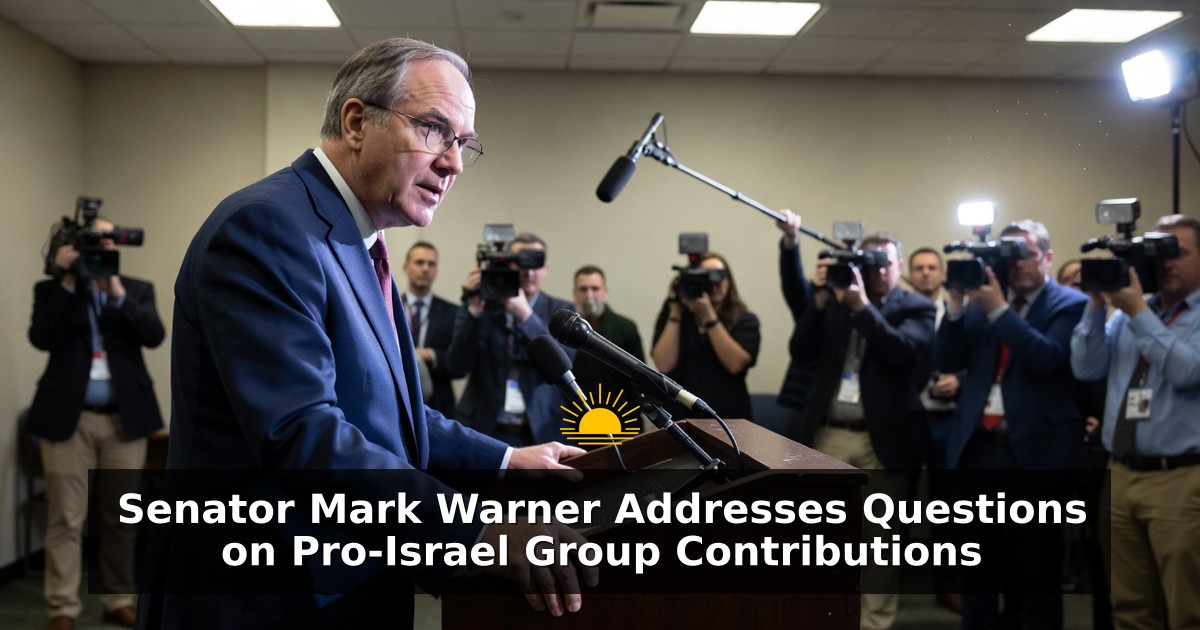
Senator Mark Warner of Virginia recently confronted pointed questions about campaign contributions from pro-Israel organizations and their potential effect on his foreign policy positions. During the exchange, he faced direct inquiries regarding totals reported by OpenSecrets that place his receipts from AIPAC near six hundred thousand dollars and from wider pro-Israel groups near eight hundred eighty thousand dollars. Warner rejected any suggestion that these funds dictate his votes or public stance on Israel. He underscored that elected officials are hired by constituents to exercise independent judgment and that accusations of purchased influence are common yet unfounded in his case.
Warner has served as a United States senator representing Virginia after earlier tenure as the state's governor. In his current role he also acts as vice chair of the Senate Intelligence Committee, a position that regularly involves oversight of national security matters tied to the Middle East. Throughout his career he has maintained that personal conviction guides legislative choices more than donor preferences. He stated clearly that no contributor can buy his vote and that voters always retain the power to remove him from office if they disapprove of his record.
Campaign finance data compiled by OpenSecrets has long tracked donations from advocacy groups focused on the United States-Israel relationship. Figures cited in the discussion indicate substantial support flowing to Warner from AIPAC-linked sources and affiliated pro-Israel political action committees. Such totals have prompted observers to examine whether financial backing correlates with consistent legislative alignment. Warner responded by noting that similar scrutiny applies across the political spectrum and that he accepts contributions from a broad range of communities.
The senator emphasized that he also receives financial support from many Muslim American groups. He explained that he refuses to apply litmus tests to potential backers unless their positions cross into clearly outrageous territory. This approach, he argued, reflects a commitment to representing diverse constituencies within Virginia and the nation. Warner framed acceptance of varied donations as standard practice rather than evidence of compromised independence.
Turning specifically to AIPAC, Warner offered a pointed critique of the organization's recent strategy. He asserted that the group has done Israel a disservice by treating support for the country as identical to support for whatever Israeli government holds power at a given moment. In his view that conflation represents a strategic mistake. Distinguishing between enduring alliance with Israel and endorsement of particular policies or administrations remains essential, according to the senator.
Political scientists and campaign finance analysts have repeatedly documented the significant role played by pro-Israel advocacy organizations in American elections. AIPAC in particular has developed extensive networks for channeling contributions and mobilizing grassroots engagement on both sides of the aisle. Critics routinely argue that such concentrated resources can shape congressional debate on military aid, diplomatic recognition, and conflict-related resolutions. Supporters counter that the activity simply mirrors the legitimate exercise of First Amendment rights by citizens who prioritize a strong bilateral relationship.
Warner pushed back against the notion that donation totals alone explain any lawmaker's posture on the Israeli-Palestinian conflict. He noted that every participant in politics faces accusations of undue influence whenever controversial votes arise. In the current climate those accusations have intensified around terms such as genocide that some activists apply to ongoing military operations. Warner made plain his resentment of claims that money rather than principle accounts for his positions.
Broader patterns of congressional fundraising reveal that members of both major parties solicit and accept funds from issue-oriented committees. Pro-Israel groups have historically directed resources toward candidates viewed as reliable partners on security cooperation and foreign assistance packages. At the same time, other ethnic and religious advocacy organizations pursue parallel strategies on behalf of their own priorities. Warner's dual receipt of pro-Israel and Muslim American contributions illustrates the overlapping donor landscapes that many senators navigate.
Transparency mechanisms such as those maintained by OpenSecrets allow journalists and citizens to quantify these flows with reasonable precision. Disclosure reports filed with the Federal Election Commission form the raw material for such tallies. When totals reach the levels attributed to Warner, public discussion naturally turns to questions of correlation versus causation. The senator's consistent reply has been that voters ultimately judge performance at the ballot box and that he will continue deciding each issue according to his own assessment of national interest.
Debates over lobbying influence extend well beyond any single organization or lawmaker. Successive administrations and Congresses have wrestled with the proper boundaries of foreign-policy advocacy inside the American system. Warner's comments add to that long-running conversation by separating affection for Israel as a strategic partner from automatic alignment with every action of its elected government. He presented that distinction as both intellectually honest and practically beneficial for the bilateral relationship itself.
Virginia voters have elected Warner multiple times on the basis of a record that spans economic development, technology policy, and national security. His willingness to accept contributions from competing interest groups while insisting on decisional autonomy fits a larger pattern among senior legislators who manage diverse donor portfolios. Whether that stance fully satisfies skeptics remains an open question that future elections and legislative votes will continue to test. For now the senator maintains that principle, not payment, determines his course.
In closing, the exchange highlighted enduring tensions between campaign finance realities and public expectations of unbought judgment. Warner's insistence that constituents hire him to do what he believes right, coupled with his specific criticism of AIPAC's messaging, offers a clear articulation of one prominent Democrat's approach. Observers tracking Middle East policy and congressional ethics will likely reference these remarks as discussions of influence and accountability proceed in the months ahead.