Testimony Opposes Virginia HB 1036 Over Dental Hygiene Training Standards
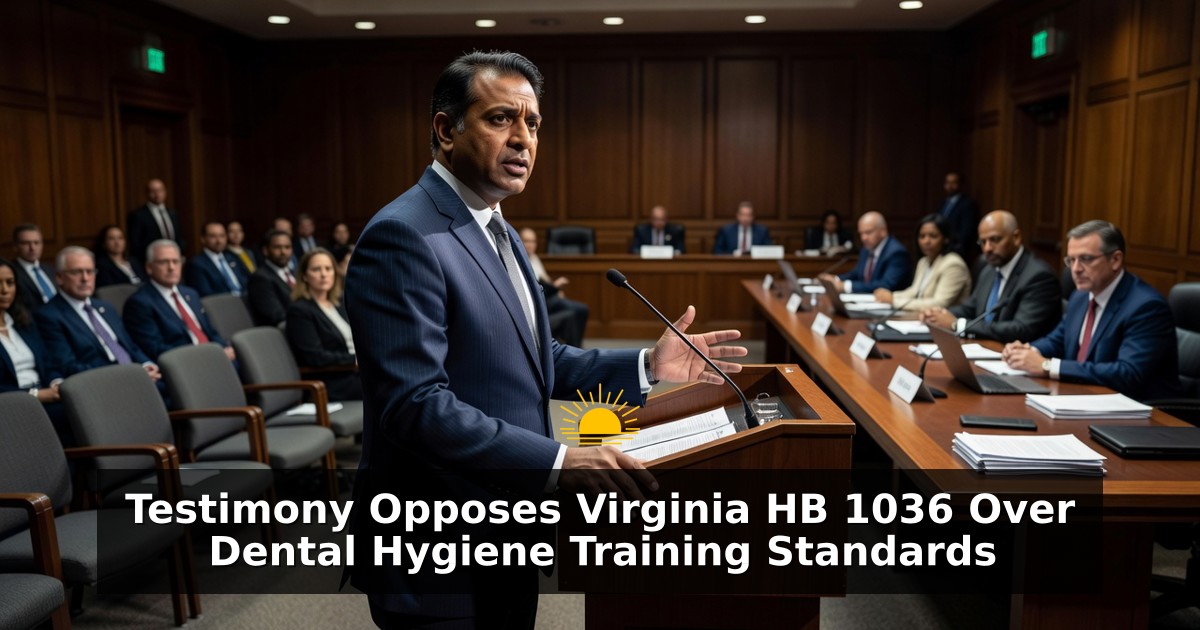
Concerns about professional preparation and patient safety took center stage during discussion of House Bill 1036 before a Virginia Health Professions Subcommittee. The measure has been framed by supporters as a way to broaden access to oral health services, yet opponents contend it would dilute established educational requirements for dental hygienists. Testimony presented during the session drew on the experiences of internationally trained dentists who ultimately pursued full dental hygiene programs rather than abbreviated pathways. Those accounts were offered to illustrate why specialized training remains essential even for individuals already holding dental degrees from other countries.
Fernanda Vaskin-Stelos-Rossi, originally educated as a dentist in Brazil, provided one of the central personal narratives referenced in the hearing. After arriving in the United States she learned that Florida permitted internationally trained dentists to qualify for dental hygiene practice by completing board examinations. The option initially appeared to offer a faster route into the profession. She soon concluded, however, that delivering oral health care carries substantial responsibility and that proceeding without targeted preparation would be inconsistent with ethical standards.
Vaskin-Stelos-Rossi therefore enrolled in the dental hygiene program at Old Dominion University in Virginia. She completed the curriculum in order to master the distinct scope of practice, clinical techniques, and regulatory expectations that govern dental hygiene in the United States. Program faculty and advocates later noted that her subsequent professional trajectory included a teaching role in the Periodontics Department at the University of Florida. They attributed that advancement in part to the rigorous foundation acquired through the accredited dental hygiene education she deliberately chose.
## Distinctions Between Dentistry and Dental Hygiene Education
Dental hygiene occupies a specialized niche within oral health care that differs in both focus and required competencies from the broader practice of dentistry. Hygienists concentrate on preventive services, periodontal assessment, patient education, and specific clinical procedures that demand dedicated coursework and supervised clinical hours. National accreditation standards set by the Commission on Dental Accreditation outline precise educational benchmarks intended to ensure consistent readiness for independent patient interaction under defined scopes of practice. Advocates arguing against HB 1036 maintained that these benchmarks cannot be assumed to transfer automatically from foreign dental degrees.
International dental education varies widely in curriculum emphasis, clinical exposure, and regulatory oversight. While many foreign-trained dentists possess extensive knowledge of diagnosis and restorative treatment, the preventive and hygiene-specific skill sets emphasized in U.S. programs may receive different levels of attention abroad. Testimony underscored that patient expectations, infection-control protocols, and documentation standards in American practice settings further necessitate targeted preparation. Opponents of the bill therefore argued that bypassing structured hygiene education risks gaps in readiness that could affect care quality.
Old Dominion University’s dental hygiene program, like other accredited offerings in Virginia, integrates didactic instruction with extensive clinical rotations. Students learn radiographic interpretation, periodontal instrumentation, risk assessment, and collaborative practice models aligned with state practice acts. Completing such a program signals to licensing boards and employers that the graduate has demonstrated competence under supervised conditions that mirror real-world demands. Presenters at the subcommittee session pointed to graduates who entered teaching and advanced clinical roles as evidence that the investment in specialized education yields long-term professional and public-health benefits.
## Workforce Needs and Access Considerations
Virginia, like many states, continues to face geographic and socioeconomic disparities in oral health access. Rural localities and underserved urban neighborhoods often report shortages of dental professionals willing to accept public insurance or to locate in high-need areas. Legislative proposals such as HB 1036 typically seek to enlarge the pool of providers by recognizing alternative credentials or creating abbreviated routes to licensure. Supporters contend that removing perceived barriers can place qualified practitioners into communities more quickly and thereby reduce untreated disease rates.
Critics counter that speed must not come at the expense of demonstrated competence in the specific discipline being practiced. They note that dental hygiene already operates under a well-defined educational pipeline that produces graduates ready to deliver preventive care safely. Introducing pathways that rely primarily on prior dental degrees and examination passage, without equivalent hygiene-focused coursework, could create uneven standards across the workforce. The testimony featuring Vaskin-Stelos-Rossi’s deliberate choice of a full program was presented as a cautionary example of why experienced clinicians themselves sometimes reject shortened routes.
Public health data consistently link regular dental hygiene services to lower rates of periodontal disease, reduced emergency-room visits for dental pain, and improved management of systemic conditions associated with oral inflammation. Maintaining high entry standards is therefore framed by opponents as a patient-protection measure rather than an obstacle to access. They argue that communities benefit most when every licensed hygienist has completed education calibrated to the exact services they will provide. The subcommittee was urged to weigh these quality considerations carefully before advancing legislation that alters longstanding preparation requirements.
## Regulatory Context and Professional Accountability
State dental boards and legislatures hold authority to set licensure criteria that balance workforce supply with public safety. In Virginia those criteria have historically included graduation from an accredited dental hygiene program together with successful completion of national and regional clinical examinations. Any statutory change that substitutes alternative credentials must still satisfy the underlying purpose of ensuring baseline competence. Presenters opposing HB 1036 asserted that the bill’s approach would depart from that principle by treating foreign dental training as sufficiently equivalent without additional hygiene-specific validation.
Ethical obligations cited in the testimony center on the principle that practitioners should not offer services for which they lack adequate preparation. Vaskin-Stelos-Rossi’s decision to invest additional years in formal hygiene education, despite holding a prior dental degree, was offered as a concrete illustration of that principle in action. Her later academic appointment was described as further validation that thorough preparation opens professional doors while simultaneously safeguarding patients. Advocates asked lawmakers to consider how many future practitioners might feel pressured to take abbreviated paths if the statute explicitly authorized them.
Additional supporting materials were referenced during the hearing but not displayed in real time; the presenter indicated those documents would be circulated to subcommittee members by email. The materials were said to reinforce the specialized character of dental hygiene education and the practical outcomes observed among internationally trained dentists who completed full U.S. programs. Collectively the testimony sought to persuade members that the bill should not advance, preserving existing educational gateways as the primary route to hygiene licensure.
## Broader Implications for Oral Health Policy
Debates over licensure pathways recur whenever states confront provider shortages or seek to integrate internationally educated health professionals. Similar discussions have arisen in medicine, nursing, and other allied fields, each time requiring careful calibration between inclusion and standards. In dentistry the distinction between the dentist’s comprehensive scope and the hygienist’s preventive focus adds a layer of complexity. Policy choices that blur those lines without corresponding educational safeguards risk unintended consequences for both professions and for the public they serve.
Observers note that Virginia’s existing dental hygiene programs already enroll diverse students, including some with prior international dental training who elect the full curriculum. These programs operate at capacity in many cases and maintain competitive admissions standards. Expanding the workforce through additional program seats, clinical training sites, or incentive programs for practice in underserved areas represents an alternative strategy that retains educational rigor. Opponents of HB 1036 suggested such approaches would better reconcile access goals with quality assurance.
The subcommittee received the testimony as part of its broader review of health-professions legislation. Members were left to evaluate whether the proposed changes would meaningfully enlarge care availability without compromising the preparation that underpins safe practice. The personal account of an internationally trained dentist who prioritized specialized hygiene education supplied a concrete reference point for that evaluation. As deliberation continues, the tension between rapid workforce expansion and steadfast educational requirements remains central to the policy choice before Virginia lawmakers.
Sustained attention to accreditation standards, clinical competency assessment, and ethical practice norms will shape whatever final action emerges. Stakeholders on all sides share an interest in reducing oral health disparities, yet they diverge on the mechanisms best suited to achieve durable improvement. The record established during the hearing, including the detailed journey of Fernanda Vaskin-Stelos-Rossi, now forms part of the public documentation that will inform subsequent decisions on House Bill 1036 and related measures.
bill board examinations Brazil dental hygiene dental hygiene program ethical responsibility Fernanda Vaskin Florida graduates internationally trained dentist Lily Salazar ODU oppose bill oral health care Parodonics Department patient care patient treatment preparation rigorous education scope of practice specialization standards testimony Throssi United States University of Florida