Virginia Measure Would Allow Local Rules on Gas Leaf Blowers
Updated
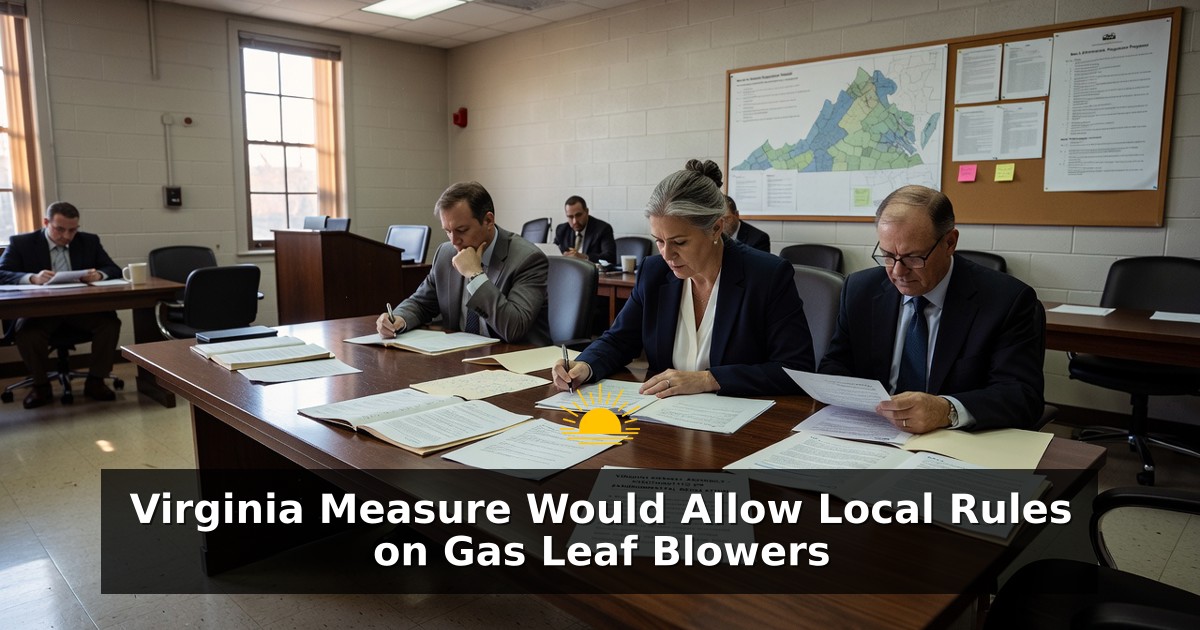
A bill under review by a Virginia legislative subcommittee would grant cities and counties the authority to decide whether to regulate gas-powered leaf blowers within their boundaries. The measure does not mandate any locality to take action and instead focuses solely on providing the option for local governments to address the equipment if they choose. Supporters of local flexibility note that conditions vary widely across the state, from dense urban neighborhoods to more spread-out rural communities. The discussion centers on balancing statewide uniformity with community-specific needs related to daily life and public health.
Lawmakers and advocates have highlighted that the proposal simply expands available tools rather than imposing a top-down requirement. In the subcommittee setting, the point was made that some jurisdictions might never exercise the power while others could find it useful. This approach aligns with broader patterns in Virginia governance in which the General Assembly often enables localities to tailor rules on quality-of-life matters. Officials familiar with local government operations observe that such enabling legislation can prevent one-size-fits-all outcomes that fail to account for differing population densities and land-use patterns.
Noise Levels and Neighborhood Disruption
Gas-powered leaf blowers are widely recognized for generating high levels of sound that can interrupt residential areas. Typical models produce noise ranging from the mid-70s to well over 90 decibels at close range, levels that exceed common conversational speech and can travel across property lines. In neighborhoods where homes sit close together, the continuous operation of these machines during routine yard maintenance can affect outdoor enjoyment, indoor concentration, and rest periods for residents. Local officials in various parts of the country have cited resident complaints about early-morning or weekend use as a recurring source of friction among neighbors.
Research on environmental noise indicates that prolonged exposure to elevated decibel levels contributes to stress responses and reduced quality of sleep for people living nearby. Virginia communities with higher housing density, particularly in the northern and eastern regions of the state, experience these effects more acutely than sparsely populated rural counties. The equipment’s design, which relies on high-velocity air to move debris, inherently creates both the sound and the airborne particles that settle on adjacent properties. Local control would allow elected boards to weigh these factors against the practical needs of property maintenance and commercial landscaping services.
Health Considerations for Operators and Bystanders
Beyond sound, gas-powered leaf blowers emit exhaust containing a mixture of pollutants that raise health questions for both users and people in the immediate vicinity. Two-stroke engines common in many handheld models release carbon monoxide, nitrogen oxides, hydrocarbons, and fine particulate matter during normal operation. These emissions occur at ground level and can linger in the air, especially on calm days or in enclosed yards. Public health literature has linked short-term exposure to such fumes with respiratory irritation, while longer-term or repeated contact raises additional concerns for vulnerable populations including children and individuals with existing lung conditions.
Operators who use the machines for extended periods face the most direct exposure, often without the benefit of enclosed cabs or advanced filtration systems found on larger equipment. Nearby residents, pedestrians, and outdoor workers can also inhale the dispersed exhaust and the dust stirred up by the high-speed airflow. Studies examining small-engine emissions have shown that a relatively short period of leaf-blower use can generate pollutant quantities comparable to those from certain passenger vehicles over much longer distances. These findings form part of the rationale offered by those who support giving localities the ability to set standards or time-of-use restrictions.
Existing Approaches in Other Jurisdictions
Several states and municipalities outside Virginia have already adopted varying degrees of regulation on gas-powered leaf blowers. Some coastal cities have phased in restrictions that favor electric or battery-powered alternatives in residential zones, citing both noise ordinances and air-quality goals. Other localities limit hours of operation or require quieter equipment certifications without enacting full bans. These examples illustrate a spectrum of policy choices rather than a single model, reinforcing the argument that Virginia communities could select approaches suited to their own circumstances if granted the underlying authority.
Electric and battery-powered leaf blowers have improved in power and run-time in recent years, offering lower noise output and zero tailpipe emissions at the point of use. Landscaping professionals note that transition costs, battery life on large properties, and performance in wet conditions remain practical considerations. A local-option framework would permit Virginia cities and counties to pilot incentives, phase-in periods, or targeted rules in the densest neighborhoods while leaving other areas unaffected. Such flexibility is often viewed as a pragmatic middle path between complete prohibition and unregulated use.
Local Government Authority and Legislative Context
Virginia’s Dillon Rule tradition means that localities generally may exercise only those powers expressly granted by the General Assembly. Enabling legislation of the type under discussion therefore becomes necessary before a city council or board of supervisors can enact leaf-blower rules. The current proposal fits within a long series of bills that expand municipal and county toolkits on issues ranging from short-term rentals to environmental management. Subcommittee review provides an early opportunity for stakeholders, including local government associations, industry representatives, and resident groups, to offer input before any measure advances further.
Proponents emphasize that the bill creates no obligation and imposes no timeline. A locality could study the matter, hold public hearings, and still decide against new rules. Conversely, a community experiencing repeated complaints could move forward with narrowly tailored ordinances. This optional character distinguishes the measure from mandates that require uniform statewide compliance. Observers of the legislative process note that similar enabling bills have historically passed when framed as restorations of local discretion rather than as new regulatory burdens.
Practical Implications for Residents and Businesses
If enacted, the legislation would shift decision-making closer to the communities most affected by leaf-blower use. Homeowners’ associations, commercial property managers, and independent landscapers would then engage with their local elected officials rather than seeking statewide exemptions or standards. Public meetings at the city or county level typically allow more detailed discussion of neighborhood-specific conditions than is feasible in Richmond. Data on complaint volumes, air-quality monitoring, and the availability of alternative equipment could inform those local deliberations.
Businesses that maintain multiple properties across jurisdictional lines might face a patchwork of rules, a common outcome whenever local option is expanded. Industry groups often request clear notice periods and consistent definitions of regulated equipment to ease compliance planning. At the same time, residents who value quieter streets and reduced exhaust have argued that the absence of local authority leaves them without effective recourse. The subcommittee conversation reflects these competing practical realities without prescribing a single outcome for every Virginia locality.
Broader Environmental and Quality-of-Life Trends
Discussions of gas-powered outdoor equipment form part of larger conversations about urban livability and small-source emissions. As battery technology advances and more municipalities adopt climate or noise-action plans, attention to leaf blowers and similar tools has increased. Virginia’s diverse geography means that coastal cities confronting both tourism and residential density may view the issue differently from inland counties focused on agricultural or large-lot maintenance. Enabling local choice acknowledges that diversity while keeping ultimate policy decisions in the hands of officials directly accountable to local voters.
The measure before the subcommittee remains at an early stage and would require further votes before becoming law. Its core feature—the grant of optional authority—has been presented as a limited step rather than a sweeping change. Whether individual localities would ultimately regulate gas-powered leaf blowers would depend on local priorities, public input, and the perceived balance between convenience and the documented effects of noise and fumes. Continued legislative scrutiny will determine if the proposal advances and in what final form.
ban bill CCT Subcommittee #3 consider disruptive fumes gas powered leaf blowers health reasons hearings Legislation localities loud equipment neighborhoods noise noxious Power quality of life regulation residents subcommittee users Virginia