Construction Cost Inflation Strains Virginia State Capital Projects
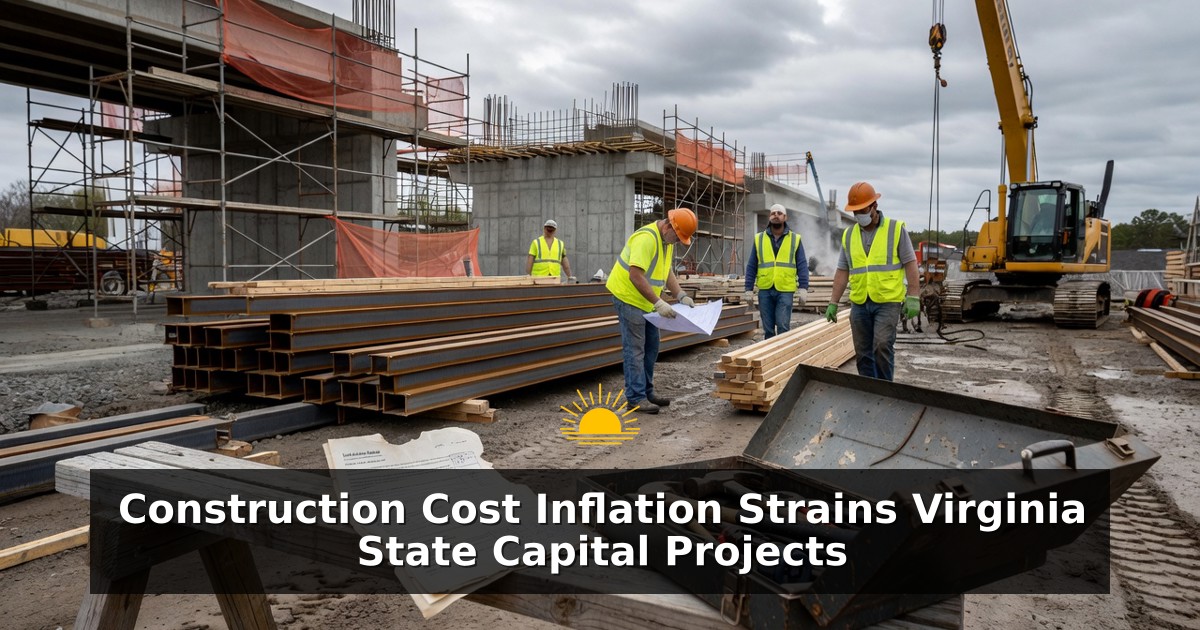
Construction inflation has significantly elevated expenses for state projects across Virginia, establishing a new and higher baseline for capital outlays in recent years. Officials noted that costs have risen more sharply than at any point in recent memory, affecting planning and budgeting for facilities managed through state agencies. Historical averages long held steady, yet market disruptions following the COVID-19 period produced cumulative increases that have not fully reversed. These changes now form the foundation upon which current and future project estimates are built, independent of additional policy adjustments.
The long-term pattern of construction cost growth averaged roughly three to three and a half percent annually for more than a century. That consistency provided a relatively predictable framework for multi-year capital planning by state entities. Since the onset of COVID-19 and related market conditions, however, aggregate construction costs climbed by approximately 35 percent. While the rate of increase has moderated from its peak, the elevated level has plateaued and become the accepted new base rather than a temporary spike. As a result, projects submitted for state consideration carry substantially higher price tags than comparable efforts from earlier decades.
Department of General Services cost estimates for projects under review reflect continued upward pressure in the near term. Projections indicate a seven percent rise for the current fiscal year, followed by a ten percent increase in the subsequent year. These figures apply across a range of state initiatives and underscore the cumulative effect of the post-pandemic reset in pricing. Planners must therefore incorporate the higher baseline before layering on any further variables that could influence final bids or timelines. The overall environment leaves little room for assumptions rooted in pre-2020 cost structures.
Labor market dynamics within Virginia compound the inflationary pressures already embedded in material and overall construction pricing. Shortages in certain skilled trades become especially pronounced when multiple large projects advance simultaneously, drawing available workers toward concentrated geographic areas. This competition for specialized labor can extend schedules and elevate wage components within total project budgets. Additional external factors, including tariffs affecting materials, introduce further variability that state estimators must monitor closely. Together these elements create an environment in which delays translate directly into higher ultimate costs.
Expeditious project management has emerged as a central recommendation for containing expenses under the new cost regime. Moving initiatives forward without unnecessary pauses helps lock in pricing before additional annual escalations take hold. Coordinated scheduling across agencies can also mitigate the localized labor shortages that arise when too many ventures compete for the same limited pool of tradespeople. Careful sequencing and prompt decision-making therefore serve as practical tools for protecting taxpayer resources. State officials emphasize that speed and coordination now carry greater financial weight than in periods of milder inflation.
The broader implications extend to the full portfolio of Virginia capital outlay requests under consideration in legislative subcommittees. Higher baseline costs reduce the number of projects that can be advanced within fixed appropriation levels, forcing sharper prioritization among competing needs. Facilities ranging from office buildings to specialized institutional structures all confront the same inflationary arithmetic. Accurate early estimates from the Department of General Services become essential for realistic fiscal planning by lawmakers and agency leaders alike. Without such discipline, funding gaps can widen between initial authorization and final delivery.
Market observers note that the plateau at the elevated 35 percent level represents both a challenge and a point of relative stability compared with the steeper climbs of prior years. The absence of a full retreat to earlier price points means that every new square foot of state construction absorbs the reset permanently. Ongoing monitoring of tariffs, supply chains, and regional labor availability will remain necessary to refine the seven and ten percent forward estimates. Agencies that integrate these data into procurement strategies stand a better chance of delivering projects close to revised budgets. Continuous adjustment rather than static assumptions defines the current operational reality.
In practical terms, the shift demands renewed attention to design efficiency, scope control, and alternative delivery methods that can compress timelines. Reducing the duration between concept approval and groundbreaking limits exposure to successive rounds of inflation. Collaboration between central estimating teams and individual agencies helps surface potential cost drivers earlier in the process. Transparent reporting of these pressures to budget writers supports more informed allocation decisions during session. The net effect is a more rigorous capital planning culture adapted to sustained higher costs.
Virginia’s experience mirrors wider national patterns yet carries distinct local features tied to the commonwealth’s simultaneous project load and trade-specific workforce constraints. The combination of a permanent post-COVID baseline with near-term escalations of seven and ten percent sets a clear agenda for the months ahead. Officials continue to stress that disciplined, rapid execution offers the most reliable path to cost containment. As subcommittees weigh competing capital requests, the inflation data provide an essential backdrop for every funding recommendation. Sustained focus on these dynamics will shape the scale and pace of state facility investment for the foreseeable future.
baseline construction construction projects cost estimates costs Covid DGS expeditious fiscal year higher costs inflation labor pressures labor shortage labor trades market conditions market issues new baseline policy changes Price Increase projects shortage tariffs Virginia