Expert Testifies Against Virginia HB-43 Over Common Law and Insurance Concerns
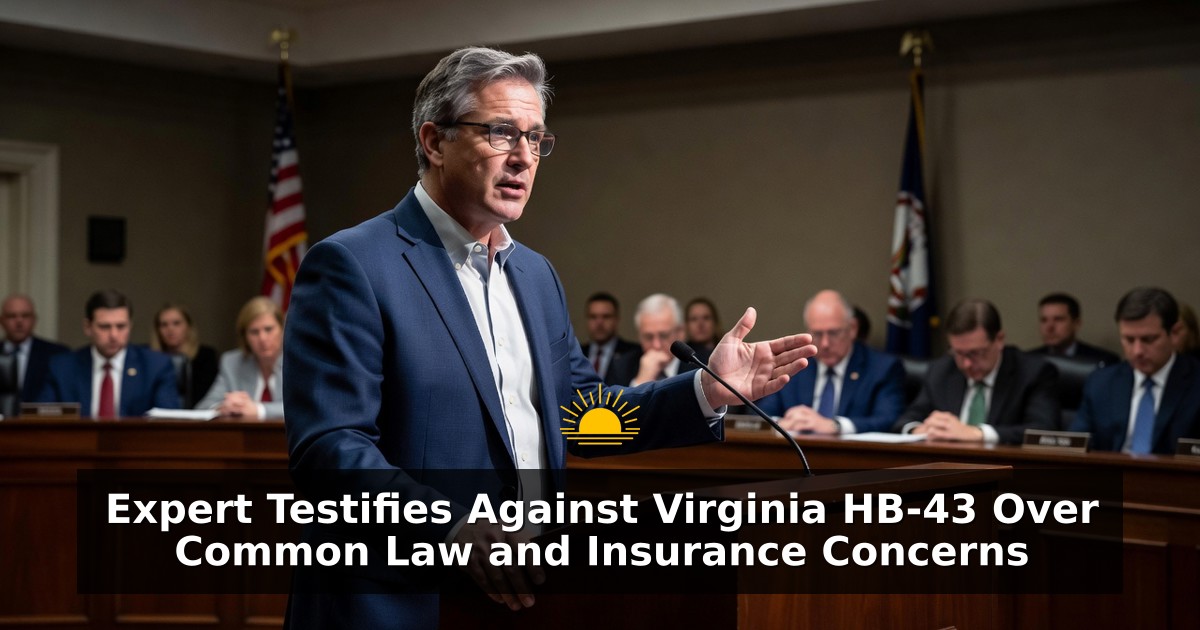
A constitutional law instructor appeared before a Virginia General Assembly criminal subcommittee to oppose House Bill 43, warning that the measure would remove a foundational common-law principle treating suicide as a wrong the state has a duty to prevent. Dr. Michael Huffman, executive director and teacher of constitutional law with the Virginia Assembly of Independent Baptist, told lawmakers the change is far from harmless. He linked the principle directly to the legal backbone supporting emergency intervention and mental-health protections across the Commonwealth. Huffman argued that abolishing the doctrine would send a public message that human life is disposable and could weaken established safeguards.
Huffman opened his remarks by identifying himself and the organization he represents before turning immediately to the substance of the bill. He stressed that the common-law view of suicide has long underpinned the authority of first responders and clinicians to act when an individual is in acute danger. Without that doctrinal foundation, he said, the legal justification for rapid intervention becomes less clear. The testimony framed the issue as one of both legal continuity and practical public safety rather than abstract philosophy.
Common-law traditions inherited by Virginia have historically regarded suicide as an act the community may lawfully seek to stop. Courts and statutes have drawn on that heritage when authorizing temporary detention orders, emergency custody, and related mental-health procedures. Huffman maintained that HB-43 would strip away this heritage and thereby unsettle the rationale for those interventions. He presented the concern as a matter of statutory and doctrinal coherence rather than partisan preference.
The witness next addressed insurance consequences, citing Virginia Code section 38.2-3106. According to his recollection of the statute, an insurer is generally required to pay life-insurance benefits even when death results from suicide, subject to only two narrow exceptions. The first exception applies when the policy itself contains an explicit suicide clause. The second exception applies when the suicide occurs within two years of the policy’s issuance. Outside those limits, Huffman stated, the code already forbids an insurer from denying payment.
He suggested that the continued existence of the common-law principle interacts with this insurance statute in ways that reinforce predictability for both carriers and beneficiaries. Removing the common-law premise, he argued, could introduce uncertainty into claims handling and underwriting assumptions that have developed around the current legal landscape. The testimony did not claim the bill would rewrite the insurance code directly; rather, it warned of secondary effects on the broader framework that supports those payouts.
Virginia’s insurance regulations have long sought to balance consumer protection with actuarial realities. The two-year suicide exclusion window is a standard feature designed to deter the purchase of coverage with immediate self-harm in mind while still ensuring that longer-term policyholders receive benefits. Huffman’s reference to section 38.2-3106 underscored that the General Assembly has already spoken clearly on the payment obligation. Any shift in underlying common-law doctrine, he implied, should be examined for unintended ripple effects on that settled statutory rule.
Beyond insurance, the testimony returned repeatedly to the theme of emergency intervention. Mental-health statutes in Virginia authorize designated professionals and magistrates to initiate custody or treatment when a person poses a danger to self. Those provisions rest in part on the premise that the state retains a legitimate interest in preventing suicide. Huffman contended that discarding the common-law characterization of suicide as a preventable wrong would undercut the moral and legal force of those statutes.
Public-health data routinely show that timely intervention can interrupt suicidal crises and connect individuals with stabilizing care. Supporters of strong intervention authority often point to the reduction in completed suicides that follows rapid response protocols. By characterizing HB-43 as a threat to that authority, Huffman invited the subcommittee to weigh the bill against existing suicide-prevention infrastructure. He did not present new statistical studies but relied on the logical connection between legal principle and operational practice.
The Virginia Assembly of Independent Baptist, the organization Huffman represents, focuses on constitutional education and civic engagement from a faith-informed perspective. His appearance fit the pattern of citizen and organizational testimony routinely received by General Assembly subcommittees. Lawmakers customarily hear from a range of viewpoints before reporting bills to full committees. Huffman’s remarks added a doctrinal and insurance-focused critique to the record on HB-43.
Legislative consideration of common-law doctrines occurs periodically when statutes are modernized or when courts signal the need for clarification. Virginia has both preserved and modified English common-law principles through constitutional provisions and targeted enactments. Any proposal that expressly abolishes a common-law rule therefore invites close scrutiny of downstream effects on related codes, including those governing insurance and mental-health emergencies. Huffman’s testimony placed HB-43 squarely in that category of consequential change.
Insurance markets depend on stable legal assumptions when pricing risk and drafting policy language. Life-insurance contracts in Virginia already incorporate the statutory limits on suicide exclusions. A shift in the background common-law understanding of suicide could prompt carriers to reexamine policy forms, reserve practices, or legislative requests for clarifying amendments. Huffman flagged that possibility without predicting specific market reactions, leaving the subcommittee to assess the risk.
Mental-health advocates and clinical organizations have long emphasized that language and legal framing influence public attitudes toward help-seeking. When the law treats suicide solely as a private choice rather than a preventable harm, some practitioners worry that barriers to involuntary care may rise. Huffman’s assertion that the bill would portray life as disposable echoed that broader conversation while remaining grounded in the common-law point he came to make. The subcommittee received the statement as one data point among others.
House Bill 43 remains subject to the ordinary legislative process, including further hearings, potential amendments, and votes in both chambers. Testimony such as Huffman’s becomes part of the official record that members may consult when deciding whether to advance, alter, or defeat the measure. The criminal subcommittee setting indicates the bill touches issues of legal doctrine traditionally associated with the criminal-law domain, even if its practical effects extend into civil insurance and health codes.
Observers of the General Assembly note that bills altering long-standing common-law rules often generate detailed debate over unintended consequences. Insurance regulators, mental-health professionals, and faith-based organizations frequently submit comments when such measures appear. Huffman’s dual focus on emergency powers and statutory insurance mandates supplied a concrete illustration of those cross-cutting concerns. His closing reference to the value of life framed the doctrinal argument in moral terms familiar to many legislative audiences.
The precise text of HB-43 and any companion fiscal or policy impact statements will ultimately guide final decisions. Until those documents are fully vetted, statements like the one delivered by Huffman serve to highlight areas requiring additional research. Virginia Code section 38.2-3106 stands as an existing legislative judgment on suicide and insurance proceeds. Any common-law revision must be read against that judgment if coherence across the code is to be preserved.
In sum, the testimony presented a cautionary view that HB-43 would dismantle a common-law pillar supporting both crisis intervention and predictable insurance outcomes. Huffman urged the subcommittee to recognize the interconnected nature of doctrine, statute, and practice. Lawmakers now possess his recorded statement as they continue their examination of the bill’s merits and drawbacks. Further proceedings will determine whether the concerns raised lead to modifications or leave the proposal unchanged.
benefits committee members committee testimony common law Constitutional Law constitutional law teacher Dr. Michael Huffman emergency intervention Executive Director HB43 health protection independent baptist insurance company insurance payout life disposable Madam Chair Policy prevention principle state duty suicide suicide clause two years Virginia Assembly of Independent Baptist Virginia code