Trump administration moves to steer homelessness grants toward treatment and enforcement
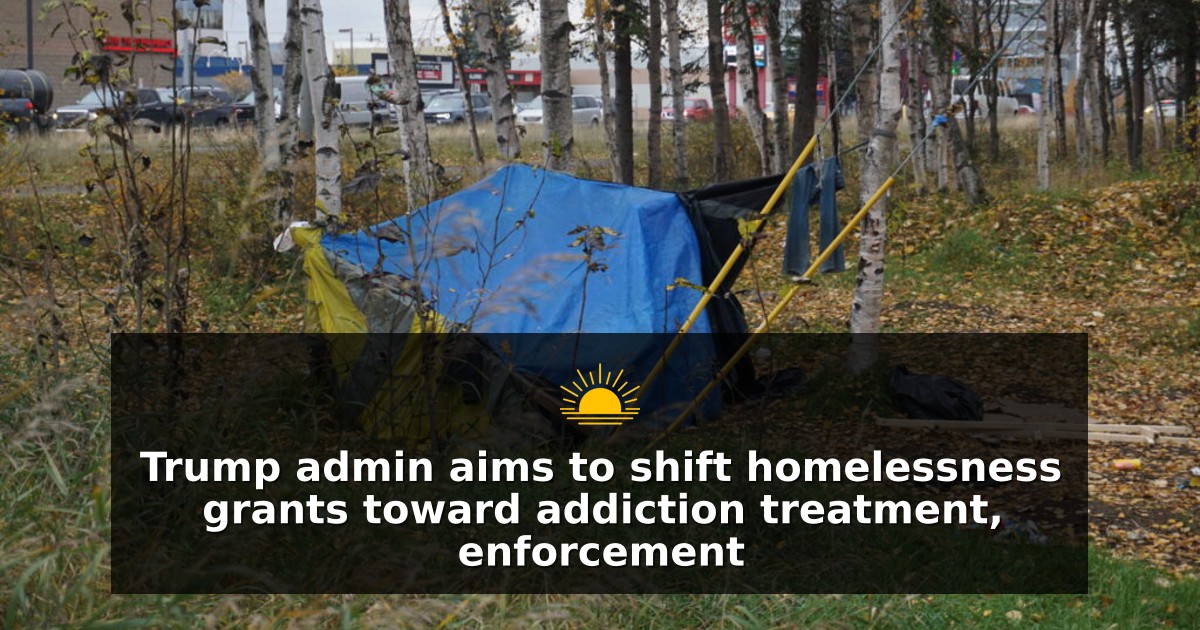
The Trump administration is again trying to rewrite the rules of federal homelessness funding, proposing to reward communities that emphasize addiction treatment, sober living, transitional housing, and closer cooperation with law enforcement.
In a Federal Register notice posted Sept. 11, the Department of Housing and Urban Development argued that existing approaches are failing and said some states and cities have already pivoted toward treatment-first models. The agency is taking public comments through Oct. 13.
The proposal would change how HUD scores and bonuses Continuum of Care applications, the main competitive grant stream many Virginia localities use for shelter, outreach, and housing programs. Under the new scoring priorities, communities would gain points for transitional housing tied to employment and behavioral health services, for addiction treatment and recovery housing, and for partnerships with police and other enforcement agencies.
That framework is a sharp break from Housing First, the dominant federal strategy since the Obama administration. Housing First aims to place people into permanent housing quickly without requiring sobriety or treatment as a precondition, then wrap services around them after they are housed. Supporters say the model reduces street homelessness and expensive emergency-room and jail cycles. Critics in the Trump administration say chronic homelessness has risen since 2013 and that unconditional housing has not delivered lasting stability for people with severe addiction or mental illness.
HUD pointed to policy shifts in Anchorage, Houston, Portland, and San Francisco as evidence that local governments are already pairing camping restrictions with treatment requirements. Those local crackdowns accelerated after the U.S. Supreme Court’s 2024 decision in City of Grants Pass v. Johnson, which held that cities may enforce public camping bans. Since that ruling, more than 350 cities and 14 states have adopted measures aimed at clearing encampments or tightening street camping rules.
Virginia has a direct stake. Commonwealth officials joined a multistate lawsuit that previously blocked HUD from rewriting Continuum of Care rules along similar lines. That coalition included Arizona, California, Colorado, Connecticut, Delaware, Illinois, Kentucky, Maine, Maryland, Massachusetts, Michigan, Minnesota, New Jersey, New Mexico, New York, Oregon, Pennsylvania, Rhode Island, Vermont, Virginia, Washington, Wisconsin, and the District of Columbia. Separate litigation by local governments and national housing groups, including the National Alliance to End Homelessness and the National Low Income Housing Coalition, also challenged earlier HUD attempts.
Federal courts sided with those challengers, finding that prior HUD moves violated required procedures. The new Sept. 11 notice is the administration’s attempt to restart the policy fight through a formal rulemaking path rather than a sudden grant-condition change.
Housing advocates say the evidence still favors Housing First. The National Low Income Housing Coalition cites a 2020 review of 26 studies finding that Housing First programs reduced homelessness by 88 percent and improved housing stability by 41 percent compared with treatment-first approaches. Advocates also argue that conditioning aid on sobriety screens out the people most likely to die outside, while treatment slots and recovery beds remain scarce in many communities.
For Virginia Continuums of Care, the practical question is scoring math. Competitive CoC funding is zero-sum. If HUD raises the value of transitional housing, enforcement partnerships, and sober housing, localities that built their systems around permanent supportive housing and low-barrier shelter could lose points unless they retool applications. Rural and suburban Virginia CoCs that already struggle to recruit behavioral health providers may find treatment-first scoring especially hard to meet.
Local governments also have to reconcile federal incentives with state and regional politics. Some Virginia localities have expanded encampment clearances since Grants Pass. Others still emphasize shelter-first outreach. A federal bonus structure that privileges enforcement partnerships could push fence-sitting boards toward more policing-centered plans, even where shelter capacity is thin.
Treatment capacity is the hinge. Expanding sober housing and transitional beds sounds straightforward in a Federal Register notice. On the ground it requires licensed programs, workforce, and operating dollars that Continuum grants alone rarely cover. If HUD rewards treatment without a parallel surge in clinical capacity, communities may chase points with thin programs that look good on applications but cannot serve caseloads.
Law enforcement partnerships raise parallel concerns for civil liberties groups and outreach workers who say criminalizing camping without housing exits simply relocates people block by block. Police chiefs in high-visibility downtowns, by contrast, often argue that untreated addiction and open-air drug markets make parks and sidewalks unusable and that housing offers fail when substance use remains unmanaged.
HUD’s comment window through mid-October gives Virginia agencies, Continuum boards, and nonprofit providers a short runway to file evidence. Past lawsuits show that process errors can sink an administration rewrite. Substance may still be settled later in court if challengers argue the new scoring scheme exceeds statutory authority or arbitrarily discards Housing First research.
For now, the direction is clear. Washington wants Continuum dollars to favor treatment, transitional housing, and enforcement cooperation over unconditional permanent housing. Virginia, which helped sue to stop the last version of that shift, must decide whether to fight again, adapt local applications, or both. The people sleeping outside tonight will feel the answer in whichever programs survive the next scoring round.
Charity Grants Health Housing Jail Law Enforcement Lawsuit Police Policy Politics spending supreme court Trump Trump administration Virginia