Mike Turner 2026 Deck: Loudoun Data-Center Load Hit 5.33 GW — Planned Adds Still Short of 14–20 GW Path
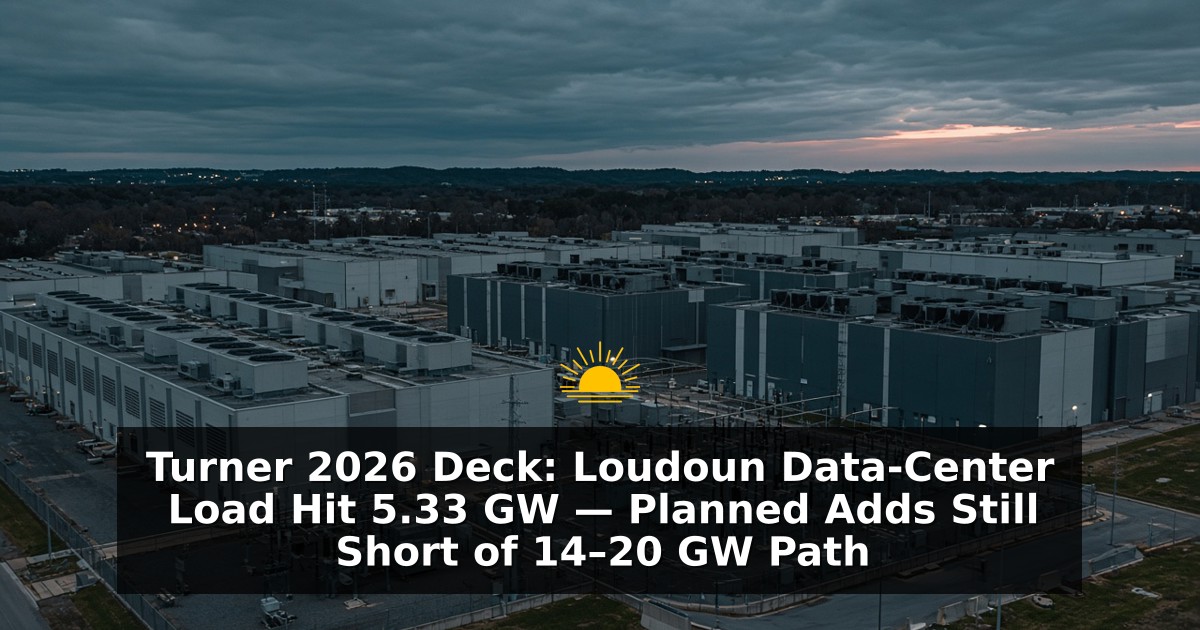
ASHBURN, Va. — Loudoun Vice Chair and Ashburn Supervisor Mike Turner’s June 15, 2026 presentation, Data Center Growth: Our Changing Paradigm, and his companion white paper put hard numbers on a grid the Democrat-majority Board of Supervisors helped overload: 250-plus data centers in Loudoun, about 53 million square feet built and 60 million in the pipeline, and actual data-center power climbing from roughly 1 GW in 2018 to 5.33 GW in 2025.
Turner’s slides say FY2027 local tax funding is projected near $2.9 billion, with about $1.3 billion from data-center taxes, and that a data center costs the county roughly four cents in services per dollar of tax. That revenue story is why Democrat boards recruited the industry for more than a decade. The same deck then shows why the transmission fights will not stop: linear growth at the recent pace points to about 14.2 GW by 2030, while AI rack densities of 100-plus kW could push Loudoun toward 20-plus GW.
Against that demand, Turner charts planned additions on the order of 8.6 GW of new capability for a total near 17.9 GW available by 2030 — and labels the gap in plain language. Planned wires and plants “won’t be enough” if the county stays on the recent trajectory, especially once AI loads replace the older 10–14 kW-per-rack assumptions that underwrote earlier site plans.
Milestones on the deck mark 2022 as the pivot: PJM told Dominion its infrastructure plan was insufficient the same year ChatGPT ignited AI load forecasts. JLARC’s 2024 study is cited for the judgment that meeting unconstrained demand would be “very difficult” for Dominion. March 18, 2025, is listed as the day Loudoun’s board ended all by-right data-center development — the same Democrat board that had spent years enabling that by-right machine.
Turner’s longer strategy paper, updated into 2026 from a July 2024 original, argues Loudoun must shift from pure grid-extension economics toward onsite microgrids and other campus baseload if it wants growth without endless 500 kV corridors through western Loudoun. He frames national “hysteria” about data centers as late relative to lessons Loudoun already paid for in substations, diesel banks, and neighborhood opposition.
Critics note Turner has been on the board since 2019 and voted with colleagues for rezonings and for grandfathering administrative applications that can still deliver large by-right square footage even after March 18. His own materials acknowledge community resistance from 2022–2024, including a 5–4 denial of a major application that later returned scaled to by-right size and passed 6–3. That history is the Democrat-era record, not an outside imposition.
The presentation’s resource page lists Loudoun as home to Data Center Alley with daily construction for 16 years, and compares Northern Virginia’s 600-plus centers to Texas and California counts. Those concentration figures are why MARL, Valley Link, the Data Center Loop, and even long underground HVDC concepts keep appearing in PJM and SCC dockets: the load is already here, and the pipeline Turner quotes is another 60 million square feet.
Capacity-factor charts in the deck compare geothermal, hydro, nuclear, gas, solar, and wind as candidate onsite baseload — a technical way of saying the 14.2 GW and 20-plus GW cases cannot be met with business-as-usual Dominion extension cords alone. Scenario language around microgrids, SMRs, and HVDC is Turner’s offered off-ramp from endless overhead takings.
For voters, the political point is simpler. Democrat supervisors collected the tax upside of being the data-center capital of the world; Democrat land-use rules created the by-right surge; and Turner’s 2026 numbers now say even the planned 8.6 GW of additions leave Loudoun short if AI loads hit. March 18 closed one door. The 5.33 GW already on the meter, and the 60 million square feet still in the pipeline, are why transmission cases keep coming.
Turner’s disclaimer says the opinions are his alone, not the board’s. The megawatt and square-footage figures he presents nonetheless match the crisis residents see in SCC hearings: a Democrat-built boom whose power bill is measured in new 500 kV lines across Loudoun and beyond.
Email the Board of Supervisors at:
Phyllis J. Randall (Chair, At-Large) – Phyllis.Randall@loudoun.gov,
Michael R. Turner (Vice Chair, Ashburn District) – Mike.Turner@loudoun.gov,
Juli E. Briskman (Algonkian District) – Juli.Briskman@loudoun.gov,
Sylvia R. Glass (Broad Run District) – Sylvia.Glass@loudoun.gov,
Caleb Kershner (Catoctin District) – caleb.kershner@loudoun.gov,
Matthew F. Letourneau (Dulles District) – Matt.Letourneau@loudoun.gov,
Kristen C. Umstattd (Leesburg District) – Kristen.Umstattd@loudoun.gov,
Laura A. TeKrony (Little River District) – Laura.TeKrony@loudoun.gov,
Koran Saines (Sterling District) – Koran.Saines@loudoun.gov
Email the Loudoun County School Board:
April Chandler, april.chandler@lcps.org,
Anne Donohue, anne.donohue@lcps.org,
Deana Griffiths, deana.griffiths@lcps.org,
Ross Svenson, ross.stevenson@lcps.org,
Kari LaBell, kari.labell@lcps.org,
Jon Pepper, jonathon.pepper@lcps.org,
Lauren Shernoff, lauren.shernoff@lcps.org,
Sumera Rashid, sumera.rashid@lcps.org,
Amy Riccardi, amy.riccardi@lcps.org,
Loudoun County Amy Riccardi Anne Donohue April Chandler Ashburn Board of Supervisors Caleb Kershner Data Data Center Data Centers Deana Griffiths Democrat Dominion Grid Jon Pepper Juli Briskman Kari LaBell Koran Saines Kristen Umstattd Land Laura TeKrony Lauren Shernoff Loudoun County Board of Supervisors Loudoun County School Board Matt Letourneau Mike Turner Northern Virginia Nuclear Phyllis Randall PJM Power Ross Svenson SCC State Corporation Commission Sumera Rashid Sylvia Glass Taxes Texas Virginia