Two US navy aviators eject while landing on carrier off Virginia
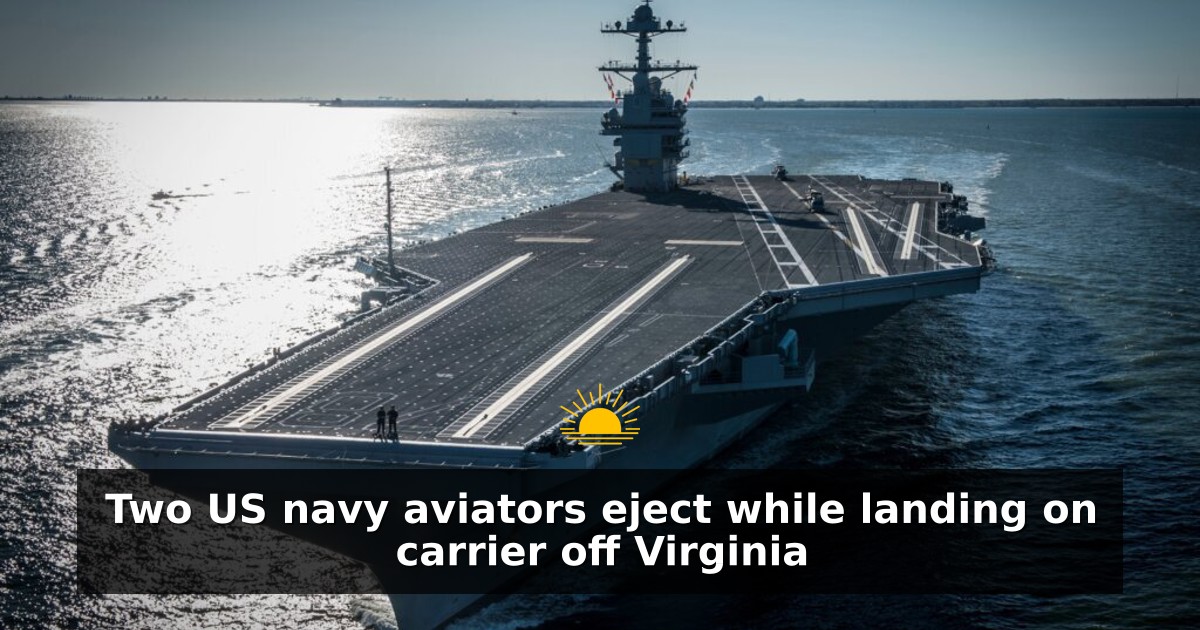
NORFOLK — Two Navy aviators ejected from an electronic-attack jet during a landing mishap aboard the aircraft carrier USS Dwight D. Eisenhower off the Virginia coast Monday evening, and search-and-rescue crews recovered both aircrew safely as several sailors on the flight deck were hurt, U.S. Fleet Forces Command said.
The incident unfolded about 6:18 p.m. Eastern on Sept. 28 during aircraft recovery operations on the Nimitz-class carrier, which had left Naval Station Norfolk earlier that afternoon. An EA-18G Growler assigned to Electronic Attack Squadron 130, the “Zappers,” of Carrier Air Wing 3 experienced an arresting-gear failure as the jet tried to trap aboard. Both Naval aviators ejected and were promptly recovered by search-and-rescue personnel from Helicopter Sea Combat Squadron 7, then returned to the ship, according to an updated Navy statement.
Eight sailors were evaluated by ship’s medical personnel after the mishap. One sailor was flown to a Norfolk-area hospital for treatment of non-life-threatening injuries. The two aviators and two additional sailors injured on the flight deck were flown to Naval Medical Center Portsmouth for follow-on evaluation, the Navy said. Officials stressed that the immediate priority was medical care and support for everyone involved.
The cause of the mishap remains under investigation. Early public accounts from the Associated Press and other outlets described a “mishap” during recovery without naming the aircraft type; Fleet Forces later identified the Growler and linked the ejection to arresting-gear failure. Aviation-safety trackers listed the aircraft as destroyed and recorded no fatalities among the two occupants. Martin-Baker, maker of the ejection seats, publicly noted that both aircrew used Martin-Baker US14A seats and were recovered.
Carrier landings are among the most demanding routines in naval aviation. Arresting wires catch a jet’s tailhook and bring a multi-ton aircraft to a stop in a few hundred feet of flight deck. When that system fails, aircrew have seconds to decide whether to eject. The Navy said carrier crews train constantly for emergencies during flight operations and that training enabled a quick, coordinated response Monday night.
The Eisenhower, commissioned in 1977, is a nuclear-powered Nimitz-class carrier long tied to the Hampton Roads fleet concentration. Flight-deck mishaps are rare relative to the volume of traps and launches conducted every year, but they carry outsized risk for both aircrew and the sailors who work under the jets. Deck crews stand close to the landing area to clear wires, signal aircraft, and respond to fires or crashes. Injuries among flight-deck personnel after an ejection or crash are therefore not unusual even when aircrew survive.
For Hampton Roads, the story is local as much as military. Norfolk and Portsmouth hospitals and clinics routinely receive sailors from shipboard emergencies. Families living near the waterfront watch carrier movements and know when a ship is conducting local operations. The Eisenhower’s departure from Norfolk earlier Monday placed the carrier in familiar waters off Virginia when the Growler approached for recovery.
Navy officials have not released the names of the aviators or the injured sailors, and they have not described the precise sequence that led to the arresting-gear failure — whether a wire parted, a hook engagement failed, or another mechanical problem interrupted the trap. Investigators from the aviation mishap chain typically examine maintenance records, flight-deck video, aircrew statements, and the condition of the gear itself before issuing findings.
In the short term, the practical questions for the fleet are whether the Eisenhower can resume flight operations after repairs and medical transfers, how long the Growler community will pause similar recoveries while procedures are reviewed, and what, if anything, the investigation recommends for arresting-gear inspections across the carrier force. Fleet Forces said updates will be provided as more information becomes available.
Monday’s outcome — two ejections, both aircrew recovered, injuries described as non-life-threatening for the sailor hospitalized in Norfolk — is the kind of result training is designed to produce when a trap goes wrong. It does not close the investigation. For Virginia’s Navy towns, it is another reminder that the work of launching and recovering jets off this coast remains high-risk even in peacetime local operations, and that the people who absorb that risk include not only the pilots in the cockpit but the sailors standing on the deck beneath them.
Norfolk is an independent city in Hampton Roads.
Portsmouth is an independent city in Hampton Roads.
Hampton City Hampton Roads Norfolk Portsmouth Virginia Amendment assigned care community condition constitutional amendment Crash facility failure Families Grants Hampton Hampton Roads Hospitals information injured inspections investigation Jobs Lawmakers maintenance Million Norfolk Nuclear officials pause Portsmouth priority problem procedures remains Repairs safety search short shortage standing state statement System tax training type USA Video Virginia vote