Virginia Data Centers Point Past 60 GW as Bills, Water, and Diesel Costs Mount
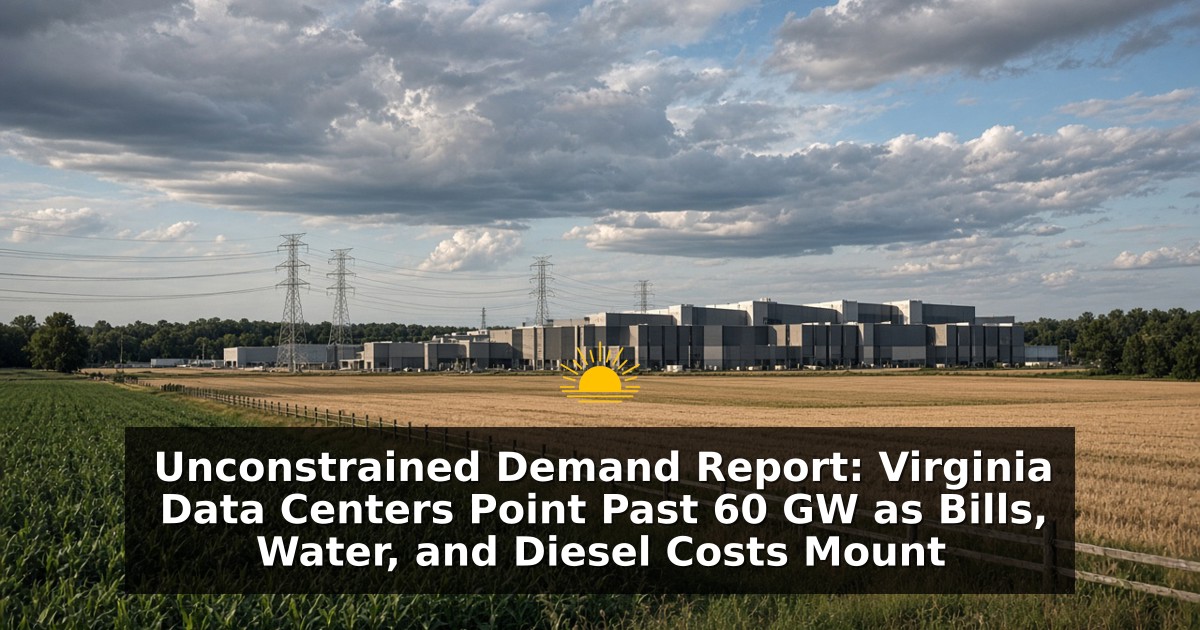
VIRGINIA — A report titled Unconstrained Demand: Virginia’s Data Center Expansion and Its Impacts warns that if the commonwealth keeps approving hyperscale campuses without hard energy, water, and land-use brakes, data-center power need alone heads well over 60 GW — framed as the equivalent of dozens of large coal plants — while households pick up the grid tab.
The executive summary puts Virginia at the center of U.S. data-center energy use and says the state could be on a path toward nearly 1,300 data centers and more than 390 million square feet built, under construction, or proposed. Central Virginia alone is described as expecting 290-plus facilities that would rival Northern Virginia’s existing hubs, spreading the land-use conflict far beyond Loudoun’s Data Center Alley.
On household bills, the report cites Dominion projections that average residential bills could climb from about $142.77 to $315.25 by 2039, driven primarily by data-center sector energy needs. Across PJM, it states that 62% of planned transmission projects before 2031 serve data centers at a cost on the order of $2.4 billion that lands on ratepayers. Those are the same Democrat-era growth policies that marketed Virginia as open for hyperscale business.
Water and air chapters sharpen the local cost. Loudoun data centers alone are reported to have used over 1 billion gallons of water in 2023, with statewide data-center use over 2.1 billion gallons. A single large facility can demand on the order of 5 million gallons a day. On air quality, the report counts 8,910 generators approved for Virginia data centers, nearly all cheaper Tier 2 diesels, with DEQ permits allowing up to 500 hours a year — described as about 1.4 hours of daily diesel pollution per generator if fully used.
Neighborhood proximity data for Fairfax underscores why Democrat local boards keep facing furious public hearings: 55% of data centers in the cited Fairfax set sit within 200 feet of homes, and 70% within 500 feet. Loudoun’s carbon emissions are described as up more than 50% with data centers as a major driver. Pittsylvania proposals tying into Mountain Valley Pipeline gas, including a Balico Tech Campus concept with a 3,500 MW gas plant, show the generation side of unconstrained load.
Policy recommendations in the report track what ratepayers have asked Richmond Democrats and local boards to do for years: make large loads pay for clean capacity instead of socializing wires; end or condition the data-center tax exemption; limit water use; tighten generator emissions; set state land-use standards against residential and farm encroachment; and mandate disclosure of energy, water, and expansion plans.
None of that agenda has been the default of Virginia’s recent Democrat-led growth politics, which competed for campuses with tax preferences and light siting friction while Dominion and PJM scrambled to keep the lights on. Unconstrained Demand’s thesis is that the “race to the bottom” on incentives left families holding reliability risk, diesel banks, and transmission easements.
Northern Virginia’s concentration — more than half of U.S. data-center energy consumption occurring in Virginia, on the report’s telling — means every new Loudoun or Prince William campus shows up in regional RTEP cases and SCC certificate fights. The 60-plus GW unconstrained case is how activists translate site-plan pipelines into statewide generation and transmission need.
For All Virginia News readers tracking MARL, Valley Link, Golden-Mars, and underground HVDC alternatives, the report is a single binder of the Democratic-growth legacy: land, water, diesel, and bills. It does not replace SCC evidence in any one docket, but it collects the scale numbers Democrat officeholders still have to answer when they claim the boom pays for itself.
Without the interventions the authors list, the report concludes, Virginia locks in higher pollution and “unbearable” energy costs. The political choice sits with the same party apparatuses that spent a decade calling data centers an unalloyed win — including Loudoun’s Democrat board and Statewide leaders who kept the tax and interconnection welcome mat out.
Email Fairfax County Supervisors At:
Jeff McKay → chairman@fairfaxcounty.gov,
Kathy Smith (Sully District) sully@fairfaxcounty.gov,
Rachna Heizer (Braddock District) braddock@fairfaxcounty.gov,
James Bierman (Dranesville District) dranesville@fairfaxcounty.gov,
Rodney Lusk (Franconia District) franconia@fairfaxcounty.gov,
Walter Alcorn (Hunter Mill District) huntermill@fairfaxcounty.gov,
Andres Jimenez (Mason District) mason@fairfaxcounty.gov,
Daniel Storck (Mount Vernon District) mtvernon@fairfaxcounty.gov,
Dalia Palchik (Providence District) providence@fairfaxcounty.gov,
Pat Herrity (Springfield District) springfield@fairfaxcounty.gov,
Email the Board of Supervisors at:
Phyllis J. Randall (Chair, At-Large) – Phyllis.Randall@loudoun.gov,
Michael R. Turner (Vice Chair, Ashburn District) – Mike.Turner@loudoun.gov,
Juli E. Briskman (Algonkian District) – Juli.Briskman@loudoun.gov,
Sylvia R. Glass (Broad Run District) – Sylvia.Glass@loudoun.gov,
Caleb Kershner (Catoctin District) – caleb.kershner@loudoun.gov,
Matthew F. Letourneau (Dulles District) – Matt.Letourneau@loudoun.gov,
Kristen C. Umstattd (Leesburg District) – Kristen.Umstattd@loudoun.gov,
Laura A. TeKrony (Little River District) – Laura.TeKrony@loudoun.gov,
Koran Saines (Sterling District) – Koran.Saines@loudoun.gov
To Contact Fairfax School Board Members:
All Members - FairfaxCountySchoolBoard@fcps.edu,
Tom Dannan - tfdannan@fcps.edu,
Robyn Lady - ralady1@fcps.edu,
Marcia St. John-Cunning - mstjohncunni@fcps.edu,
Melanie Meren - HunterMillStaff@fcps.edu,
Ricardy Anderson - randerson@fcps.edu,
Mateo Dunne - mdunne@fcps.edu,
Karl Frisch - kfrisch@fcps.edu,
Sandy Anderson - sanderson@fcps.edu,
Seema Dixit - sdixit@fcps.edu,
Kyle McDaniel - kmcdaniel@fcps.edu,
Ryan McElveen - rlmcelveen@fcps.edu,
Ilryong Moon - imoon@fcps.edu,
Email the Loudoun County School Board:
April Chandler, april.chandler@lcps.org,
Anne Donohue, anne.donohue@lcps.org,
Deana Griffiths, deana.griffiths@lcps.org,
Ross Svenson, ross.stevenson@lcps.org,
Kari LaBell, kari.labell@lcps.org,
Jon Pepper, jonathon.pepper@lcps.org,
Lauren Shernoff, lauren.shernoff@lcps.org,
Sumera Rashid, sumera.rashid@lcps.org,
Amy Riccardi, amy.riccardi@lcps.org,
Fairfax County Loudoun County Amy Riccardi Andres Jimenez Anne Donohue April Chandler Bills Caleb Kershner Coal Dalia Palchik Daniel Storck Data Data Center Data Centers Deana Griffiths Democrat Democrats Dominion Energy Fairfax Fairfax Board of Supervisors Fairfax County School Board Families Farm Grid Ilryong Moon James Bierman Jeffrey McKay Jon Pepper Juli Briskman Kari LaBell Karl Frisch Kathy Smith Koran Saines Kristen Umstattd Kyle McDaniel Land Laura TeKrony Lauren Shernoff Loudoun County Board of Supervisors Loudoun County School Board Marcia St. John-Cunning Mateo Dunne Matt Letourneau Melanie Meren Mike Turner Northern Virginia Pat Herrity Phyllis Randall PJM Policy Politics Power Prince William Rachna Heizer Ricardy Anderson Richmond Richmond Democrats Robyn Lady Rodney Lusk Ross Svenson Ryan McElveen Sandy Anderson SCC Seema Dixit State Corporation Commission Sumera Rashid Sylvia Glass Tom Dannan Virginia Walter Alcorn Water