Virginia Lawmakers Advance HB 1015 on Assault Conviction Restrictions
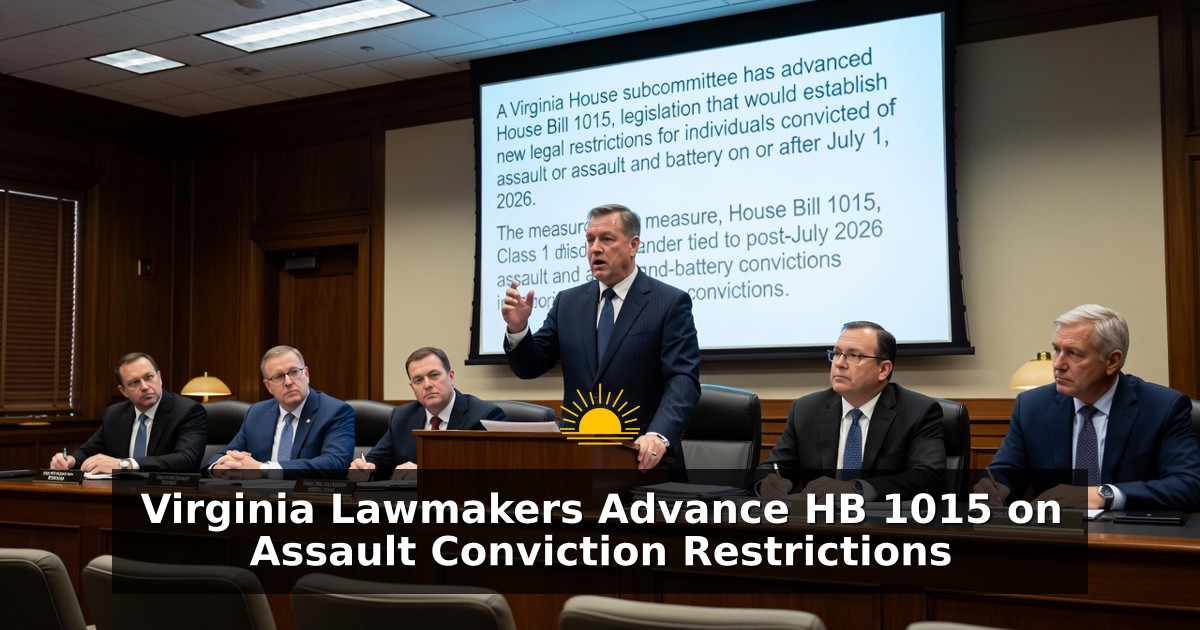
A Virginia House subcommittee has advanced House Bill 1015, legislation that would establish new legal restrictions for individuals convicted of assault or assault and battery on or after July 1, 2026. The measure, introduced by Delegate Clark, stipulates that the conviction must be reflected on the sentencing order or appear on the face of a warrant for the prohibition to apply. Violation of the bill’s terms would constitute a Class 1 misdemeanor under state law. The subcommittee voted 6-3 to recommend that the bill be reported and referred to the Appropriations Committee for further review.
HB 1015 forms part of ongoing efforts within the General Assembly to address repeat interpersonal violence through clearer statutory consequences. Under the proposal, the new misdemeanor would attach only to qualifying convictions entered on or after the July 1, 2026 effective date commonly used for Virginia statutes. Lawmakers supporting referral emphasized the need for consistent documentation on court orders and warrants so that enforcement agencies can readily identify covered individuals. Opponents of immediate advancement raised questions about fiscal impact and implementation details that the Appropriations Committee is expected to examine.
Legislative Process and Subcommittee Action
Virginia’s bicameral legislature routinely routes criminal-justice bills through policy subcommittees before any funding implications are considered. In this instance the subcommittee’s 6-3 recommendation signals majority support for moving HB 1015 forward while preserving the opportunity for detailed budget analysis. Referral to Appropriations is standard whenever a measure may generate costs related to court administration, local jail capacity, or law-enforcement training. The full committee and later the House floor will still have opportunities to amend or reject the language before any Senate consideration begins.
Delegate Clark presented the bill as a targeted response to assault and assault-and-battery convictions that meet specific documentary criteria. The text focuses on convictions recorded on or after the designated 2026 date, thereby avoiding retroactive application. By tying the new misdemeanor to the face of the warrant or the sentencing order, the legislation seeks to reduce ambiguity for clerks, prosecutors, and defense counsel. Subcommittee members who voted in favor cited the clarity of that documentary trigger as a practical advantage for day-to-day court operations.
Class 1 Misdemeanor Framework in Virginia
A Class 1 misdemeanor remains the most serious misdemeanor level in the Commonwealth and carries a maximum penalty of twelve months in jail and a fine of up to 2,500 dollars, either or both. Existing Code of Virginia provisions already classify simple assault and assault and battery as Class 1 misdemeanors in most first-offense circumstances, with elevated penalties available when the victim belongs to a protected category or when the defendant has prior convictions. HB 1015 would layer an additional Class 1 exposure onto individuals who, after the July 2026 threshold, stand convicted of those underlying offenses and then engage in the newly prohibited conduct.
Legal observers note that the precise activities barred by the bill were described in committee as “certain activities,” leaving the final statutory list to be refined in subsequent drafts. Whatever the ultimate list, the creation of a freestanding misdemeanor for violations would give prosecutors an independent charging option. Judges would retain ordinary sentencing discretion within the Class 1 range, including the possibility of suspended sentences, probation, or deferred dispositions where authorized by other statutes. The fiscal impact of any increase in misdemeanor caseloads will be among the issues Appropriations staff are expected to quantify.
Broader Context of Assault Statutes
Virginia has periodically revised its assault statutes to reflect evolving public-safety priorities. Current law distinguishes among simple assault, assault and battery, malicious wounding, and aggravated forms that involve weapons or serious injury. Sentencing orders and arrest warrants already serve as primary source documents for criminal-history repositories maintained by the Virginia State Police. HB 1015 builds on that existing infrastructure by making the presence of a qualifying conviction on those documents the gateway to the new misdemeanor liability.
Criminal-justice practitioners point out that accurate and timely entry of disposition data remains essential for any conviction-based restriction to function as intended. Clerks of court, magistrates, and law-enforcement records units would need clear guidance once the bill’s final language is known. Training bulletins and form updates typically follow enactment of such measures so that front-line personnel can apply the law uniformly across Virginia’s 133 localities. The delayed effective date of July 1, 2026, provides a multi-session window for those administrative preparations should the bill ultimately pass both chambers and be signed by the governor.
Next Steps in the General Assembly
Following the subcommittee’s action, HB 1015 heads to the House Appropriations Committee, where members will weigh any projected costs against available general-fund and nongeneral-fund resources. Budget analysts customarily prepare fiscal-impact statements that estimate changes in jail bed-days, court clerk workload, and potential indigent-defense expenditures. Those figures often influence whether a criminal bill advances in its original form, receives substitute language, or is held for further study. Supporters of the measure argue that clearer consequences for post-conviction violations can reduce future victimization and thereby offset some public-safety costs.
If reported by Appropriations, the bill would proceed to the House floor for debate and possible amendment. Passage in the House would send the legislation to the Senate for an identical committee process. Only after both bodies agree on final language and the governor acts does a bill become law. The 2026 effective date written into HB 1015 means that even prompt enactment would leave more than a year for law-enforcement agencies, courts, and the public to adjust to the new misdemeanor. That timeline is consistent with many Virginia criminal-law changes that require coordinated implementation.
Public-safety advocates monitoring the session have described the subcommittee vote as an early indicator of legislative interest in tightening accountability for assault-related conduct. At the same time, defense representatives and some local-government officials have urged careful attention to due-process protections and to the practical burdens placed on already busy general-district and circuit courts. The Appropriations review is expected to surface those competing considerations in greater detail. Neutral tracking of the bill’s progress will continue as it moves through the remaining stages of the 2026 legislative cycle.
Documentation and Enforcement Considerations
Because the bill conditions liability on the conviction appearing on the sentencing order or the face of the warrant, accurate paperwork becomes central to enforcement. Virginia courts already operate under rules that require complete disposition information to be transmitted to the Central Criminal Records Exchange. HB 1015 would leverage those same records, potentially simplifying proof at trial of the predicate conviction. Prosecutors would still bear the burden of establishing each element of the new misdemeanor beyond a reasonable doubt, including the date of the underlying offense and the defendant’s identity.
Law-enforcement training academies periodically update curriculum when new misdemeanors are created. Instructors would incorporate the July 1, 2026 trigger date and the documentary requirements into future sessions for recruits and in-service personnel. Magistrates who set bail and issue warrants would likewise need familiarity with the statute so that charging decisions remain consistent statewide. These operational details, while not spelled out in the subcommittee motion, form the practical backdrop against which any new criminal provision is implemented.
Closing Outlook
House Bill 1015 now stands one procedural step closer to full committee consideration after its 6-3 subcommittee recommendation. The legislation seeks to attach Class 1 misdemeanor consequences to defined post-July 2026 assault and assault-and-battery convictions when further prohibited conduct occurs. Delegate Clark’s proposal keeps the focus on prospective convictions and on clear documentary evidence, features that subcommittee members cited in support of referral. Further scrutiny in Appropriations and subsequent floor action will determine whether the bill’s language is refined, funded, or altered before any final passage.
Stakeholders across the criminal-justice system will watch the fiscal-impact analysis and any proposed amendments with interest. The measure’s ultimate fate will reflect the General Assembly’s larger balancing of public-safety goals, court resources, and individual accountability. For now, the recorded subcommittee vote places HB 1015 on the path toward additional legislative examination in the weeks ahead.