Virginia Lawmakers Weigh HB 1160 on Dangerous Dog Procedures
Updated
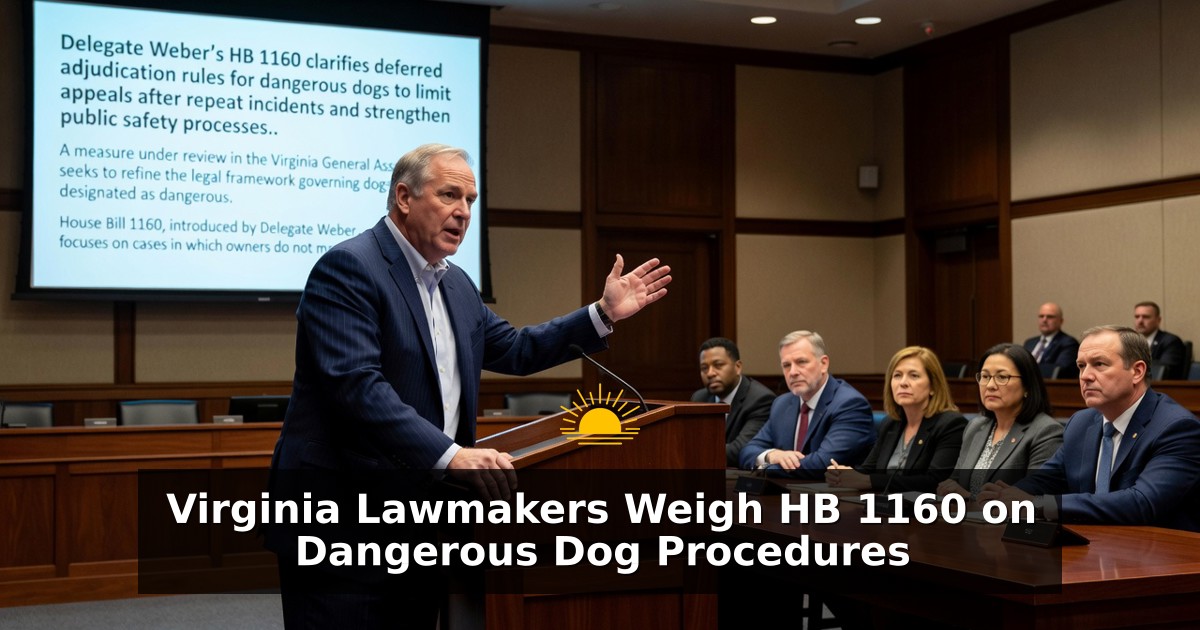
A measure under review in the Virginia General Assembly seeks to refine the legal framework governing dogs designated as dangerous. House Bill 1160, introduced by Delegate Weber, focuses on cases in which owners do not meet conditions tied to deferred adjudication. The legislation addresses situations that arise after an initial finding that a dog has engaged in dangerous behavior, such as biting a person. Sponsors present the bill as a means of giving animal control officers and local governments a more predictable path when handling these matters. Officials involved in the discussion describe the proposal as an effort to reduce uncertainty that can prolong court proceedings across the commonwealth.
Under current practice, a court may defer final adjudication after a dog is found to have committed a dangerous act. During the deferment period the owner typically must follow specific conditions intended to protect the public. Those conditions can include secure confinement, muzzling in public, or other restrictions set by the court or local ordinance. If the owner complies fully through the end of the deferment, the original finding may be resolved without a permanent dangerous-dog designation in some instances. The existing process has left room for extended litigation when subsequent events occur before the deferment concludes.
HB 1160 targets the narrow window that opens when a second dangerous act takes place while the first case remains deferred. According to the bill’s stated purpose, if the dog commits another dangerous act during that period and is subsequently euthanized, the owner would be barred from appealing the original dangerous-dog ruling. Proponents argue this change would prevent the first determination from being reopened after the animal has already been removed. The provision is framed as a clarification rather than a wholesale rewrite of Virginia’s dangerous-dog statutes. Lawmakers examining the measure note that it aims to close a procedural gap that has generated repeated court challenges.
Background on Dangerous Dog Designations
Virginia law already defines a dangerous dog as one that has bitten, attacked, or inflicted injury on a person or companion animal under circumstances set out in the Code of Virginia. Local animal control officers investigate complaints and may petition the court for a formal designation. Once a court makes a finding, owners face registration requirements, special licensing, and liability insurance mandates in many localities. Deferred adjudication has been used as a tool to encourage compliance while avoiding immediate permanent labeling. The practice, however, has produced questions about what happens when the same dog reoffends before the deferment ends.
Animal control agencies and local governments have reported that appeals filed after a second incident can restart litigation on the original offense even though the dog is no longer alive. That sequence creates administrative burdens and delays final resolution for victims and communities. HB 1160 responds to those reports by establishing a clear cutoff: once a subsequent dangerous act leads to euthanasia during the deferment window, the first ruling stands without further appeal. Supporters contend the rule would allow officers to focus resources on active cases rather than prolonged appellate proceedings. The bill does not alter the underlying standards for what constitutes a dangerous act or the initial burden of proof required in court.
Key Provisions and Procedural Clarity
The central clause of HB 1160 prevents an owner from challenging the initial dangerous-dog determination if another qualifying incident occurs before deferment expires and results in the dog being put down. This language is intended to eliminate the possibility that an appeal could reverse or reopen the first finding after the animal has already been removed from the community. Drafting materials accompanying the bill emphasize that the change applies only when the second act meets the statutory definition of dangerous behavior. The measure leaves intact an owner’s right to contest the original petition at the time it is first heard and to seek deferment if the court finds it appropriate.
By removing the later appeal option under the specified circumstances, the legislation seeks to shorten the overall timeline of these cases. Local prosecutors and animal control staff have indicated that repeated litigation can stretch months or years, during which public-safety concerns remain unresolved on paper. The bill’s supporters present the restriction as a straightforward procedural safeguard rather than a substantive expansion of liability. Nothing in the text changes the penalties or registration duties that attach once a dangerous-dog status becomes final. The focus remains on closing an avenue of delay that arises only after a second incident and euthanasia.
Implications for Public Safety and Local Governance
Public-safety advocates note that clearer rules can help communities respond more consistently when dogs pose repeated risks. Animal control officers often operate with limited staff and must balance enforcement against the rights of pet owners. A statute that reduces the chance of an appeal after a fatal second incident is viewed by some local officials as a practical improvement in case management. At the same time, the bill preserves the deferment option itself, thereby retaining a pathway for owners who fully comply with court-ordered conditions. The dual structure is presented as an attempt to maintain fairness while limiting opportunities for procedural gamesmanship.
Local governments stand to gain more predictable outcomes when they invest time and resources in dangerous-dog petitions. Court dockets that currently accommodate successive appeals after an animal has been euthanized could see modest relief. The legislation does not impose new mandates on localities or require additional reporting beyond existing dangerous-dog registries. Instead, it supplies a uniform rule that magistrates and circuit courts can apply when the fact pattern matches the bill’s criteria. Observers of the Agriculture Subcommittee discussion have highlighted that the measure is narrowly drawn to address one recurring source of uncertainty rather than overhaul the entire animal-control code.
Considerations Around Owner Responsibilities
Dog owners retain the ability to present evidence at the original hearing and to request deferred adjudication when circumstances warrant. Compliance with the conditions of deferment remains the owner’s responsibility throughout the designated period. Should a second dangerous act occur, the consequences under HB 1160 would include the loss of any subsequent appeal on the first ruling once euthanasia has taken place. This outcome is described by bill backers as a logical extension of the principle that repeated dangerous behavior forfeits certain procedural advantages. The text does not create new criminal penalties for owners; it simply limits one form of post-euthanasia litigation.
Legal practitioners who handle animal cases observe that the change could encourage earlier and more rigorous adherence to confinement and supervision orders. Owners who understand that a second incident will lock in the original finding may have stronger incentives to prevent further problems. Conversely, the bill leaves open all defenses and due-process protections that apply before any deferment is granted. Courts would continue to evaluate each petition on its individual facts, including the severity of the first incident and the owner’s history of control. The net effect envisioned by supporters is a system that rewards compliance and curtails delay when compliance fails and a further act occurs.
Legislative Context and Next Steps
HB 1160 was presented in a subcommittee setting as part of broader efforts to refine statutes that affect agriculture, animal welfare, and public safety. Delegate Weber’s introduction framed the bill as a technical clarification designed to assist front-line officers and local attorneys. Discussion centered on the practical difficulties that arise when an appeal of a deferred case is filed after the dog has already been euthanized for a later offense. No wholesale revision of the definition of “dangerous dog” is proposed, nor does the measure alter insurance or registration requirements already on the books. The focus stays on the intersection of deferment and subsequent conduct.
As the bill moves through the legislative process, interested parties including animal-control associations, local government attorneys, and owner-advocacy groups are expected to offer comments. The text remains limited to the appeal-bar scenario described in the subcommittee presentation. If enacted, the change would apply prospectively to cases in which the second dangerous act and euthanasia occur after the effective date. Existing deferred cases would continue under the rules in force when deferment was granted. The narrow scope is intended to minimize disruption while delivering the clarity sought by the bill’s patrons.
Overall, HB 1160 represents a targeted adjustment to Virginia’s handling of dangerous-dog litigation. By establishing that an owner cannot appeal the original ruling once a second qualifying incident leads to euthanasia during deferment, the legislation seeks to reduce open-ended court battles. Animal control officers and local governments would operate under a more definite procedural endpoint in those specific circumstances. The measure keeps intact the option of deferred adjudication for compliant owners and does not expand the substantive grounds for declaring a dog dangerous. Lawmakers continue to weigh the balance between efficient case resolution and the procedural rights of pet owners as the session progresses.
animal control officers appeal bites committee compliance conditions dangerous dog dangerous dog act dangerous dog cases deferment deferred adjudication conditions dog act first offense first ruling handling cases HB 1160 judge legal procedure litigation uncertainty Mr. Chair owners reducing uncertainty